7 Business Bank Account Benefits for Global Founders
Discover 7 business bank account benefits for global founders: separate finances, get an EU IBAN, pay in multiple currencies, and simplify VAT.

You're living outside the EU, invoicing clients in euros, pounds, and dollars, paying suppliers from a personal card, and watching the next VAT deadline get closer. Every payment requires a manual check. Every expense raises the same question: business or personal? An EU IBAN and a dedicated business bank account can turn that disorder into one online system for receiving revenue, paying suppliers, recording transactions, and preparing tax documentation. The business bank account benefits go beyond convenience. They include cleaner financial evidence, better payment control, easier reconciliation, stronger lender conversations, and a more credible operating structure. This guide also compares Bulgaria's tax position with other European countries and focuses on the practical setup decisions that make each benefit work for a non-resident founder.
Table of Contents
- 1. Access to Bulgaria's 10% Corporate Tax Rate
- 2. Simpler VAT Registration and EU Compliance
- 3. Instant EU IBAN and Multi-Currency Banking
- 4. Separation of Personal and Business Finances
- 5. Automated Tax Filing and Compliance Alerts
- 6. Professional Invoices and Faster Reconciliation
- 7. Real-Time Cash Flow Visibility and Forecasting
- 7-Point Business Bank Benefits Comparison
- Start Your Business Account Setup This Week
1. Access to Bulgaria's 10% Corporate Tax Rate
Bulgaria's 10% standard corporate income-tax rate is one of the clearest reasons global founders compare a Bulgarian company with structures elsewhere in Europe. The KPMG Bulgaria country profile explains that Bulgarian tax residents are generally taxed on worldwide income, while non-resident companies are generally taxed on Bulgarian-source income. The same profile states that corporate-tax returns and payments are due by March 31 of the following year, with electronic filing required.
That rate is attractive, but it isn't a complete tax answer. The final result also depends on tax residence, taxable profit, permanent-establishment exposure, VAT, payroll charges, dividend taxation, and treaty rules. Incorporating in Bulgaria doesn't automatically make a non-resident founder personally tax-resident there, and a Bulgarian bank account doesn't decide where profits are taxable.
Compare the full operating structure
The Tax Foundation's 2025 European comparison lists Bulgaria at 10%, compared with 9% in Hungary, 12.5% in Cyprus and Ireland, 25% in Belgium, and 35% in Malta. Those are statutory corporate rates, not promises of overall savings. Accounting, banking, VAT, withholding tax, social contributions, and personal tax can change the comparison substantially.
A dedicated account helps you support the tax position with cleaner evidence. It separates company revenue, expenses, and retained earnings, which makes bookkeeping and audit preparation more reliable.
Practical rule: Compare the full annual cost of operating in each country, not just the corporate rate.
This week, ask your accountant to model the company's expected profit, founder salary, dividends, VAT position, and cross-border activity. Then activate the Bulgarian business account before the first customer payment and connect it to online accounting software.
2. Simpler VAT Registration and EU Compliance
VAT becomes easier to manage when customer receipts, supplier payments, and tax reserves move through one business account. For a non-resident SaaS founder or online seller, that visibility matters because EU transactions can involve different customer locations, currencies, VAT treatments, and reporting obligations.
A Bulgarian structure can provide a central operating base, but it doesn't remove the need to identify where VAT is due. B2B supplies, B2C digital services, physical goods, marketplace sales, and local expenses may follow different rules. The account supports the records. It doesn't replace a tax adviser or determine the correct treatment by itself.
Build a monthly VAT control
Use the account and accounting feed to separate:
- Customer VAT receipts: Move the tax portion into a clearly labelled reserve so it isn't mistaken for available profit.
- B2B evidence: Store customer VAT numbers, invoices, contracts, and proof of the transaction treatment.
- Cross-border sales: Track revenue by customer country, product type, currency, and VAT treatment.
- Filing records: Keep statements and reconciliations together with the relevant VAT reports.
For EU customers, an EU IBAN can reduce payment friction, while multi-currency collection can limit unnecessary conversions. Still, check the provider's supported currencies, payment rails, beneficiary countries, and transaction limits before opening the account.
Don't assume that one registration solves every obligation. A business may need additional registrations or reporting arrangements depending on its customers, products, and locations.
Put the VAT reserve, operating cash, and tax-payment schedule on the same dashboard. You'll spot a shortfall before the filing date, not after it.
This week, map every sales channel and customer type, then ask an adviser to confirm the relevant VAT treatment. Configure separate bookkeeping categories for output VAT, input VAT, refunds, and tax payments before revenue starts flowing.
3. Instant EU IBAN and Multi-Currency Banking
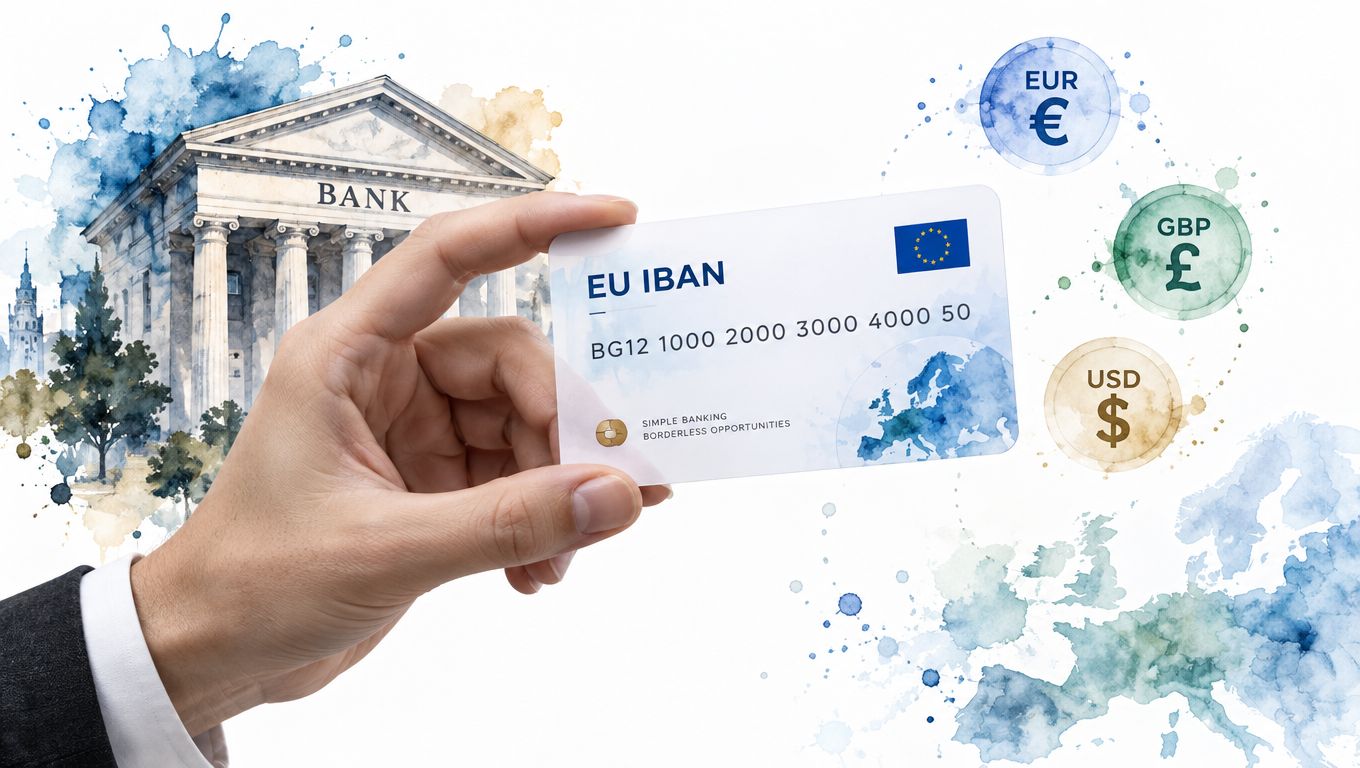
A non-resident founder can run the company online, yet still lose time when customers, suppliers, or platforms question a foreign account. An EU IBAN can make euro collections, supplier payments, recurring transfers, and bookkeeping easier for a Bulgarian company. Online providers such as Wise Business and Revolut Business may offer remote onboarding, while a traditional Bulgarian bank may provide different support and compliance procedures.
Compare the provider with the banking and tax setup you already use elsewhere. An electronic-money institution is not the same as a bank. Safeguarding, payment protection, currencies, support, account reviews, and feature availability can differ. An EU IBAN also does not guarantee acceptance by every marketplace, payroll platform, customer, or public administration.
IBAN discrimination remains a practical risk. The European Court of Auditors recorded almost 3,500 alleged IBAN-discrimination cases between February 2021 and September 2023. EU rules prohibit requiring a particular Member State for covered euro transfers and direct debits, but a founder may still need to challenge a refusal or offer another payment route.
Choose the account by testing the full payment workflow:
- Currencies: Confirm that it can receive and hold the currencies customers use, then compare conversion costs with your existing country setup.
- Payment rails: Check SEPA, SEPA Instant, international transfers, and card settlement.
- Controls: Verify role-based access, approval workflows, beneficiary checks, and transaction limits.
- Exports: Require downloadable statements and accounting integrations that your bookkeeper can use.
- Fallbacks: Keep a second regulated account if a review or outage could interrupt collections.
The ECB defines instant credit transfers as making funds available to the payee within ten seconds. The European Central Bank's instant-payments explainer notes that business use can improve cash flow, reduce late payments, and speed invoice reconciliation.
Use this guide to EU business bank accounts to compare providers. This week, confirm non-resident director eligibility, test one customer payment, and document a backup route before switching invoices or payment processors.
4. Separation of Personal and Business Finances
A non-resident founder can run every operation online and still create a messy tax and banking record. Bulgarian EOOD or OOD revenue should reach the company IBAN, while company costs leave through that account. Personal funds remain outside it. This separation gives your accountant a clean record and makes the company's activity easier to explain than a mixed account would be in many other countries.
The trade-off is discipline. You must document salary, reimbursement, dividends, or director payments instead of transferring money whenever convenient. A personal purchase on the company card can trigger questions about deductibility, VAT treatment, and whether the company operated as a distinct entity. Separate banking supports the legal and accounting position, but it does not provide absolute liability protection by itself.
Use a simple rule: every transaction must have a business purpose and supporting evidence.
Keep the boundary practical:
- Company revenue: Change invoices, payment processors, marketplaces, and customer records to the business IBAN.
- Operating costs: Pay software, advertising, contractors, and other business expenses with the company card.
- Founder payments: Record salary, reimbursement, dividends, or director payments with the required documents.
- Personal purchases: Pay household and private costs from a personal account, not from company funds.
- Record review: Match bank entries with invoices and receipts on a fixed schedule.
This setup also clarifies available cash. You can check whether the company can cover suppliers, payroll, VAT, and corporate tax without mentally removing personal transactions. Compared with a single personal account used for freelance activity in another country, the Bulgarian company account creates a clearer audit trail, though it requires more upfront administration.
Activate the business IBAN before collecting revenue this week. Move recurring subscriptions to the company card, create a reimbursement form, and agree on a quarterly statement review with your accountant.

5. Automated Tax Filing and Compliance Alerts
A non-resident founder running a company entirely online can reduce routine bookkeeping by connecting the Bulgarian business account to accounting software. Bank data can match payments with invoices, apply categories, flag possible deductible costs, and estimate cash reserved for VAT or corporate tax. Compared with handling freelance income through a personal account in another country, this creates a cleaner review process. It also depends on accurate rules and regular human checks.
Build the controls around the transactions that create the most risk:
- Bank feed: Connect a supported accounting integration or export reliable statements.
- Category rules: Define treatment for software, advertising, contractors, travel, bank charges, and taxes.
- Compliance alerts: Set deadline notifications and low-balance warnings, then add calendar reminders.
- Exception review: Ask an accountant about unusual payments instead of forcing them into a familiar category.
- Monthly check: Match entries with invoices, receipts, refunds, and transfers before records reach the reporting stage.
Automation can misclassify a personal withdrawal as a supplier cost, or apply the wrong treatment to a foreign-currency conversion. The founder remains responsible for complete records and supporting information. Tax, VAT, and banking rules also differ across countries, so an automated alert should prompt a review, not replace one.
The World Bank's financial-inclusion research identifies digital payments as a mechanism that can improve business accounting, cash management, and access to credit. For an online company, machine-readable statements, role-based access, and accounting or API integrations are practical account-selection criteria.
Use this accounting automation resource to separate repeatable tasks from decisions requiring human review. This week, connect the account to your ledger, create category rules, and set alerts before the first reporting cycle.
6. Professional Invoices and Faster Reconciliation
A customer in another country should receive an invoice that answers payment and compliance questions immediately. For a Bulgarian company selling online, include the legal name, registration details, applicable VAT number, IBAN, currency, payment terms, and reverse-charge wording only when the transaction qualifies.
The business account then provides a consistent destination for every payment. A matching bank reference lets accounting software connect the incoming transfer to the correct invoice, even when the non-resident founder serves customers across several countries and manages operations remotely.
Build the invoice around the transaction
Before sending an invoice, check:
- Customer identity: Record the legal name, address, country, and VAT number where relevant.
- Supply type: Confirm whether the sale is B2B, B2C, domestic, intra-EU, or outside the EU.
- Currency and deadline: State the requested currency and a clear due date.
- Payment reference: Ask the customer to include the invoice number with the transfer.
- Collection process: Schedule overdue reminders and assign a point for personal follow-up.
A customer's location alone does not determine reverse-charge treatment. Validate the customer's status and retain the evidence supporting your decision. An EU IBAN also does not change place-of-supply rules, VAT obligations, or the treatment required in the customer's country.
Invoice design affects reconciliation speed. A Bulgarian company with one dedicated account can compare issued invoices with received payments without combining personal-card transactions, payment-processor dashboards, and foreign accounts. That gives the founder a cleaner view of overdue receivables and supports a faster collection decision.
This week, revise the invoice template with the company's legal details and business IBAN. Connect the invoicing tool to the bank feed, test matching against one real payment, and store invoices and supporting documents in a controlled digital archive.
7. Real-Time Cash Flow Visibility and Forecasting
A non-resident founder can earn revenue in several countries while paying contractors, software providers, and taxes from another. A dedicated business account brings those movements into one view. It shows cleared cash, pending transfers, paid suppliers, recurring charges, and funds reserved for tax. That clarity helps you compare Bulgaria's banking and VAT position with the obligations attached to accounts and payment providers elsewhere.
Use the account feed to build a forward view, not just monitor today's balance. Include outstanding invoices, committed expenses, expected supplier payments, payroll, VAT, and annual tax provisions. Separate cleared funds from pending card settlements and transfers. A strong balance can still hide a near-term liability, while a weak balance may reflect payment timing rather than a genuine shortfall.
The World Bank's digital-payments research reports that 61% of adults in low- and middle-income economies made or received a digital payment in 2024, up from 34% in 2014. Among account owners, the share reached 82%, and digital merchant payments reached 42% of adults, compared with 35% in 2021. For an online company, more digital collections increase the value of consistent, account-linked records.
A weekly review can stay short:
- Cash position: Check cleared balances in operating and currency accounts.
- Receivables: Mark invoices that are late, due soon, or disputed.
- Commitments: Record supplier, contractor, software, payroll, VAT, and tax payments.
- Currency needs: Confirm the right currency is available for upcoming obligations.
- Actions: Accelerate collections, defer discretionary spending, or discuss credit.
Use this cash-flow management guide to match the forecast to your actual payment cycle. This week, schedule the review, connect each collection channel to one reporting process, and set a reserve for known tax and VAT payments.
7-Point Business Bank Benefits Comparison
| Item | Implementation complexity 🔄 | Resource requirements 💡 | Expected outcomes 📊 | Ideal use cases | Key advantages ⭐⚡ |
|---|---|---|---|---|---|
| Access to Bulgaria's 10% Corporate Tax Rate – the Lowest in the EU | Moderate, company formation (3–5 days); compliance & transfer‑pricing documentation required 🔄 | Low–Medium, incorporation services, corporate accounting, legal advice 💡 | High tax savings and predictable retained earnings; improved reinvestment capacity 📊⭐ | Global founders, SaaS, e‑commerce, digital agencies seeking EU tax efficiency | Lowest statutory EU CIT (10%); EU market access; simplified forecasting ⭐⚡ |
| Simplified VAT Registration and Multi‑Country EU VAT Compliance | Low–Moderate, VAT reg 48–72 hrs; MOSS threshold monitoring 🔄 | Moderate, VAT reporting, accounting software, FastCorp setup support 💡 | Centralized VAT compliance (MOSS); fewer registrations; lower compliance costs 📊 | Digital services, SaaS, cross‑border B2C sellers, e‑commerce platforms | Single EU/MOSS filing, quarterly returns, reverse‑charge capability ⭐⚡ |
| Instant EU IBAN and Multi‑Currency Business Banking Access | Low, online onboarding 15–30 min; provider selection required 🔄 | Low, company docs, fintech account fees, API/accounting integration 💡 | Faster payments, reduced FX costs, improved payment acceptance and reconciliation 📊⚡ | Businesses invoicing EU clients, payroll, multi‑currency merchants, freelancers | SEPA, multi‑currency accounts, instant opening, real‑time reconciliation ⭐⚡ |
| Separation of Personal and Business Finances for Liability Protection | Low, open dedicated business IBAN and enforce discipline 🔄 | Low, separate bank accounts, bookkeeping practices, periodic reconciliations 💡 | Clear liability protection; stronger audit defence and simpler accounting 📊⭐ | Any LLC (EOOD/OOD), founders, SMEs needing asset protection | Protects personal assets, meets auditor expectations, professional image ⭐ |
| Automated VAT and Tax Return Filing with Real‑Time Compliance Alerts | Moderate, initial mapping (2–4 hrs) and integrations; ongoing tuning 🔄 | Moderate, accounting software subscription, integration costs, occasional manual review 💡 | Fewer errors, time savings, timely filings, audit‑ready records and alerts 📊⭐ | VAT/CIT filers, e‑commerce, SaaS and agencies with recurring returns | Pre‑filled returns, deadline alerts, MOSS automation, audit trail ⚡⭐ |
| Professional Invoice Issuance with Built‑In EU Compliance and Payment Terms | Low, template setup with conditional rules (reverse‑charge, MOSS) 🔄 | Low, invoice software, IBAN & VAT data, minor customization 💡 | Faster payments, regulatory‑compliant invoices accepted as input VAT proof 📊 | B2B invoicing across EU, freelancers, consultants, SaaS vendors | Auto VAT tagging, multi‑currency invoicing, automated reminders ⭐⚡ |
| Real‑Time Cash Flow Visibility and Payment Forecasting | Moderate, requires quality data and integrations; scenario setup 🔄 | Moderate, accounting integration, historical data, forecasting tools or premium features 💡 | Early warnings of shortfalls, improved collections, proactive financing decisions 📊⚡ | Growing SMEs, seasonal businesses, firms seeking credit or investor readiness | Live balances, aging reports, 12‑month forecasts and "what‑if" scenarios ⭐⚡ |
Start Your Business Account Setup This Week
The strongest business bank account benefits appear when the account is part of a complete operating system. A Bulgarian company can provide a clear legal and accounting structure for a global founder, while an EU IBAN can support customer collections, supplier payments, and digital reconciliation. Bulgaria's 10% corporate income-tax rate is notable against rates such as 9% in Hungary, 12.5% in Cyprus and Ireland, 25% in Belgium, and 35% in Malta, but the statutory rate is only one part of the decision. Tax residence, VAT, payroll, dividends, permanent establishment, banking costs, and compliance work still require professional review.
Start with four actions. Incorporate the company online, activate the EU IBAN before collecting revenue, connect the account to accounting software with automated categorisation and deadline alerts, and reserve a fixed monthly slot for reconciliation. Then test one customer payment, one supplier payment, one currency conversion, and one invoice match. Small tests expose account limits and missing integrations before they affect a filing deadline or payroll run.
Cost deserves equal attention. A 2025 Federation of Small Businesses survey found that 58% of businesses with a current account paid a regular standing charge, while nearly one in five paid more than £20 per month for day-to-day banking. The survey excluded transaction and other ad hoc fees, and 34% reported paying no fees. Compare the complete cost stack, including transfers, cards, foreign exchange, cash deposits, compliance reviews, support, and switching disruption.
FastCorp supports non-resident founders with online Bulgarian company incorporation, EU VAT registration, banking assistance, virtual office services, bookkeeping, VAT returns, and annual corporate-tax filings. The online setup is completed in 3–5 working days, allowing you to manage the process from anywhere without travelling to Sofia. With the account, records, alerts, and reconciliation routine in place, your first invoice can enter a system designed for control rather than cleanup.
FastCorp helps global founders set up Bulgarian limited companies, arrange EU VAT registration, assist with EU IBAN banking, and manage ongoing accounting and compliance online. Visit FastCorp to connect your company formation and business bank account setup with a practical operating system for cross-border work.