When to File VAT Return in Bulgaria and the EU
Learn when to file VAT return in Bulgaria and across the EU. Get clear deadlines, monthly vs quarterly rules, and practical tips for online filing.
You've just received a Bulgarian VAT number. You're not trading yet, your first invoices may be weeks away, and you're trying to work out whether there's anything to file now. There is one date to put on your calendar immediately: the 14th day of the month after each reporting month.
If you're searching for when to file a VAT return in Bulgaria, start with the monthly deadline, then build a repeatable process around it. The filing is handled online, but online doesn't mean optional or automatic. You'll need the right records, any required VIES information, and payment ready by the deadline.
Table of Contents
- The Basic Rule for Bulgaria's VAT Return Deadline
- Building a Practical Monthly Filing Workflow
- How Bulgaria Compares with UK Quarterly Filing
- The EU-Wide Pattern for VAT Filing Frequency
- Rates Thresholds and Triggers That Change the Calendar
- Your Monthly VAT Return Checklist and How FastCorp Fits In
The Basic Rule for Bulgaria's VAT Return Deadline
A newly VAT-registered founder often assumes the first return is due only after the business starts selling. In Bulgaria, that's the wrong assumption. VAT-registered businesses generally report every calendar month, and the filing obligation continues during a month with no taxable activity. Bulgarian VAT reporting guidance confirms that the calendar month is the tax period and that a return is still required when there were no taxable supplies.
By the 14th day of the following month, submit the VAT return and the required accounting records electronically to Bulgaria's National Revenue Agency. The package includes the sales ledger and purchase ledger, and, when relevant, a VIES declaration for intra-EU transactions. For example, the return for January is normally due by 14 February. The same deadline generally applies to paying VAT owed, so treat filing and settlement as one compliance task, not two unrelated reminders.
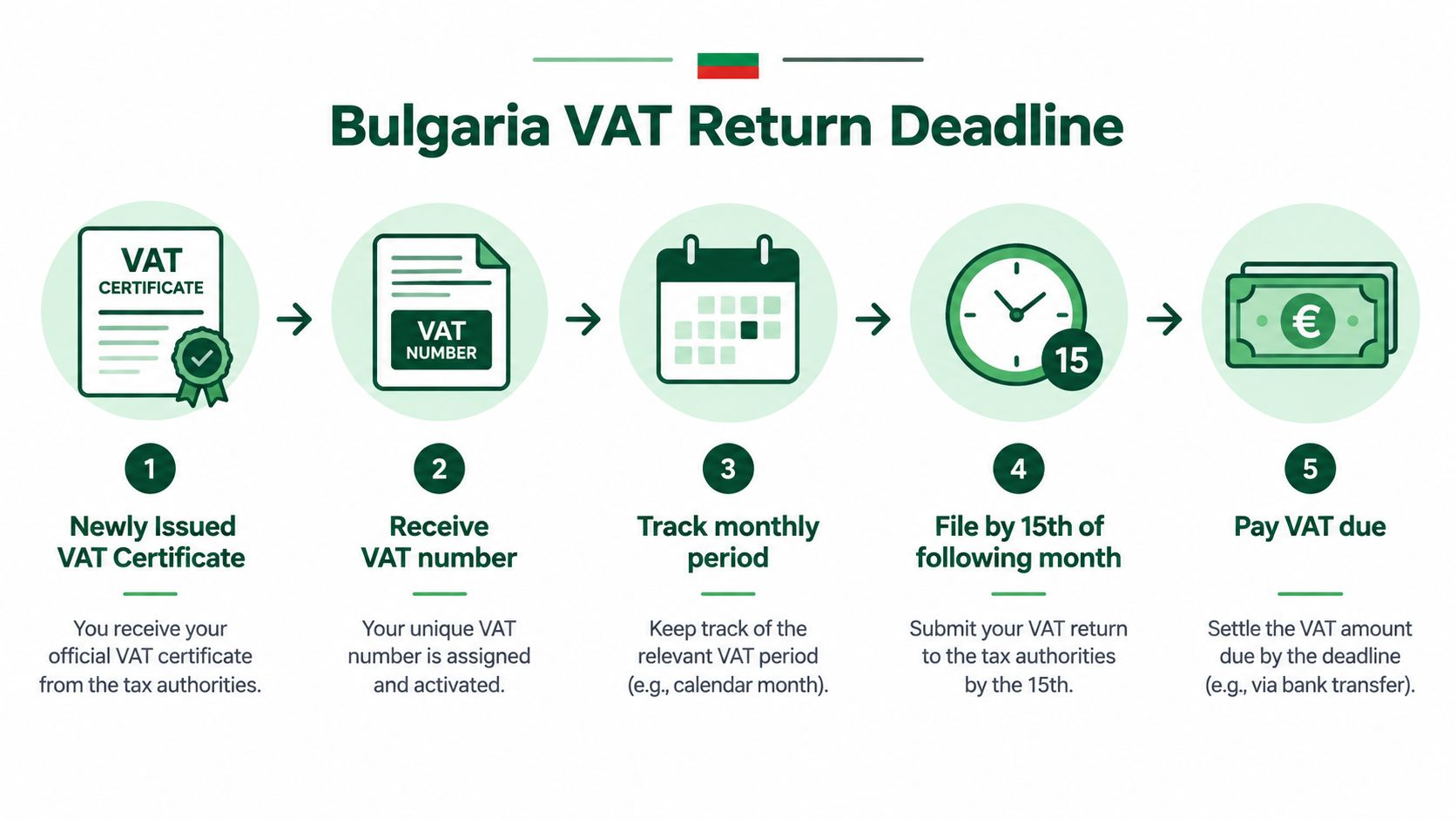
A quiet month still has a deadline
No sales doesn't cancel the return. If your registration remains active, file for the period even when there's no VAT to pay. This catches new companies that register before launching, founders waiting for a marketplace account, and established businesses between projects.
There's no general quarterly or annual VAT-return cycle that replaces Bulgaria's standard monthly regime. The compliance clock starts with VAT registration and keeps running through inactive periods. Keep monthly sales and purchase records from the start, even if both ledgers initially show little or no activity.
Practical rule: Add the 14th to your calendar as the filing and payment deadline for the previous month. Don't wait for a sales invoice or a reminder from an accountant to begin organizing the return.
Building a Practical Monthly Filing Workflow
The deadline is fixed; your process should be routine. Put the month-end close on the calendar, gather sales and purchase documents, and reconcile the ledgers before preparing the return. A reliable bookkeeping routine turns the deadline into a submission task rather than a last-minute search for missing invoices.

Close the books and check the transactions
Start with the sales ledger. Confirm that the recorded sales match your invoices and that the VAT treatment reflects the supplies you made. Then check the purchase ledger and the supporting documents for input VAT. Reconcile the two so you can see the output VAT on sales alongside the input VAT on purchases before you finalize the return.
Next, review cross-border activity. Check EU customer VAT numbers and identify the transactions that may need to appear in VIES. Don't assume every EU invoice belongs in the same reporting category. The treatment depends on the transaction, so flag uncertain supplies for review before the filing package is prepared.
Prepare and submit the full package
Bulgarian VAT reporting isn't just entering one net VAT figure. The electronic submission normally includes the VAT return and accounting registers, with VIES information where applicable. The Bulgarian Ministry of Finance's VAT reporting guidance states that the materials are submitted monthly by the 14th of the following month and that the filing deadline isn't extended.
Outsourced bookkeeping can help coordinate the records, checks, and electronic submission, especially when founders work across countries or don't have a local finance team. If you're comparing support options, online bookkeeping services for a Bulgarian business can be one part of a consistent monthly process. Keep your own calendar and make sure someone is accountable for confirming submission and payment.
A short walkthrough can also help new founders understand the recurring filing steps:
How Bulgaria Compares with UK Quarterly Filing
Founders operating in Bulgaria and the UK need two compliance calendars. Both systems use online filing as the standard approach, but the frequency and due-date calculations differ. Don't copy a UK deadline into your Bulgarian calendar, or vice versa.
In Bulgaria, the standard reporting period is the calendar month, with submission and payment generally due by the 14th of the following month. In the UK, HM Revenue & Customs says businesses generally file every three months, with the online filing and payment deadline normally falling one calendar month and seven days after the accounting period ends. HMRC's VAT Return guidance gives the UK process and deadline rule.
For example, a UK quarter ending 31 March would normally have a 7 May deadline. Payment must reach HMRC by the same date, even if the deadline falls on a weekend or bank holiday. Virtually all UK VAT-registered taxpayers must file online, with paper returns limited to taxpayers specifically exempted from online filing.
| Element | Bulgaria | United Kingdom |
|---|---|---|
| Standard filing frequency | Monthly | Generally every three months |
| Filing method | Electronic submission | Online filing for virtually all VAT-registered taxpayers |
| Typical deadline rule | By the 14th of the month after the reporting month | One calendar month and seven days after the accounting period |
| Example | January return normally due 14 February | Quarter ending 31 March normally due 7 May |
| Payment timing | Generally due by the filing deadline | Must reach HMRC by the filing deadline |
Keep the calendars separate
Quarterly UK filing means fewer routine returns, but more months of records to reconcile at once. Bulgaria's monthly rhythm calls for more frequent close-and-submit work. In both cases, you need to plan for the payment date as well as the return.
If you're active in both countries, create separate reminders for each registration and verify the applicable accounting period. The country where you're registered determines the reporting calendar. A shared spreadsheet can help track both, but it shouldn't blur the differences between them.
The EU-Wide Pattern for VAT Filing Frequency
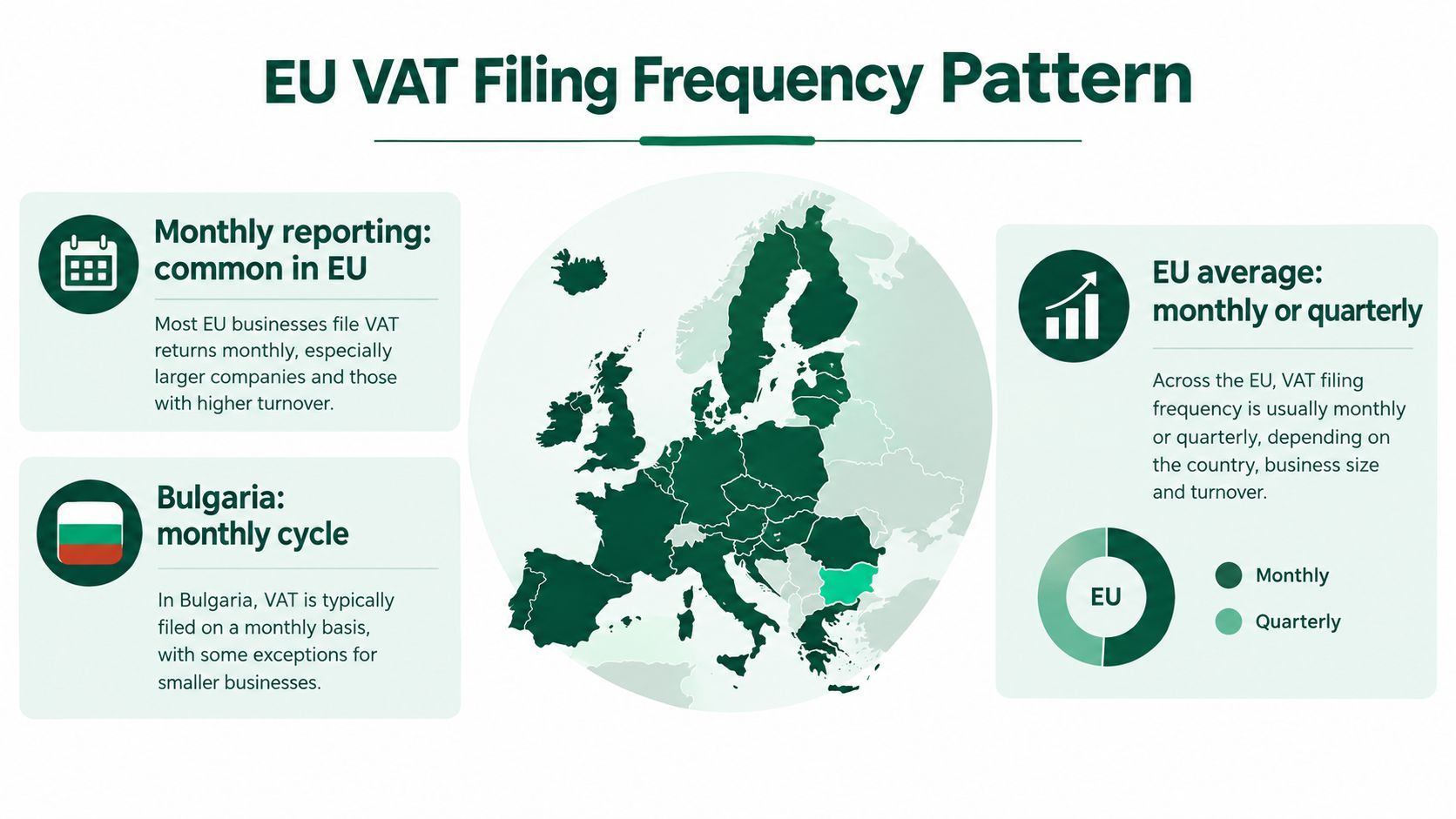
Bulgaria's monthly cycle fits a broader European pattern. The European Commission reports that Member States usually require monthly VAT reporting, while quarterly reporting is also common and some countries add annual requirements. The practical point is straightforward: there's no single EU-wide VAT filing date that applies to every registration.
The Commission's report puts the EU-wide average on-time filing rate at 93.1% and lists Bulgaria among countries with on-time rates close to 100%. It also reports that 25 of 28 responding Member States monitored VAT filing automatically, while more than half used risk criteria or taxpayer profiling to support timely filing. These figures show why deadline management matters: tax authorities can monitor whether businesses file on time, so treat each return as a recorded compliance obligation. The European Commission's report on VAT filing compliance sets out the filing patterns and monitoring information.
Let the registration country set the schedule
The Commission's comparison also notes that Member States set their own reporting calendars. In the relevant comparison, Bulgaria allows more than a month between the end of the reporting period and the filing deadline, identified as 61 days. Don't treat that observation as a replacement for the statutory due date. Your action is to follow the Bulgarian 14th-of-the-month deadline and check the rules for every other country where you're registered.
For cross-border founders, the registration country determines the relevant frequency and due date. A company selling across the EU may need to manage different domestic returns and reporting requirements rather than one consolidated calendar. If you're assessing where registration obligations arise, review the rules for VAT registration across Europe before you begin filing.
Make a country-by-country calendar when you expand. Assign each return to a named person, record its period and deadline, and confirm that payment arrangements match the local timetable.
Rates Thresholds and Triggers That Change the Calendar
The filing deadline is only one part of a VAT setup. When comparing Bulgaria with another EU market, check the rates, registration rules, reporting frequency, and whether cross-border activity calls for VIES or other reporting. Don't assume that a familiar company tax rate tells you what the VAT return requires.
The European Commission states that the EU standard VAT rate must be at least 15%, while each Member State sets its own actual rates. Countries may apply reduced rates as low as 5% to specified categories, and EU law permits certain super-reduced or zero rates for limited basic-needs categories under the relevant conditions. The same framework includes a cross-border small-business simplification for eligible businesses whose total annual EU turnover doesn't exceed €100,000. National eligibility conditions and domestic thresholds still matter. The European Commission's VAT rates guidance explains the common framework and its limits.
Run these checks before filing
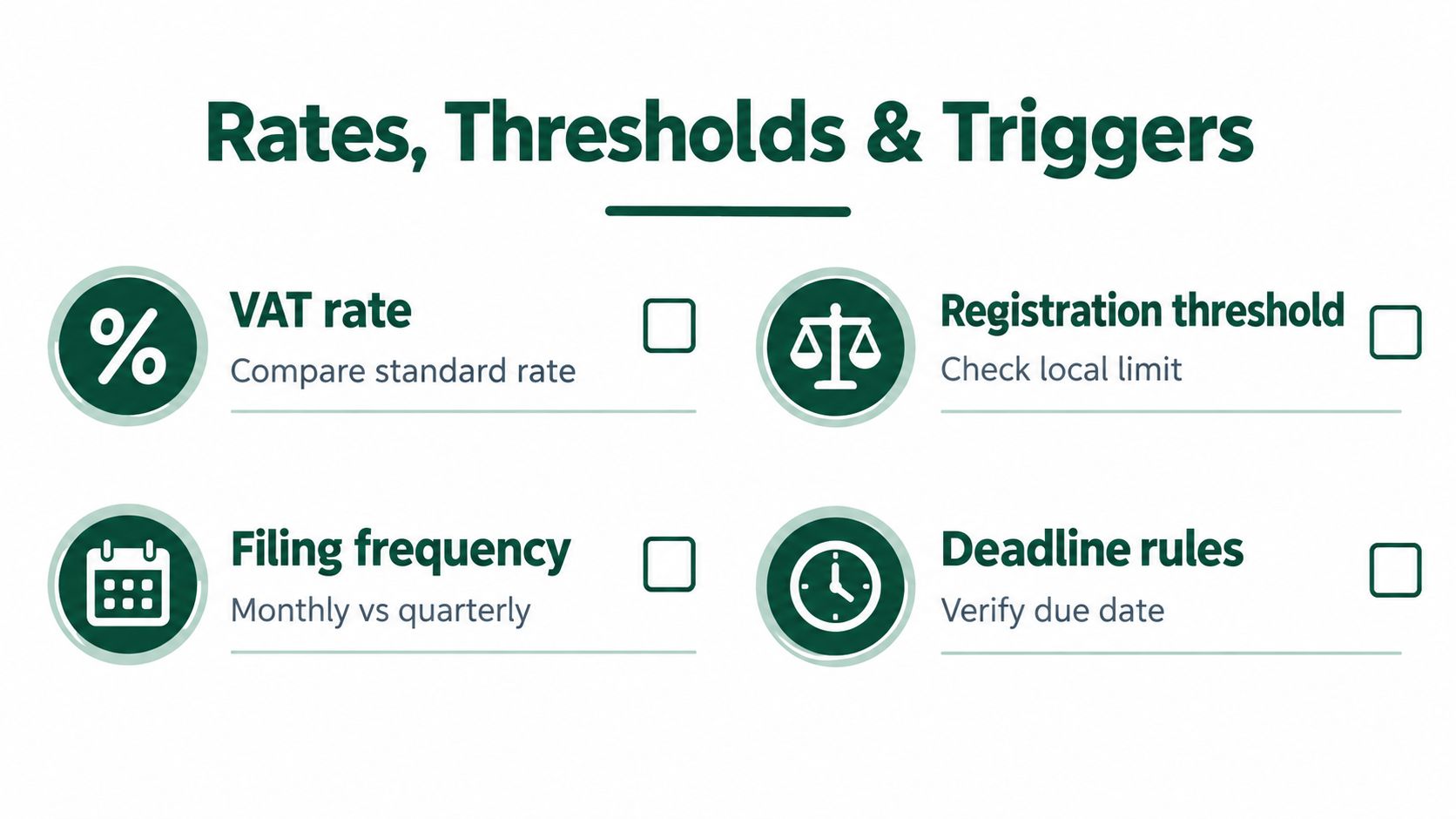
Use this checklist when setting up a new registration or reviewing a cross-border transaction:
- VAT rate: Confirm the standard or reduced rate that applies to the goods or services. Rates vary by country and category.
- Domestic registration threshold: Check the local threshold or exemption rules. A cross-border simplification doesn't erase national conditions.
- Filing frequency: Confirm whether the registration requires monthly or quarterly reporting, or has another reporting requirement.
- VIES and related reporting: Review whether intra-EU transactions require a VIES declaration or another filing alongside the VAT return.
Keep corporate tax and VAT planning separate. FastCorp describes Bulgaria's corporate tax rate as 10%, but that rate doesn't determine a company's VAT filing frequency, VAT rate, or reporting duties. A low corporate-tax rate isn't a substitute for checking the VAT rules that apply to your registration and transactions.
For the same reason, don't assume that one country's thresholds or filing cycle carry over to another. If you're evaluating local limits across markets, use a country-specific review of EU VAT registration thresholds and confirm the filing obligations that follow from the registration.
Your Monthly VAT Return Checklist and How FastCorp Fits In
Keep the process simple enough to repeat. Before each Bulgarian submission, confirm the reporting month, close your records, review the sales and purchase ledgers, check whether VIES applies, prepare the electronic files, and arrange payment of VAT owed. Submit by the 14th and retain confirmation that the filing went through.
The deadline isn't extended, so don't plan to finish the bookkeeping on the due date. Build time into the monthly routine to resolve missing invoices, check cross-border transactions, and make sure the person responsible can access the information needed to file.
A checklist you can use every month
- Confirm the period: Identify the calendar month being reported, including months with no taxable supplies.
- Reconcile the ledgers: Match sales and purchases to the supporting records and review output VAT against input VAT.
- Review EU transactions: Verify customer VAT numbers and decide whether VIES information is required.
- Prepare the submission: Compile the VAT return and required accounting registers in the required electronic structure.
- File and pay: Submit the return and any applicable VIES declaration by the 14th, and pay any VAT owed by the same deadline.
- Save the evidence: Keep the submission confirmation and the records used to prepare the return.
FastCorp provides company formation, EU VAT registration and filings setup, bookkeeping, VAT returns, annual corporate tax filings, and ongoing compliance support for Bulgarian companies. Its online formation process is offered in 3–5 working days; the ongoing accounting services can help coordinate the recurring records and filings after registration. Those services are one operational option, alongside an in-house accountant or another qualified local provider.
Set a recurring reminder for the 12th so there's time to resolve problems before the deadline. Treat the 14th as firm, whether the month was busy or completely quiet.
If you're setting up a Bulgarian company or need help coordinating VAT registration, bookkeeping, and monthly returns, review how FastCorp handles online formation and ongoing compliance. Put the filing calendar in place before your first reporting month, then assign responsibility for each return and payment.