Payroll Reporting Requirements in Bulgaria: 2026 Guide
Payroll reporting requirements in Bulgaria: deadlines, contribution rates, forms and penalties explained, with a practical checklist for employers in 2026.
More than 1.9 million PAYE schemes covering 48 million employees now report through the UK's Real Time Information system, according to HMRC's PAYE manual. That scale shows why payroll reporting requirements have moved from a once-a-year declaration to a filing tied to each payment.
Bulgarian payroll follows the same idea. You run a monthly cycle, and you also file the moment you hire, change a contract, or end one. The flat 10% income tax is easy to quote. The employer cost that influences a hiring decision is in social security and health insurance, and that is the figure I put next to other OECD countries.
If you employ people through a Bulgarian company from abroad, the portals are online and the first run can be straightforward. The calendar is not optional. I would load every date into one shared calendar, with a named owner, before the first salary leaves the bank.
Table of Contents
- Bulgarian Payroll Filings and Deadlines at a Glance
- Social Security Rates and Income Tax Withholding
- Registering Employees and Reporting Changes
- Your Monthly Payroll Cycle Step by Step
- Telling Employees From Contractors Before It Costs You
- Bulgaria's Payroll Tax Burden Against Other Countries
- Penalties and Correction Steps
- How FastCorp Handles Payroll for Non-Resident Companies
- First-Month Payroll Compliance Checklist
Bulgarian Payroll Filings and Deadlines at a Glance
Bulgarian payroll combines a monthly filing cycle with reporting deadlines triggered by employment events. Each month, the employer reports salary, withheld personal income tax, and social-security and health-insurance contributions. Hiring, changing, or ending an employment relationship brings separate reporting duties.
| Filing | Frequency | Deadline | Recipient |
|---|---|---|---|
| Advance income tax withheld from salaries | Monthly | By the 25th of the following month | NRA |
| Social security and health insurance contributions | Monthly | By the 25th of the following month | NSSI |
| Monthly employer declaration | Monthly | By the 25th of the following month | NRA and NSSI |
| Employment contract registration | Per hire | Within 3 days of signing | NRA |
| Termination notification | Per exit | Within 7 days after termination | NRA |
| Unified Electronic Employment Record updates | Per change | On the date of each employment change | NRA |
How to read the calendar
A payroll month is complete when the National Revenue Agency (NRA) and the National Social Security Institute (NSSI) have accepted the monthly filings. Paying salaries alone does not complete the reporting cycle.
Event deadlines run from the date of the employment event, not from payday. For a new contract, the three-day registration period starts on the signing date. For a termination, the seven-day notification period starts on the termination date.
Update the Unified Electronic Employment Record on the date of each employment change. The annual employer declaration reconciles the monthly figures and has its own statutory deadline, which the NRA and NSSI publish each year.
Practical rule: If a deadline falls on a weekend or public holiday, it shifts. Confirm current form requirements and the applicable deadline with the NRA and NSSI before the first payroll.
Record each filing date in a shared calendar and assign an owner. That makes missed event-based deadlines less likely.
Social Security Rates and Income Tax Withholding
Social-security and health contributions are the heavy part of Bulgarian payroll. The Ministry of Economy and Industry states that the combined burden is generally 32.70%–33.40% of gross pay: 18.92%–19.62% paid by the employer and 13.78% withheld from the employee. Contributions apply to total gross monthly remuneration, inside minimum and maximum thresholds that are reset each year.
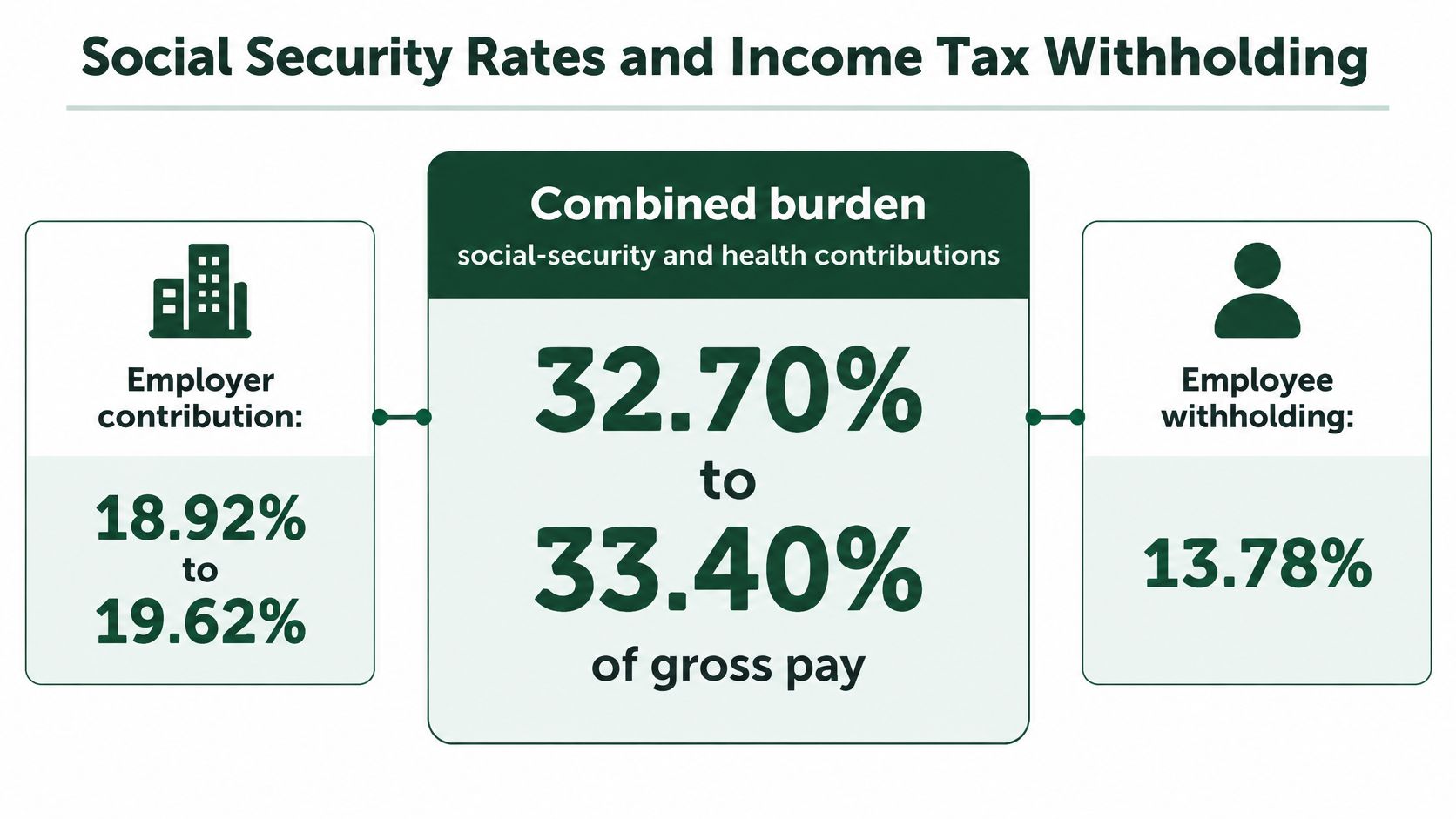
| Item | Rate | Who pays |
|---|---|---|
| Social security and health insurance, employer share | 18.92%–19.62% of gross | Employer |
| Social security and health insurance, employee share | 13.78% of gross | Employee, withheld by employer |
| Combined contributions | 32.70%–33.40% of gross | Split between employer and employee |
| Personal income tax | 10% flat on taxable employment income | Employee, withheld by employer |
Personal income tax is a flat 10% on taxable employment income, with no individual tax-free allowance. You still deduct the employee's insurance before you apply that rate. Skip that step and you overstate tax.
A €2,000 gross month
Say gross pay is €2,000 and the salary sits inside the thresholds, so the full gross is the base. This example ignores the caps on purpose.
The employee contribution is €275.60 (13.78%). Taxable income becomes €1,724.40. Income tax is €172.44. Net pay is €1,551.96.
The employer share is €378.40 at 18.92% and €392.40 at 19.62%. That €14 gap is why you apply the rate that matches the employee's insurance category, not a midpoint you like.
If the monthly gross crosses the maximum insurable income, contributions stop at the cap. Using the full gross above the cap overstates both shares.
Three checks close the month. Confirm that month's thresholds before you calculate. Round the same way on the payslip, the register, and the declaration. Reconcile each payslip to the payroll register before anyone is paid.
Registering Employees and Reporting Changes
Hiring, a contract change, and an exit each start their own filing. The EURES living and working guide for Bulgaria states that employers must register each employment contract with the NRA within 3 days after it is concluded and notify the NRA within 7 days after termination. Monthly withholding doesn't cover those events.
Paper labour books are gone. Bulgaria replaced them with a Unified Electronic Employment Record for employment relationships on 1 June 2025, and employers must transfer historical information, including agreed annual leave, leave taken in the termination year, and the dates of contract annexes, as described in the Paul Hastings Bulgaria practice note. Digital records make old gaps easier for an inspector to see, not harder.
Five steps and the proof you keep
- Collect the signed contract. Take identity details and the start date on the day it is signed, and don't start the clock from the day payroll is set up.
- Register within 3 days. File the contract with the NRA inside that window, because a late registration is its own problem even if the first salary is correct.
- Save the acceptance proof. Store the NRA confirmation in the employee file the same day, next to the signed contract.
- Open the monthly record. Put the person on payroll from the start date so the first declaration matches the contract you just registered.
- Close the exit inside 7 days. Record the last working day and the leave balance, then notify the NRA and keep that acceptance too.
Keep scans or certified copies of pre-transition records, and write down any discrepancy you can't resolve, including who still holds the missing paper. Personal data may be shared with Bulgarian authorities such as the Commercial Register and the NRA, so a wrong identifier on day one travels further than a payslip error.
Your Monthly Payroll Cycle Step by Step
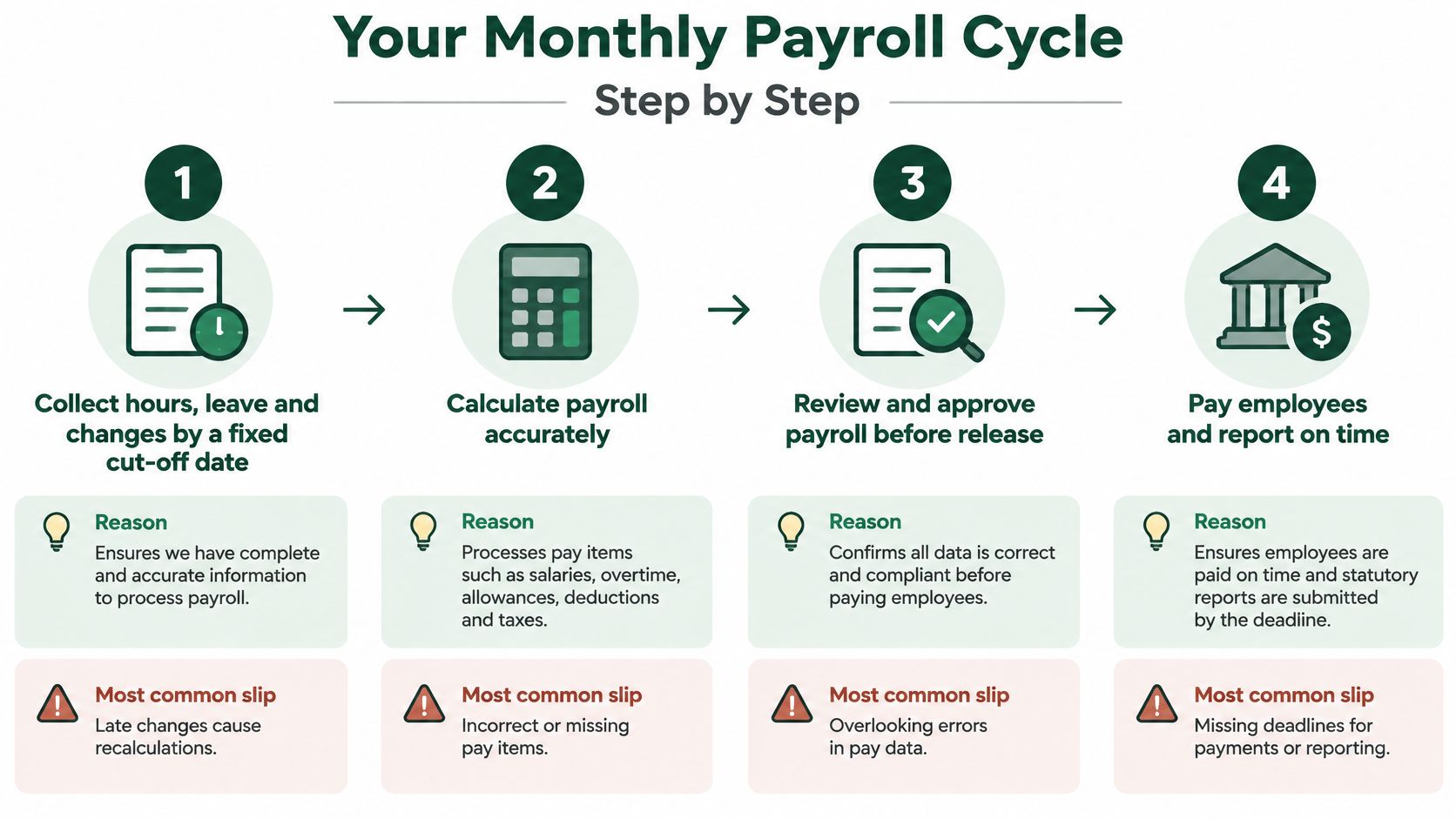
A monthly payroll cycle works best when each payment is tracked from its original input through to the filed declaration and bank transfer. Keep the eight steps in order, and retain the records that show how each figure was calculated and approved.
- Collect hours, leave, and changes by a fixed cut-off. Freeze the inputs before calculations begin. Changes received later can require recalculation and another review.
- Calculate gross pay for each employee. Gross pay is the starting point for insurance contributions and tax. Record bonuses in the payroll register as well as in the payment instructions so they appear in the reported figures.
- Apply social security and health insurance within the applicable thresholds. The minimum and maximum insurance bases affect the contribution calculation. Check both before finalising the register.
- Withhold personal income tax at the flat 10% rate on taxable income. The OECD labour-market review of Bulgaria states that the rate is 10%, with no individual tax-free allowance, and that withheld advance tax is due by the 25th day of the month following the month the salary was paid. Deduct employee contributions when calculating the taxable amount.
- Prepare the monthly declarations for the NRA and the NSSI. The declarations should reflect the same gross pay, contributions, and tax recorded in the payroll register. Check that the uploaded files match the approved figures.
- Pay the withheld tax and contributions by the 25th of the following month. Match each payment to the declared amounts and confirm that it has reached the relevant authority.
- Pay net salaries and issue payslips. Use the approved payroll figures for both. A payslip generated from an earlier draft can disagree with the bank transfer.
- Reconcile the register against bank payments and filed declarations, then save the acceptance confirmations. Keep the completed records together so the calculation, payment, and filing can be traced. Document who approves payroll and where confirmations are stored, following the guidance on payroll administrator responsibilities.
A healthy month
The payroll register, bank payments, and declarations agree. After approval, lock the period. If a later edit is needed, record who made it and when rather than overwriting the original.
Release salaries only after the figures have been checked and approved. Resolving a short payment after employees have been paid takes longer than correcting the file before payment.
Telling Employees From Contractors Before It Costs You
Calling someone a freelancer doesn't keep them off payroll. The classification itself can trigger registration, social insurance, an employment record, and possible back payments.

Directive (EU) 2024/2831 addresses bogus self-employment on digital labour platforms through a legal presumption of employment, and it requires platforms to give authorities and worker representatives updated information at least every six months, with simpler rules for some SMEs. The same visibility problem shows up beyond platforms: 75% of payroll leaders say keeping up with local regulations is a significant challenge, while only 12% report full regional or global reporting.
Six factors, one concrete test
Look at control over working time, exclusivity, substitution rights, equipment, integration into the business, and whether the person bears real entrepreneurial risk.
A remote designer who works 40 hours a week only for one SaaS company, uses company tools, and reports to a manager is the pattern that gets reclassified. A designer who delivers defined projects, uses their own tools, and works for several clients usually stays a contractor. SaaS teams, agencies, e-commerce operators, and event businesses are the ones most exposed when they engage people across borders without local payroll.
If the pattern looks like employment mid-year, don't wait for year-end.
- Review the contract and the actual week. What people do beats the label on the invoice.
- Write the facts in a dated file. Hours, tools, clients, and who sets the diary.
- Register the person as an employee if the review requires it. That starts the payroll record from the corrected date.
- Get local advice on back payments before you file a catch-up. A material reclassification is not a DIY adjustment.
This is a risk check, not legal advice. Clear notes help even when the platform rules don't apply to you.
Bulgaria's Payroll Tax Burden Against Other Countries
For a single average worker in 2024, Belgium had the OECD's highest tax wedge at 52.6%. Germany followed at 47.9%, France at 47.2%, Italy at 47.1%, and Austria at 47.0%, according to OECD Taxing Wages 2025. The tax wedge measures income tax and social-security contributions as a share of total labour cost, accounting for relevant cash benefits.
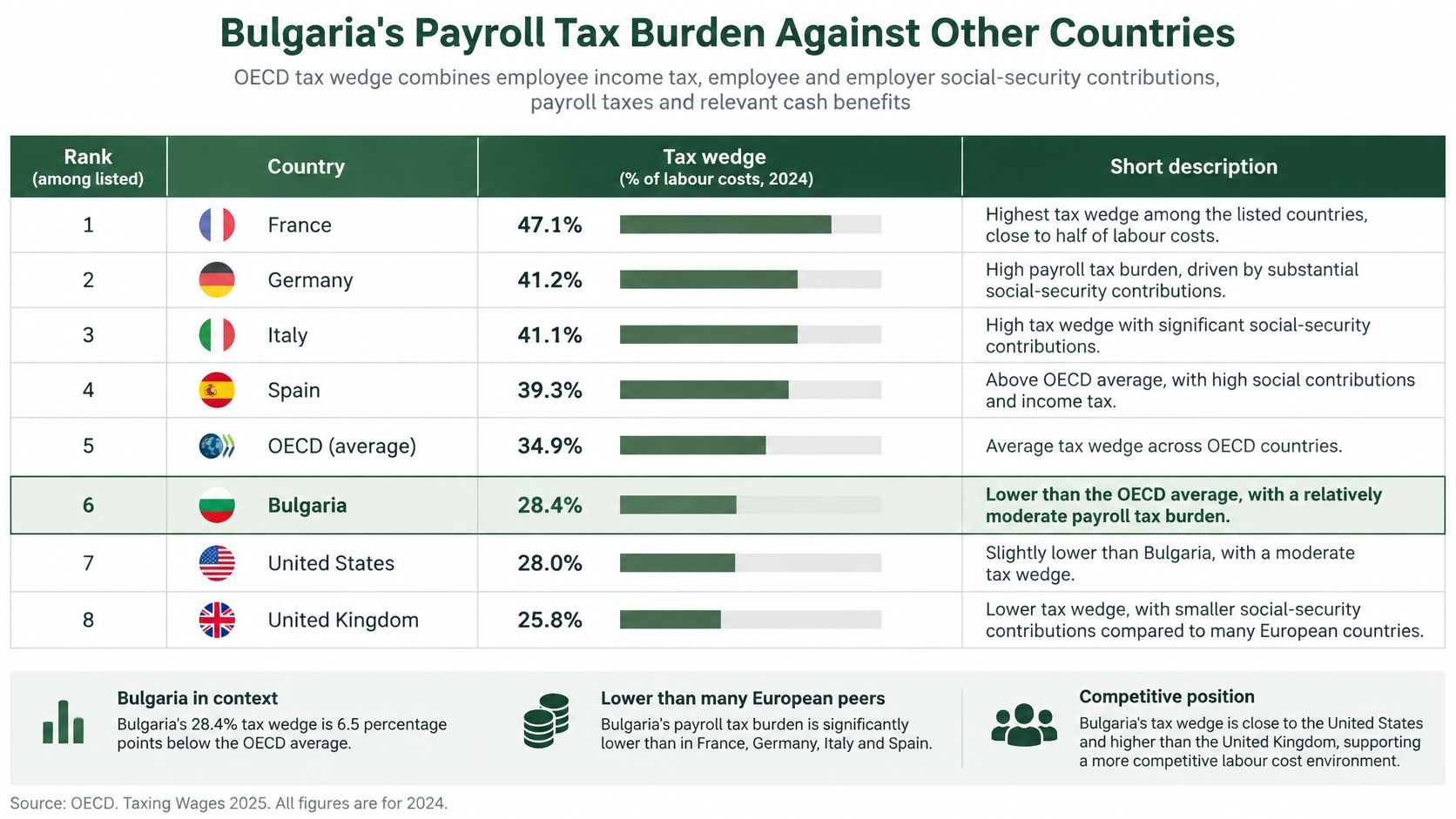
| Country | Tax wedge | Context |
|---|---|---|
| Belgium | 52.6% | Highest tax wedge in the OECD comparison |
| Germany | 47.9% | Among the five highest tax wedges |
| France | 47.2% | Among the five highest tax wedges |
| Italy | 47.1% | Among the five highest tax wedges |
| Austria | 47.0% | Among the five highest tax wedges |
| Bulgaria (illustrative, €2,000 salary) | About 34.7% to 35.1% | Worked calculation, not an OECD average-worker figure |
What the €2,000 month implies
For this illustrative salary, the employee pays €275.60 in contributions and €172.44 in income tax. Employer contributions add €378.40 to €392.40, bringing total labour cost to €2,378.40 to €2,392.40. The resulting wedge is about 34.7% to 35.1% of total cost.
That calculation shows why the flat 10% income-tax rate does not capture the full employer cost. Social-security contributions make up much of the difference between the headline rate and the total wedge.
A fair comparison between two hiring locations
- Use the same gross annual salary for both countries.
- Add employer contributions to calculate total employer cost.
- Subtract employee contributions and income tax to calculate net pay.
- Compare net pay with total cost. Headline income-tax rates do not show the full payroll burden.
Repeat the comparison when thresholds change. The Bulgaria row here is a worked calculation for one €2,000 salary, not an OECD average-worker statistic, so compare it with OECD figures only as an illustration of how the tax wedge is built.
Penalties and Correction Steps
Penalty amounts for late or missing payroll filings are set in Bulgarian law and they change. This guide gives no figures. Confirm the current amounts with the NRA and the NSSI before you rely on any estimate you have seen elsewhere.
Use one correction routine for every error. Late payments, a missed 3-day registration, a late 7-day termination notice, a wrong threshold, a misclassified contractor, and an incomplete historical record all go through the same five moves.
- Fix the input that caused the error. That might be a threshold, a contract date, or a bad identifier.
- Recalculate the affected months from the payroll register. Don't patch only the declaration.
- Correct and resubmit the monthly declaration or the event filing, and keep the new acceptance confirmation.
- Pay any shortfall as soon as you can, and record the reason and the date.
- Log who approved the correction in the audit trail the same day.
Where classification or back pay is material, speak to a qualified Bulgarian accountant or lawyer before you file the correction. Business compliance still sits with the company: FastCorp is not a law firm or a tax authority, and the client remains legally responsible for the company's activities, tax obligations, and reporting accuracy.
Document every correction on the day it is made. A note written a month later rarely matches the file the authority already holds.
How FastCorp Handles Payroll for Non-Resident Companies
A non-resident founder still needs to account for Bulgarian payroll obligations through the Bulgarian company. FastCorp handles registration, VAT, banking and bookkeeping for companies it sets up, with ongoing compliance support that can include bookkeeping, tax filings and payroll.
For companies FastCorp sets up, it handles the legal paperwork and compliance. Company formation can be completed fully online, and bookkeeping, tax and full compliance support are optional after setup. See how payroll fits with corporate tax compliance services.
Onboarding in four steps
- Confirm which filings the company needs using its payroll calendar.
- Choose any optional ongoing services and clarify what they cover.
- Agree who is responsible for each filing and where records will be kept.
- Review the arrangement when headcount or contract terms change.
Clients must provide requested documents and information promptly. Petar Mitkov, Accountant at FastCorp, handles accounting, reporting and compliance. FastCorp is not a law firm or tax authority, and the client remains legally responsible for the company's activities, tax obligations and reporting accuracy.
First-Month Payroll Compliance Checklist
Finish these five actions before the first salary run. They are short on purpose.
- Copy the filing calendar into a shared tool, with one named owner for each filing.
- Confirm this year's contribution thresholds and load them into the payroll system before any salary is calculated.
- Write the 3-day registration and the 7-day termination notice into the hiring and exit process, including the proof you will save.
- Set a reconciliation that runs before each 25th deadline, so the register, the payments, and the declarations match.
- Decide whether payroll stays in-house or moves to a provider, and record who is responsible for each filing.
Before that first run, confirm the current rules and any penalty figures with the NRA, the NSSI, and a qualified Bulgarian accountant. Form numbers, thresholds, and dates change from year to year, and an old checklist is how a clean company starts with a late file.
FastCorp runs Bulgarian payroll for non-resident companies, including payroll runs, social and health insurance filings, and employee onboarding and offboarding, fully online. If you want the monthly declarations and the hire-and-exit notices handled with the rest of your compliance, talk to the team before your first payday. Visit FastCorp and tell us who you plan to employ.