Business Bookkeeping Services Explained for EU Founders
Discover business bookkeeping services for non-resident EU founders. Compare Bulgarian pricing, online workflows, and practical tips
You've got customers in more than one country, invoices going out in different currencies, payroll running in the background, and a VAT deadline that doesn't care what time zone you're in. That's the point where business bookkeeping services stop being admin and start being the operating system of the company. If the records are sloppy, every filing gets harder, every explanation gets longer, and every mistake costs more to unwind.
The right setup is boring in the best possible way. Documents land in one place, bank feeds reconcile cleanly, VAT evidence stays attached to each transaction, and the annual corporate-tax return doesn't become a panic job at the end of June. For a Bulgarian EOOD or OOD owned by a non-resident founder, that discipline is what keeps the company usable from abroad.
Practical rule: if your books can't explain a payment, a VAT treatment, or a payroll posting without a side conversation, they aren't ready for real business.
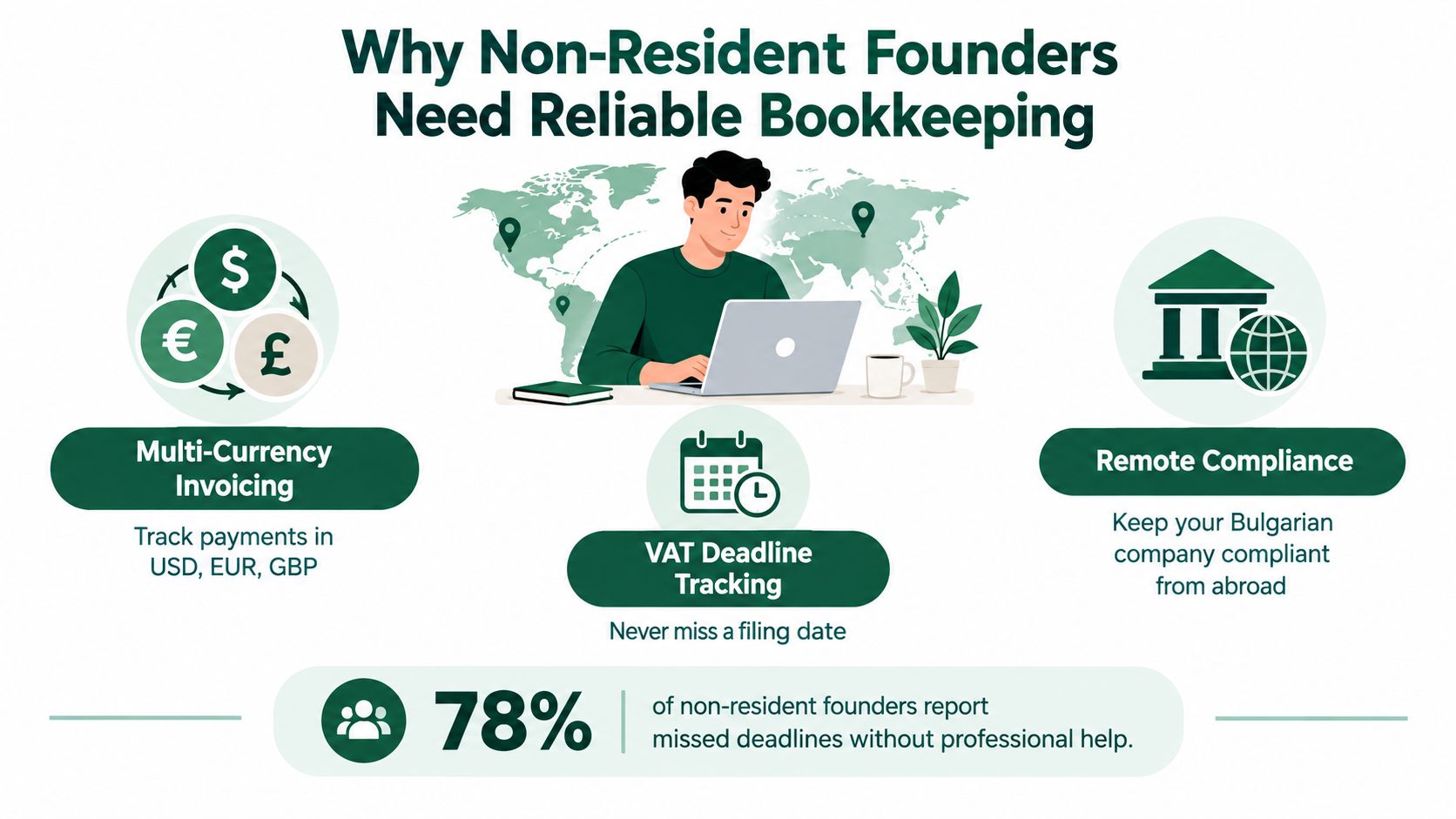
Table of Contents
- Why Non-Resident Founders Need Reliable Bookkeeping
- What Business Bookkeeping Services Actually Include
- How an Online Bookkeeping Workflow Runs Each Month
- Bulgaria's 10% Corporate Tax in European Context
- Practical Pricing Considerations for Bookkeeping
- Reconciliations, Controls, and Fraud Prevention in Practice
- How to Choose the Right Bookkeeping Provider
- Practical FAQ for Founders Buying Bookkeeping
Why Non-Resident Founders Need Reliable Bookkeeping
A founder in Berlin, Dubai, or Toronto can run a Bulgarian company well, but only if the records keep pace with the business. One client pays in EUR, another in USD, a contractor invoice arrives late, payroll is due, and the VAT deadline is close. In that situation, bookkeeping holds the company together.
Coordination, not typing: what the work involves
Good books connect payments, payroll, VAT filings, and the annual corporate tax return into one chain of evidence. For a Bulgarian EOOD or OOD, that chain has to stand up when the founder is abroad and the accountant is the only person on the ground keeping the monthly flow intact.
The work is operational. The IRS expects electronic records to stay complete, accurate, accessible, and traceable from source document to ledger and return IRS recordkeeping guidance. If a provider cannot show that trail, you do not have a bookkeeping system, you have a pile of entries.
Why outsourcing is usually smarter in year one
Hiring in-house sounds tidy, but for a new Bulgarian company with a non-resident owner, it usually costs more and solves less. You need someone who understands local deadlines, remote document flow, VAT treatment, payroll journals, and the annual tax calendar. Paying for presence instead of process is a bad trade.
A stronger setup is a provider that already handles cross-border founders. The first year brings invoices with missing VAT evidence, payroll that starts later than planned, bank feeds that break, and founders who need clear answers fast. Professional bookkeeping services turn those moving parts into a repeatable monthly routine.
Bulgarian bookkeeping also matters because the headline tax rate is only part of the picture. The actual cost sits in whether VAT, payroll, and corporate-tax filings are prepared cleanly the first time, or whether you spend money fixing avoidable errors after the fact. That is why reliable monthly bookkeeping is one of the few expenses that usually saves more than it costs.
What Business Bookkeeping Services Actually Include
A proper package is not just “enter transactions.” It is a controlled system with a chart of accounts, reconciliation, review, reporting, and evidence retention. Think of the chart of accounts as a warehouse with labeled bins, if the bins are wrong, the goods end up in the wrong place and you spend the rest of the month fixing it.
The deliverables that actually matter
A serious provider records daily transactions, reconciles bank and card accounts, posts payroll journals, maintains fixed-asset records when needed, and prepares a monthly close pack. The IRS specifically says electronic accounting systems need to preserve source-document detail, reconcile machine-readable records to the general ledger and tax return, and document data flow and integrity controls IRS recordkeeping guidance. That is the standard, not a nice-to-have.
Bookkeeping is not the same thing as tax advisory or legal work. A bookkeeper keeps the numbers clean, an accountant interprets them, a tax adviser handles planning and edge cases, and a lawyer deals with structure and contracts. If a provider blurs those lines, you usually get weak accountability.
| Work area | Routine output | Why it matters |
|---|---|---|
| Transaction recording | Categorized income and expenses | Keeps the ledger usable and prevents cleanup work later |
| Bank and card reconciliations | Matched balances with exceptions flagged | Exposes omissions, duplicates, and unauthorized items |
| VAT-ready reporting | Sales and purchase coding aligned to tax treatment | Reduces filing errors and weak evidence trails |
| Payroll journals | Salary, tax, and deduction postings | Keeps payroll tied to the ledger and filings |
| Fixed-asset register | Asset additions and depreciation tracking | Supports accounting and tax treatment |
| Monthly close pack | Reports, reconciliations, and review notes | Gives the founder and reviewer one defensible file |
A good monthly package should also answer the question investors and auditors care about most, can every figure be traced back to something real? Cosmetic statements look neat. Audit-grade files stand up to review.
Practical rule: if the provider won't show you the reconciliation file, the approval trail, and the source documents together, you're paying for appearance, not control.
How an Online Bookkeeping Workflow Runs Each Month
A founder who waits until the last minute usually pays for it in corrections, not just stress. The better setup is remote, scheduled, and built around Bulgaria's VAT and corporate tax filings. The Council document linked here shows Bulgaria's move to full electronic filing for corporate-income-tax and VAT returns EU digitalization document, so there is no reason to handle monthly bookkeeping as a paper chase.
The monthly cycle should be predictable
The founder uploads invoices, receipts, and bank statements to a secure portal. Bank feeds pull in transactions, payroll entries come in from the payroll module, and the bookkeeper matches everything against the ledger. Speed matters, but control matters more.
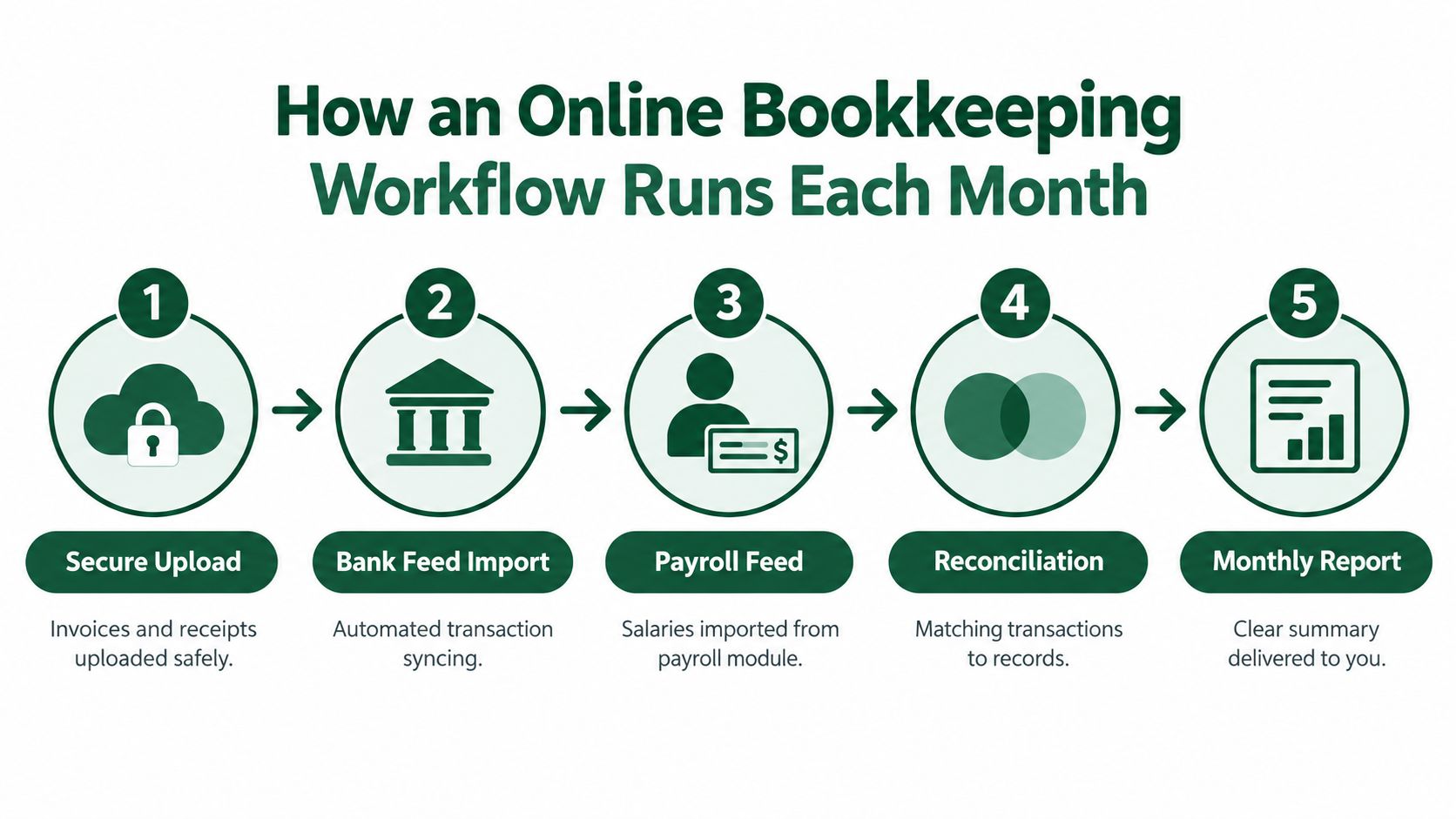
A good provider sets its internal cut-off several days before the 14th of the month. The same document also points to Bulgaria's VAT return deadline on the 14th day of the following month. If source records are missing, the provider should flag them at once. Waiting until filing day is how avoidable compliance problems start.
What a remote close should produce
By month-end, the founder should receive a review of unreconciled items, unusual postings, VAT codes, and payroll movement. The file should be clean enough to support both the VAT return and the monthly close.
For founders comparing software-led workflows, this bookkeeping software comparison is useful when deciding how much automation is worth paying for.
An embedded walkthrough can help here, but only if it shows the full sequence, from document upload through reconciliation and reporting. If it does not add that kind of practical value, skip it.
Bulgaria's 10% Corporate Tax in European Context
Bulgaria's 10% corporate-income-tax rate is attractive, but the actual bill depends on the taxable result. Accounting profit is only the starting point. Permanent and temporary adjustments still decide what ends up on the corporate tax return, so a bookkeeping service that does not keep a tax-adjustment schedule leaves you half-prepared.
Compare the headline rate, then ask what sits underneath it
The Tax Foundation reported that the average combined corporate-income-tax rate across its European Tax Policy Scorecard countries was 21.9% in 2025, while Bulgaria's rate was 10% Tax Foundation European rankings. The same comparison placed Hungary at 9%, Cyprus and Ireland at 12.5%, Austria at 23%, and Belgium at 25%. Bulgaria sits at the low end of the range, but the headline rate still does not tell founders what they will owe.
| Jurisdiction | Headline corporate income tax rate | Quick caveat |
|---|---|---|
| Bulgaria | 10% | Low headline rate, but taxable profit still needs adjustments |
| Hungary | 9% | Lower headline rate, other taxes and rules still matter |
| Cyprus | 12.5% | Attractive headline rate, substance and classification still matter |
| Ireland | 12.5% | Corporate structure and tax residency still drive the outcome |
| Austria | 23% | Higher headline rate, but total burden still depends on deductions and taxes |
| Belgium | 25% | Higher headline rate, yet the effective result depends on the full tax mix |
Why the headline number can mislead founders
Payroll taxes, withholding taxes, dividend treatment, VAT, residency, and permanent-establishment rules all sit outside the headline figure. Compare countries using the whole operating model, not just the tax rate. For a fuller rate comparison, see this corporate tax rates overview.
The Ministry of Economy page on Bulgarian corporate tax filing says the annual return is generally filed electronically with a qualified electronic signature between 1 March and 30 June of the following year, and tax due is paid by 30 June Bulgarian corporate tax filing guidance. For companies over the threshold in the prior period, quarterly advance payments can also apply. Those dates only work if the books stay current all year.
A serious bookkeeping provider keeps a tax-adjustment schedule, closes the books every month, and separates accounting profit from taxable profit. That is the difference between a manageable 10% rate and a nasty filing surprise.
Practical Pricing Considerations for Bookkeeping
Flat-fee bookkeeping looks tidy until you break down what the fee covers. The price driver is workload: transaction volume, invoice count, payroll headcount, multi-currency activity, bank-feed integrations, and whether corporate tax filing sits inside the package or gets billed separately. If a quote skips those items, it is hiding the work somewhere.
What changes the monthly fee
A low-activity company with clean records needs less review than a SaaS business taking card payments, issuing refunds, and paying contractors in several currencies. More feeds and more classifications mean more checking, and that is what you pay for. The cheapest quote is often cheap because it excludes the messy parts.
| Cost driver | What it usually affects | What to ask before signing |
|---|---|---|
| Transactions | Data entry and reconciliation time | How many entries are included each month |
| Invoices | Coding and evidence checks | Whether purchase and sales invoices are both covered |
| Payroll | Journal work and statutory filings | Whether payroll support is monthly or separate |
| Multi-currency | Conversion review and VAT treatment | Who checks exchange-rate methodology |
| Integrations | Import setup and break-fix work | Whether broken feeds cost extra |
Where hidden fees usually hide
The most common trap is the per-filing charge. A package can look affordable until VAT returns, payroll filings, annual accounts, and corporate-tax returns appear as separate line items. Another trap is “support” that really means slow email replies and extra charges for anything unusual.
Bulgarian bookkeeping often prices below many Western European or US structures, but the quote only matters if the deliverables are clear. A provider like FastCorp, which has incorporated 3,000+ Bulgarian companies since 2018, can combine incorporation, VAT setup, bookkeeping, and filings in one workflow. That matters more than a low sticker price if you want fewer handoffs and fewer excuses about who owns each filing.
For a practical way to compare packages, use this accounting services pricing guide before you sign anything.
Reconciliations, Controls, and Fraud Prevention in Practice
Reconciliations are not clerical busywork. They are one of the few controls a small company can use every month without building a big finance department. The Association of Certified Fraud Examiners' 2024 global study found that organizations using active detection methods such as management review, surveillance or monitoring, internal audit, document examination, automated transaction monitoring, and account reconciliation had lower median losses and faster detection, with fraud duration reduced by roughly 14% to 50% in the study's reported range ACFE 2024 study.
In a small company, segregation has to be deliberate
One person records the transaction, another reviews the reconciliation, and the person approving payments should not also be the one changing supplier bank details. If one founder and one provider are doing everything, the control design has to compensate with role-based access, versioned logs, and approval thresholds. Otherwise, a single error can sit unnoticed until the filing deadline.
The best monthly review is the one that catches the bad transaction before it reaches VAT, payroll, or the annual return.
What to verify every month
- Bank reconciliations: Confirm the review is separate from the person who entered the transactions.
- Supplier master changes: Check who can change bank details and whether those changes are logged.
- Unusual journals: Look for manual postings that don't follow normal patterns.
- Exception reports: Make sure the founder receives them, not just the bookkeeper.
- Close pack sign-off: Ask for reconciliation sign-offs, adjustment logs, and approval records together.
For Bulgarian companies, those controls should live inside the monthly close pack. That file is where you prove that the numbers were checked, not just posted.
How to Choose the Right Bookkeeping Provider
Choose the provider the same way you'd choose your bank. If you're going to rely on them every month, you need access, transparency, and a clean exit path. Anything less creates lock-in, and lock-in is expensive when the business changes.
The checklist I use with founders
Start with data ownership. You should know where the accounting file lives, who can export it, and what happens if you switch providers. Then check integrations, because a provider who can't work cleanly with your bank feed, invoicing tool, or payroll system will waste time every month.
Ask for the handover format before you sign. If they won't explain the chart of accounts, the reconciliation process, or the audit trail, walk away. A provider that refuses to document its workflow is asking you to trust a black box.
Red flags worth taking seriously
- No access to the accounting file: You should not have to beg for your own records.
- Vague fixed-fee wording: If a quote doesn't say what's included, expect add-ons later.
- No VAT evidence workflow: Cross-border sellers need more than a ledger.
- Weak response-time commitments: Deadlines don't wait for slow inboxes.
- No exit process: If you can't leave cleanly, you don't really own the relationship.
Use this short procurement note when comparing providers. Can I export my history? Can I see the audit trail? Can I understand the monthly close? Can I switch without losing records? If any answer is fuzzy, the service is not ready for a serious founder.
Practical FAQ for Founders Buying Bookkeeping
How often do I need to send documents?
Monthly is the minimum that works for most Bulgarian companies, and weekly is smarter if you invoice heavily or pay in multiple currencies. The earlier the records arrive, the easier it is to catch VAT issues before the deadline.
What does the provider file for me?
A solid provider handles the bookkeeping records, VAT return preparation, payroll support, and the annual corporate-tax filing workflow, while keeping the evidence trail attached to each number. The filing dates and tax-adjustment work still depend on clean monthly inputs, as covered above.
How do I switch providers without losing history?
Insist on an exportable archive, a clear chart of accounts, and signed handover files. If the current provider can't produce those, switching will be messy, and that's usually a sign you should have left earlier.
Does bookkeeping alone cover the annual corporate tax return?
Not by itself. The books feed the return, but the return still needs tax adjustments, deadline control, and a filing process aligned with Bulgarian rules. The annual return timing and payment date are set out in the tax filing guidance cited earlier.
Keep every VAT invoice, receipt, and support document tied to the transaction. That's the detail founders usually ignore until the first cross-border invoice lands and the evidence trail suddenly matters.
If you want one provider to handle incorporation, VAT registration, bookkeeping, payroll, and annual filings in a single remote workflow, that's exactly the sort of setup FastCorp supports for Bulgarian EOODs and OODs. If you're trying to keep a non-resident company compliant without building an internal finance team, visit FastCorp and compare the workflow against your current setup.