Business Bank Account Minimum Balance: A Complete Guide
Understand business bank account minimum balance rules across providers. Learn how to avoid fees and set up banking for your Bulgarian company with FastCorp.
While US banks typically require $500–$15,000 to waive monthly fees, many online providers and Bulgarian banks offer accounts with €0 minimum balance, allowing non-resident founders to preserve working capital immediately. The amount needed to open an account and the amount you must keep there to avoid charges are often completely different.
You may be forming a company, waiting for your first client payment, and watching every outgoing transfer closely. A bank representative says the account has “no minimum deposit,” but the fee schedule mentions a balance condition. That wording creates unnecessary anxiety, and it can become expensive when payroll, tax payments, or supplier invoices temporarily drain the account.
The right question isn't just, “Does this account have a minimum balance?” Ask four questions instead: What must I deposit to open it? How does the bank measure the ongoing balance? What fee applies if I miss the threshold? What will international payments cost? This framework works for US accounts, Bulgarian banks, and online providers serving EU-based founders.
Table of Contents
- Understanding Your Minimum Balance Options
- Traditional Banks Versus Online Providers
- The Hidden Costs of Zero Minimum Accounts
- Navigating Bulgarian Banking Requirements
- FastCorp Client Success Stories
- Practical Strategies to Avoid Monthly Fees
- Tax Implications and International Comparisons
Understanding Your Minimum Balance Options
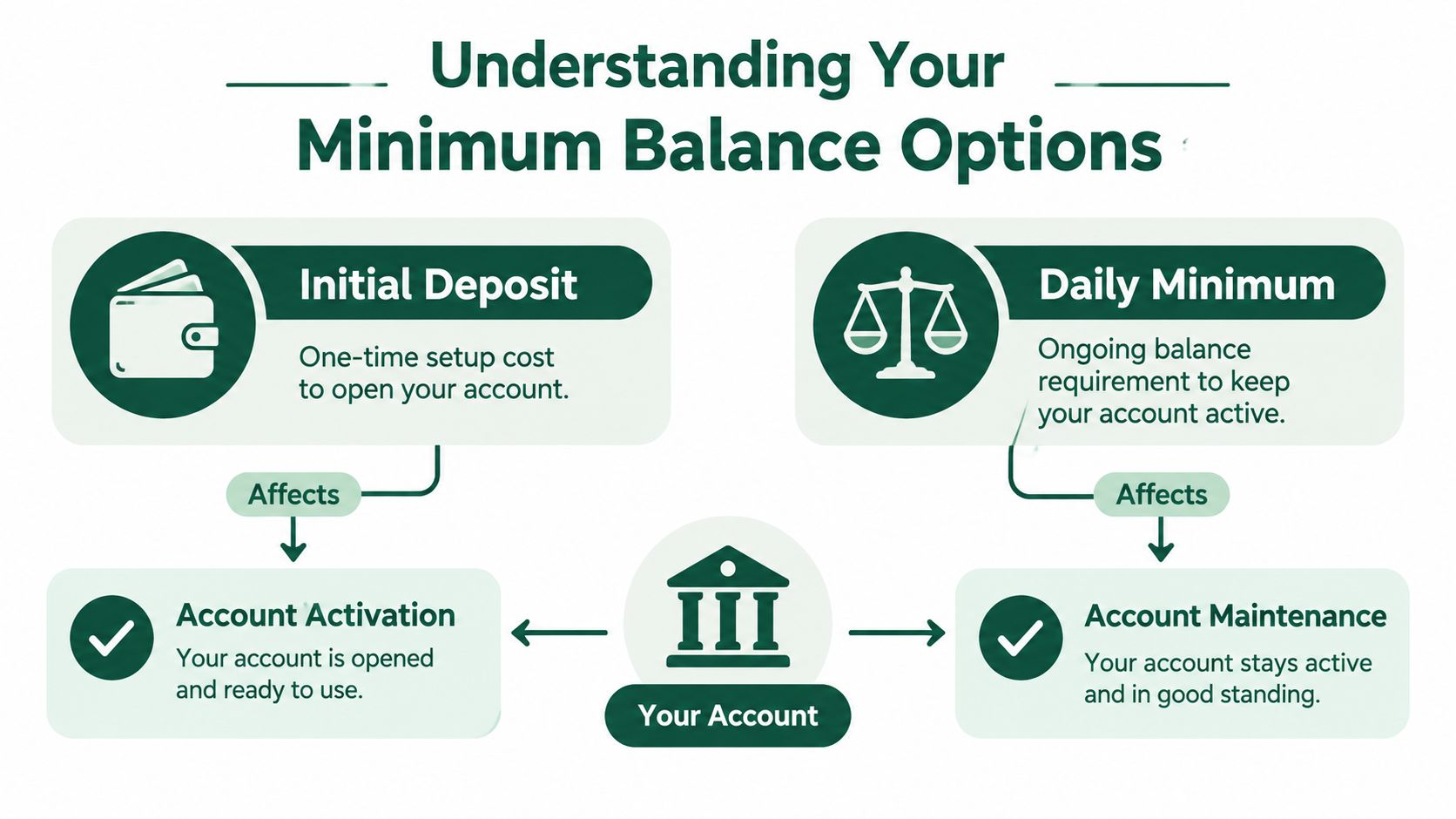
Cash-flow anxiety usually starts with one confusing phrase. A bank calls something a “minimum balance,” while the founder assumes it means cash that must remain untouched forever. In practice, the phrase commonly describes two separate conditions: an initial opening deposit and an ongoing balance used to waive a monthly fee.
Separate the two thresholds
The opening deposit is a one-time entry requirement. U.S. Bank lists a basic business savings account with a $25 minimum opening deposit, while Wells Fargo lists a $25 minimum opening deposit for its business checking accounts, as documented in the FDIC's business banking education material and Wells Fargo's business checking information. Once the account is open, that initial amount no longer tells you whether the bank will charge a maintenance fee.
The second threshold is an operating condition. U.S. Bank identifies a $500 daily balance that can waive a $5 monthly fee on a basic business savings account, while Bank of America says some business checking accounts can waive fees through a $5,000 combined average monthly balance or qualifying debit-card activity, with higher-tier products requiring a $15,000 average monthly balance. The FDIC explains that monthly maintenance fees can range from approximately $8 to $30, depending on the account and institution.
Use the account as a cash-management tool
Treat the opening deposit as a setup cost and the ongoing threshold as a pricing decision. A company can open an account with $0 at Bank of America in some cases, yet still need to maintain several thousand dollars or meet an activity condition to avoid a recurring fee, according to its business fee schedule.
Before signing, write these items into a simple account checklist:
- Opening deposit: Confirm the exact amount required on day one.
- Measurement method: Check whether the bank uses daily, average monthly, combined, ledger, or collected balances.
- Penalty: Record the monthly fee when the condition isn't met.
- Scope: Confirm whether linked accounts count toward the threshold.
Practical rule: Never leave a balance requirement in a sales conversation. Ask for the account agreement and fee schedule, then model the rule against your actual payment calendar.
Traditional Banks Versus Online Providers
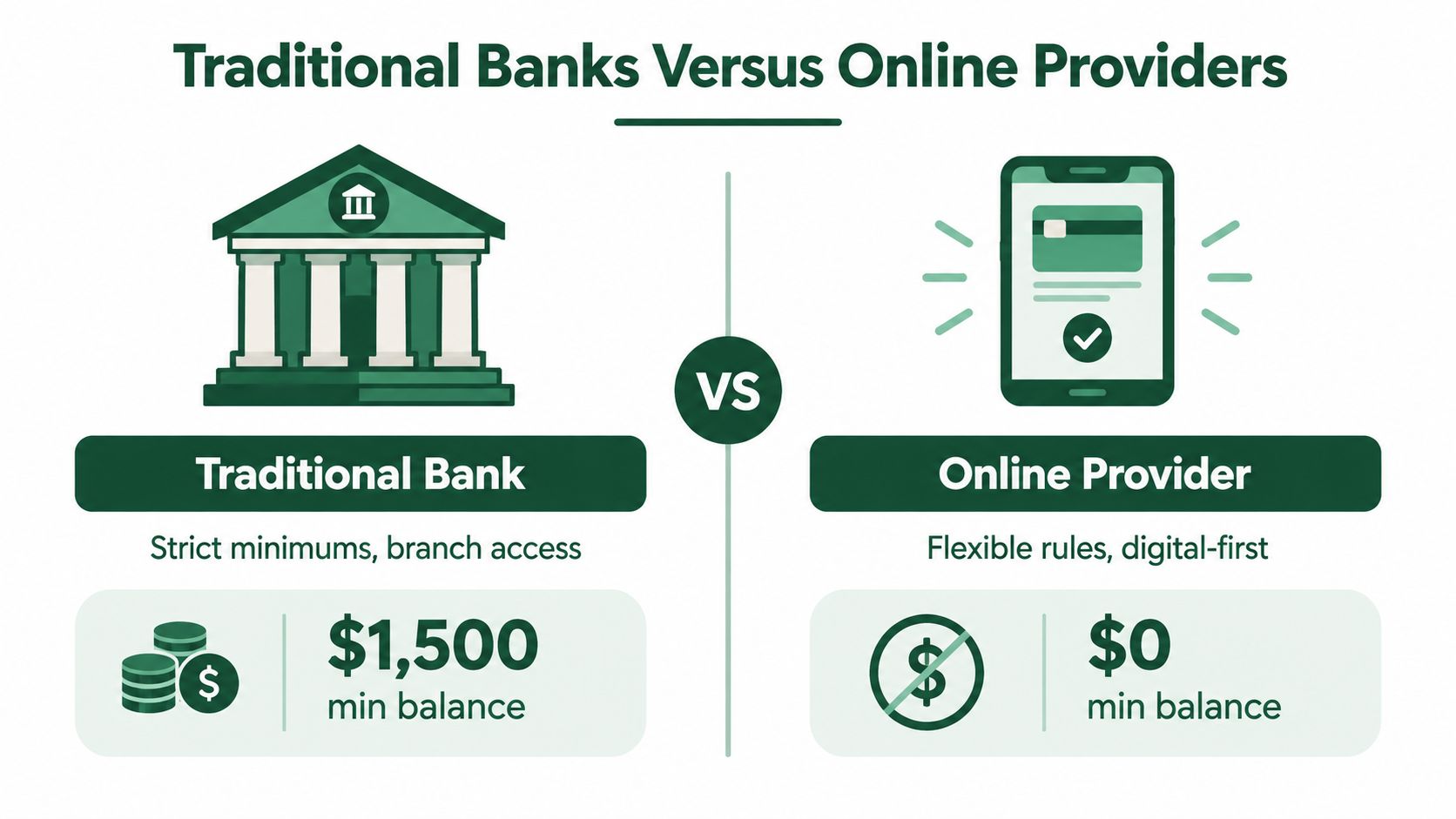
Traditional banks and digital-first providers solve different operating problems. A branch bank may be the better choice for a cash-heavy company or a founder who needs in-person support. An online account can be the better choice for a remote consultancy, SaaS company, or international agency that wants to keep working capital available rather than immobilize it for fee relief.
Fulton Bank's 2025–2026 fee schedule shows the traditional tiered model clearly. Its basic business checking product lists a $0 minimum balance requirement, while Business Premium Checking requires a $10,000 minimum ledger balance and charges a $25 monthly maintenance fee when the balance falls below that threshold. Business Interest Checking requires $15,000 and charges $30 monthly when the condition isn't met, according to the Fulton Bank fee schedule.
Compare the operating models
| Account model | Main advantage | Common trade-off |
|---|---|---|
| Traditional branch bank | Branch access, cash handling, broader in-person support | Tiered fees, balance tests, and potentially higher international costs |
| Online provider | Low or zero opening and balance requirements, fast digital administration | Limited branch access, possible cash-deposit restrictions, and different wire or eligibility rules |
Some US online-oriented accounts advertise no minimum balance or no opening deposit, but “no minimum” doesn't mean every service is free. The FDIC recommends comparing account terms because fees and options vary by institution. A digital provider may preserve cash while charging differently for wires, foreign-exchange conversion, cash deposits, or payment acceptance.
For global founders, this distinction matters more than a headline advertisement. An account with a $0 minimum balance may be ideal when revenue arrives unevenly, but it may be a poor fit if the business regularly deposits physical cash or needs a local branch. Conversely, a premium account requiring $10,000 or $15,000 can make sense only when its interest, lending, treasury, or payment features justify the capital tied up.
Read this guide to opening a business bank account online alongside the provider's actual tariff. My recommendation is straightforward: choose the lowest-balance account that supports your real payment workflow, not the account with the most impressive banking brand.
The Hidden Costs of Zero Minimum Accounts
A $0 minimum balance can preserve cash during a slow month, yet still produce an expensive account. Providers may waive the balance requirement while charging for international wires, foreign-exchange conversion, excess transactions, cash handling, or limited payment acceptance. Global founders should calculate the full operating cost, then compare it with Bulgarian account tariffs and the tax treatment of keeping funds idle in different jurisdictions.

The balance formula often matters more than the advertised minimum. Bank of America describes a $2,500 minimum daily balance or a $5,000 combined average monthly balance as alternative ways to waive a $16 monthly fee on Business Advantage Fundamentals Banking. Wells Fargo uses a $2,000 minimum daily balance or a $5,000 average combined business-deposit balance for its Initiate Business Checking account. Its minimum daily balance is the lowest ending balance after nightly transaction processing.
Daily and average tests behave differently
A payroll run or supplier payment can push the measured ending balance below a daily threshold, triggering a fee for that cycle. An average-balance test allows more room for short-term cash swings, although a large outflow can still lower the average enough to affect eligibility.
Schedule payments around the bank's measurement method. Track payroll, tax payments, card settlements, supplier invoices, and incoming client receipts instead of checking only the month-end balance.
The economics deserve a direct comparison. Keeping $2,500 idle to avoid a $16 monthly fee equals an annual fee-equivalent cost of 7.68% of that reserve, based on the Bank of America fee explanation. If that cash could fund inventory, payroll, or a higher-yield use, the “free” account may cost more than its fee.
Watch these charges:
- International payments: Ask about incoming and outgoing wires separately.
- Currency conversion: Check the exchange-rate spread and stated conversion charge.
- Transaction limits: Confirm the cost after included activity is exhausted.
- Cash support: Verify whether the provider accepts cash deposits.
- Eligibility: Confirm that your company, owners, and activity qualify.
For onboarding comparisons, review the business bank account sign-up bonus requirements. Treat a promotion as secondary to recurring charges, transfer costs, and the tax consequences of holding operating cash across borders.
Watch how fee-free accounts hide costs in wire fees and currency conversion, not just the balance line.
Navigating Bulgarian Banking Requirements
Bulgarian banking rules are not built around one universal business bank account minimum balance. Each institution sets its own tariff, and the decisive detail may be whether the stated amount must be deposited at opening, maintained later, or used to determine interest and account conditions.
United Bulgarian Bank lists BGN 50 or BGN 150 minimum balances for certain current-account categories. Its tariff also states that the minimum generally doesn't need to be deposited when the account opens, except for term deposits. Balances below the required minimum don't bear interest, so a founder should still understand the commercial effect even where the bank doesn't demand the amount on day one, as shown in the United Bulgarian Bank business tariff.
Compare the local tariffs carefully
D Commerce Bank takes a different approach. Its business tariff specifies a 25 currency-unit minimum account balance and lists a €10.20 monthly maintenance charge, equivalent to BGN 19.95, for certain business accounts with card and statements. That combination proves why a token balance isn't enough for comparison. The recurring fee can matter more than the amount needed to keep the account open.
BACB's institutional tariff lists a €50 minimum balance, equivalent to BGN 97.79, on a current account. Its published terms also distinguish account-opening charges for local legal entities from those for foreign legal entities, which is particularly relevant to non-resident founders. Review the BACB institutional tariff before assuming that a Bulgarian company and a foreign-owned company receive identical terms.
| Bulgarian example | Stated balance condition | Important qualification |
|---|---|---|
| United Bulgarian Bank | BGN 50 or BGN 150 | May not need to be deposited at opening for relevant current accounts |
| D Commerce Bank | 25 currency units | Certain accounts also show a €10.20 monthly maintenance charge |
| BACB | €50 or BGN 97.79 | Terms distinguish local and foreign legal entities |
The practical conclusion is positive but not careless. Bulgarian banks can offer accessible operating structures, yet non-resident applicants must verify identification, ownership, source-of-funds, account purpose, currency, and tariff treatment before choosing a provider. Keep the account's balance comfortably above the contractual condition, and ask how pending transfers, card authorizations, foreign-exchange conversions, and collected funds are treated.
Remote opening is available, but eligibility isn't universal. UniCredit Bulbank limits remote registration to Bulgarian legal entities whose legal representative is a local natural person, specifically a Bulgarian citizen with independent representation rights. Eligible companies can submit a request, complete remote consultation, exchange documents electronically, and sign with a qualified electronic signature, according to UniCredit Bulbank's remote business account process. Companies outside those conditions must visit a branch.
That makes a complete business bank account documents checklist essential before you apply.
FastCorp Client Success Stories
A representative non-resident founder usually starts with a practical constraint, not a theoretical banking question. The founder needs a Bulgarian entity, an EU operating account, a workable payment route, and a clear compliance process, but doesn't want to travel repeatedly or immobilize early revenue in a high-balance account.
Consider a typical FastCorp client, an international software consultant establishing a Bulgarian limited company to invoice EU customers. The founder chose an online setup, prepared the corporate information and identity documents, and used remote verification and electronic signing. The company formation and banking assistance were coordinated as one workflow rather than treated as unrelated administrative projects.
What the process looks like in practice
The founder's decision wasn't based only on finding a “free” account. He compared whether the provider supplied an EU IBAN, accepted the company's expected customer payments, supported required currencies, and applied a genuine zero-balance condition rather than a fee waiver that required idle cash. That distinction protected the company's early working capital.
The online formation route was completed in 3–5 working days, according to FastCorp's stated service process. An in-person Sofia option is listed at 2–3 working days, while online and in-person packages are advertised at €1,750 and €1,500 respectively, with legal and government fees included in the package descriptions on FastCorp's website. These are service details, not banking guarantees, so the founder still had to satisfy the selected provider's onboarding and compliance requirements.
The resulting setup gave the client a clear operating sequence:
- Form the Bulgarian company and secure the corporate documents.
- Prepare the banking file around ownership, activity, expected payments, and source of funds.
- Choose an EU IBAN route that matched the company's international payment needs.
- Set up accounting and VAT administration before trading volume increased.
- Keep a documented operating buffer rather than chasing a fee waiver blindly.
The broader lesson is useful for any non-resident entrepreneur. An online account can make the mechanics easy, but “everything online” only works when the bank accepts the company and representative under its own eligibility rules. A formation provider can simplify document preparation and introductions, but it cannot replace the bank's compliance decision.
Practical Strategies to Avoid Monthly Fees
Fee avoidance starts with a cash-flow model, not a larger idle balance. Founders often hold too much money in a bank account because they haven't tested the fee against payment timing. That protects against one charge while weakening the business's ability to pay suppliers, invest, or cover tax obligations.
Build the buffer around real payment dates
Start with the bank's exact test. If it uses a daily minimum, identify the lowest projected ending balance after payroll, tax, card settlement, and supplier payments. If it uses an average monthly balance, model the full period and include expected delays in customer receipts.
Use a simple worksheet with these columns:
- Date: When each material payment or receipt is expected.
- Amount: The cash movement, including bank charges.
- Balance after processing: The amount left after nightly transactions.
- Test applied: Daily, average, combined, ledger, or collected.
- Safety margin: The extra amount you choose to retain above the contractual threshold.
Set alerts before the low point, not after it. A founder who waits for a month-end statement may discover that a single payment already triggered the fee.
Cash-control rule: Maintain a buffer based on the lowest realistic operating balance, then compare its opportunity cost with the fee. Don't lock away cash simply because the account marketing uses the word “premium.”
Select the account for your transaction rhythm
A project-based consultancy with uneven receipts should prioritize a zero-balance or flexible average-balance account. A retailer handling physical cash may accept a monthly fee in exchange for branch deposits. An international agency should test incoming wires, outgoing wires, currency conversion, local payment details, and card settlement before evaluating the balance requirement.
Collected funds deserve special attention. U.S. Bank explains that collected balance is stricter than ledger balance because funds generally must be available for withdrawal after the collection process. A newly deposited check or pending transfer may appear in the account while failing the bank's fee-waiver calculation.
Finally, prevent unnecessary account disruption. U.S. Bank states that an account may automatically close after four consecutive months with both a zero balance and no deposit or withdrawal activity. Keep documented activity where the account matters, and review dormant-account terms before allowing a secondary account to sit unused.
Tax Implications and International Comparisons
Banking cost and tax cost belong in the same decision model. A zero-balance account can preserve working capital, but it doesn't automatically produce the best net result if the company pays more for currency conversion, wires, payment acceptance, or compliance elsewhere.
Bulgaria's stated 10% corporate tax rate is a major reason international founders compare Bulgarian structures with higher-tax alternatives, but tax residence, management location, permanent-establishment risk, VAT, payroll, withholding, and substance requirements still need professional review. Banking convenience alone doesn't determine tax liability.
A practical comparison framework
| Decision factor | Bulgarian structure | Higher-fee US alternative |
|---|---|---|
| Corporate tax benchmark | 10% corporate tax, subject to the company's facts and applicable rules | Compare the relevant federal, state, and local treatment for the actual company |
| Balance strategy | Low or token minimums may be available, depending on the bank and tariff | Fee waivers can require $500–$15,000, depending on the product |
| Working-capital effect | Less cash may need to remain idle in an operating account | A balance waiver can tie up cash that could fund operations |
| International fit | EU IBAN options and Bulgarian banking routes can support EU operations | US accounts may require separate review of wires, currencies, and eligibility |
| Compliance burden | EU VAT and Bulgarian corporate filings remain essential | US reporting and state obligations vary with activity and location |
The comparison isn't “Bulgaria is always cheaper.” It is more precise: model tax, banking, payment, accounting, and compliance costs together. A US account with no opening deposit may still impose a fee unless you maintain its balance condition, while a Bulgarian account with a low stated balance may still charge recurring maintenance or treat foreign legal entities differently.
For EU founders, the winning structure is the one that leaves sufficient cash available after taxes and banking friction, while remaining compliant. Ask an accountant to compare the company's actual activities and ownership before relocating profits or assuming a tax result.
FastCorp helps global founders form Bulgarian limited companies, arrange EU banking assistance, prepare VAT and corporate documents, and manage ongoing accounting and compliance through an online workflow. Visit FastCorp to compare a low-balance banking setup with the formation and tax-administration support your company needs.