Ultimate Beneficial Owner Explained for EU Founders
Learn what an ultimate beneficial owner is, how EU disclosure works, and how FastCorp handles UBO declarations when you form a Bulgarian company online.
You're ready to invoice, the Bulgarian company is lined up, and the last thing you expect is a bank form stopping everything with one blunt question, who is the ultimate beneficial owner? That's the moment most founders realise this isn't a filing detail, it's the checkpoint for banking, VAT registration, and customer due diligence. If the UBO file is sloppy, the setup slows down immediately.
Table of Contents
- Why an Ultimate Beneficial Owner Question Stops Your EU Setup
- What an Ultimate Beneficial Owner Actually Is
- The 25 Percent Threshold and Why It Is Not the Whole Story
- How the EU UBO Framework Built Up
- Bulgaria's 10 Percent Tax in a Real Cross-Border Comparison
- How FastCorp Handles UBO Declarations During Online Incorporation
- Three Mistakes That Bounce UBO Filings and Bank KYC
Why an Ultimate Beneficial Owner Question Stops Your EU Setup
The first real delay usually comes before the company even trades. A founder has the incorporation plan sorted, a Bulgarian EOOD or OOD is the obvious choice, and then the bank asks for the ownership chain, control rights, and the natural person behind the structure. That's not bureaucracy for its own sake, it's the gatekeeper for an account, an EU IBAN, and the documents that follow.
The banking team is not looking for the biggest name on paper
Banks and registries don't care who looks important in the company profile. They want the person who ultimately owns or controls the entity, because that's the person they need to identify for AML and KYC purposes. If you hand them a shareholder list without a clean control analysis, expect questions, not approval.
Practical rule: if you can't explain ownership in one straight line from company to human being, the bank will probably stop you there.
That same problem affects VAT registration and onboarding with counterparties. A customer asking for your company details is often also checking whether your filing matches the share register, whether nominee arrangements are disclosed, and whether the control picture is current. When the records are weak, everyone in the chain sees the weakness.
Why early UBO clarity saves time later
Founders often treat UBO disclosure as a form they can solve at the end. That's backwards. The cleanest files are built before formation finishes, because the bank, accountant, and registry all read the same ownership story.
A solid UBO file helps you avoid three avoidable headaches, missing bank questions, a stalled VAT process, and a compliance team asking for an ownership chart after you've already started trading. It also keeps later updates manageable when shares, directors, or control rights change. A sloppy declaration is cheap to create and expensive to fix.
What an Ultimate Beneficial Owner Actually Is
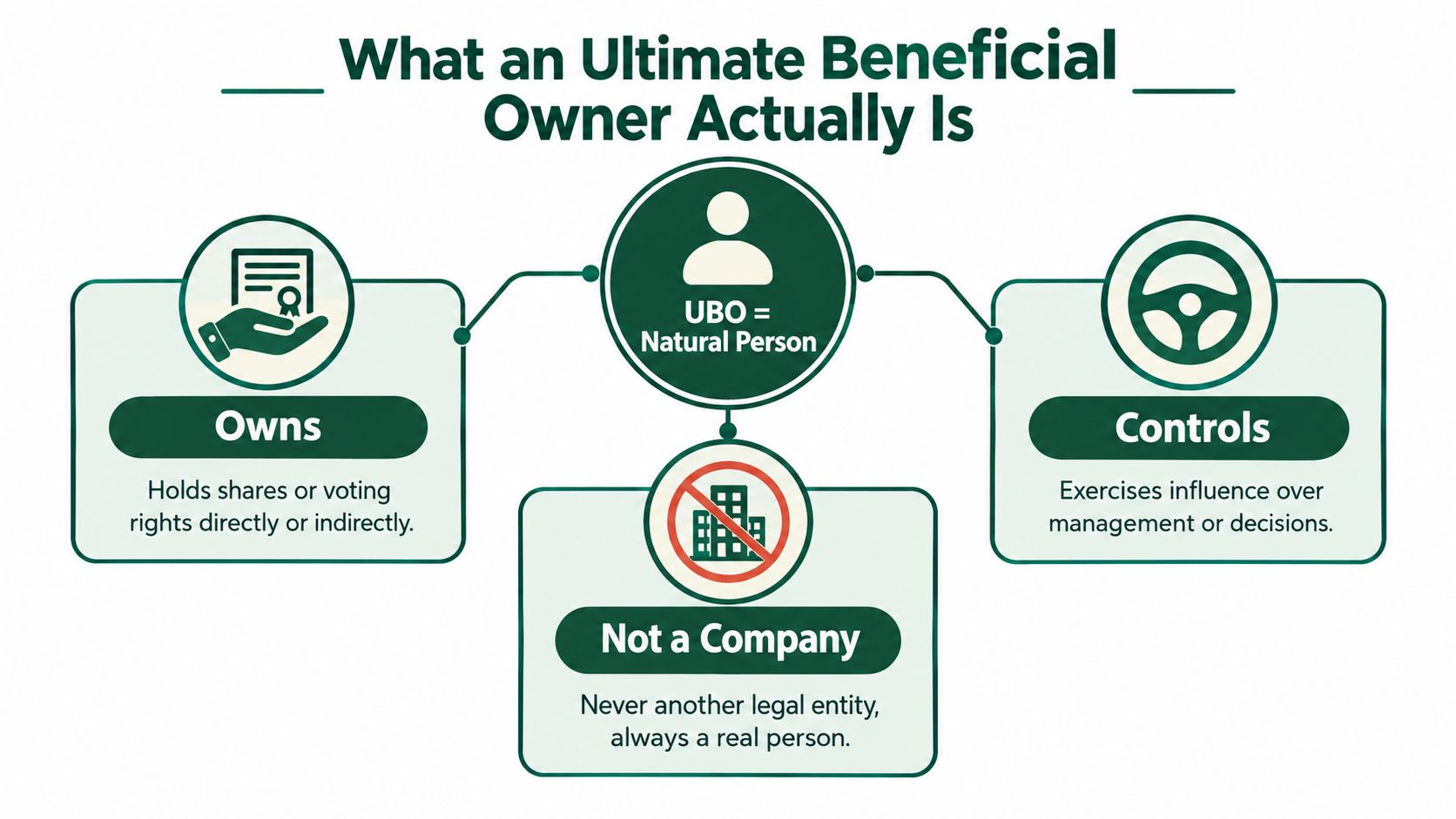
An ultimate beneficial owner is always a natural person, not another company, who ultimately owns or controls a legal entity, or on whose behalf a transaction is conducted, according to FATF guidance on beneficial ownership transparency FATF guidance. That simple sentence is where many founders go wrong, because they stop at the parent company, the nominee, or the director on paper.
Legal owner, nominee, and real owner are not the same thing
Think of the company as a building. The legal owner is the name on the deed, the nominee is the person holding the keys for someone else, and the real beneficial owner is the human being who controls what happens inside. The key point is that legal title and beneficial ownership are separate concepts, and FATF treats them that way.
A nominee director is on paper to act on another person's instructions. That alone doesn't make them a beneficial owner. A nominee shareholder should also disclose the nominator's identity and the nominee status, because the purpose of the arrangement is transparency, not disguise.
The rule to use when you're filing
If you want one working definition, use this one: the UBO is the human being at the end of the ownership chain. If the chain runs through a holding company, a trust, a nominee arrangement, or a layered cross-border structure, keep tracing until the chain ends in a person.
A clean UBO file names the person who actually owns or controls the structure, not the entity that sits nearest the top of the chart.
That distinction matters because banks and registries are not satisfied with a formal shareholding summary. They want a control picture supported by identity documents and independently sourced data, not just a declaration that sounds plausible on its face. When the facts are messy, the person who signs the filing needs to be able to show why the named individual is the final answer.
The 25 Percent Threshold and Why It Is Not the Whole Story

Under EU anti-money-laundering rules, more than 25% of the shares or ownership interest is a major indicator of beneficial ownership, but it is not the whole definition EU AML rules. The law also requires you to consider indirect ownership and other means of control, including voting rights, shareholder agreements, veto powers, and similar arrangements.
Why the threshold is only the starting point
A founder with 20% of the shares can still be the UBO if that founder has a casting vote or another mechanism that controls strategy. A passive investor with 30% can fail the practical test if someone else controls appointments, removals, or key decisions. The percentage matters, but control matters just as much.
That is why a percentage test is a screening tool, not a complete legal definition. If you rely on the largest shareholder alone, you can end up filing the wrong person and trigger a bank correction later. The person who reviews the structure should ask, who can appoint, block, direct, or override decisions?
Map the chain to a human being before you sign
Before you file, build the chain all the way down and make sure each layer makes sense. I'd use this sequence every time:
- List the direct owners. Start with whoever appears on the share register and note the exact holding.
- Trace every intermediary. Record each company, trust, nominee, or holding vehicle until the ownership chain reaches a person.
- Check control rights. Read the shareholder agreement, articles, voting arrangements, and any veto or appointment rights.
- Test for indirect influence. Ask whether someone controls the business without crossing the formal ownership threshold.
- Document the conclusion. Put the final human owner and the reasoning in writing before submission.
A short reality check before you file
If the share register looks neat but the control story doesn't, the file is still wrong. The Bulgarian registry, the bank, and the accountant are all looking for consistency, not convenience. If the ownership chain changes, the UBO conclusion changes with it.
How the EU UBO Framework Built Up
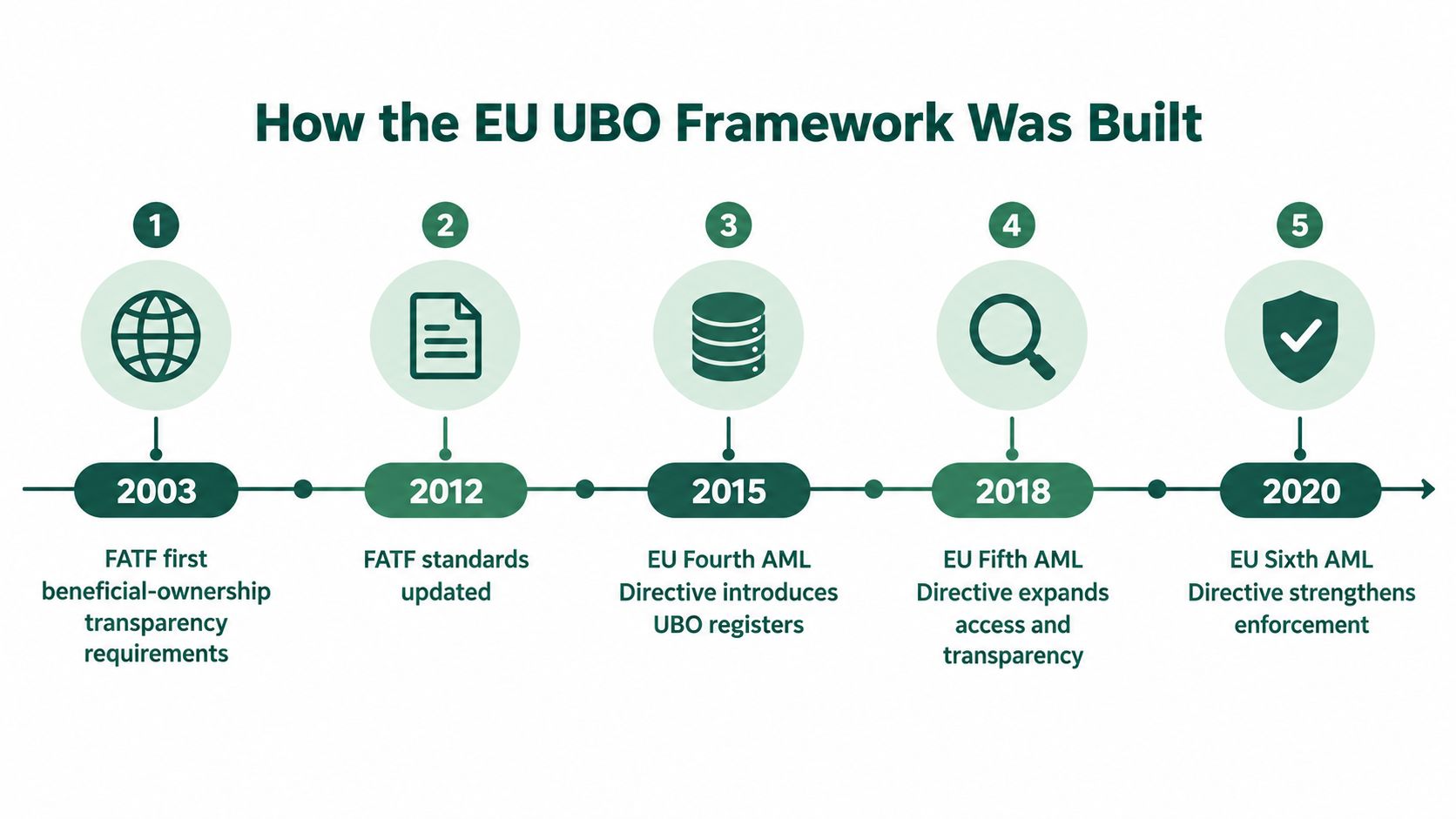
The modern framework did not appear overnight. FATF transparency requirements have existed since 2003, were updated in 2012, and were tightened again in March 2022 under Recommendation 24 and its Interpretive Note, which expect countries to make beneficial-ownership information quickly and efficiently available to competent authorities IMF-hosted FATF guidance. Banks now ask for more than a shareholder list because the global AML standard has moved toward real human ownership, not paper ownership.
The EU moved from identification to access
The EU Third AML Directive, adopted on 26 October 2005, required regulated entities to identify beneficial owners, not just customers. Later directives pushed Member States to record beneficial-ownership information and then make it available through centralized registers. By the Fifth AML Directive, disclosure was no longer just an internal compliance file.
Member States were expected to have those registers operating by 10 January 2020. A March 2020 assessment found that 17 of the EU's 27 Member States still did not have a centralized public register of company beneficial owners Global Witness summary of EU register progress. That gap matters because a legal duty means little if the register does not work in practice.
Why today's onboarding feels strict
The reason is simple. FATF pushed for real human ownership, the EU pushed for registries, and banks now want files that line up with both.
Practical rule: if your UBO declaration would confuse a regulator reading it cold, it will also confuse the bank reviewer.
A sloppy structure might still get incorporated, but it will not survive an actual review. The people approving your account expect the ownership trail to make sense on the first read.
Bulgaria's 10 Percent Tax in a Real Cross-Border Comparison
Bulgaria's headline corporate income-tax rate is 10%, and the annual corporate-tax return is generally filed from 1 March through 30 June of the following year, with final payment due by 30 June PwC tax summary. That is a clean, concrete number, and it's one reason founders compare Bulgaria against higher-rate jurisdictions when planning where to incorporate.
Headline tax is not the full tax outcome
A low rate is useful, but it doesn't answer the key question. Residence, substance, transfer pricing, dividend withholding, VAT, payroll, and personal-tax treatment all still matter. A Bulgarian company can still create tax obligations elsewhere if effective management, employees, permanent establishment, or operations sit in another country.
For founders, the comparison should be broader than corporate tax alone. You need to test the full burden against your home-country controlled-foreign-company rules, how dividends and salary are taxed, your social-security position, and the reporting cost of keeping the structure compliant. A headline rate that looks attractive on a slide can become irrelevant once the rest of the tax stack is added.
Compare the filing profile, not just the rate
| Country | Headline CIT Rate | Typical CIT Filing Window |
|---|---|---|
| Bulgaria | 10% | 1 March to 30 June of the following year |
| Higher-rate comparator markets | Higher than Bulgaria | Varies by country |
| Other EU jurisdictions | Varies by country | Varies by country |
A comparison like this is useful because it shows the shape of the decision, not just the rate. Bulgaria is attractive for qualifying profits, but only if the ownership, management, and tax-residency picture is handled properly from day one. If you want a tighter tax-rate overview, read the detailed note on Bulgaria's corporate tax rate.
The bottom line is blunt. Don't choose a country on headline tax alone, and don't issue invoices before the UBO and tax-residency review is done. A clean structure saves more money than a rushed one ever will.
How FastCorp Handles UBO Declarations During Online Incorporation
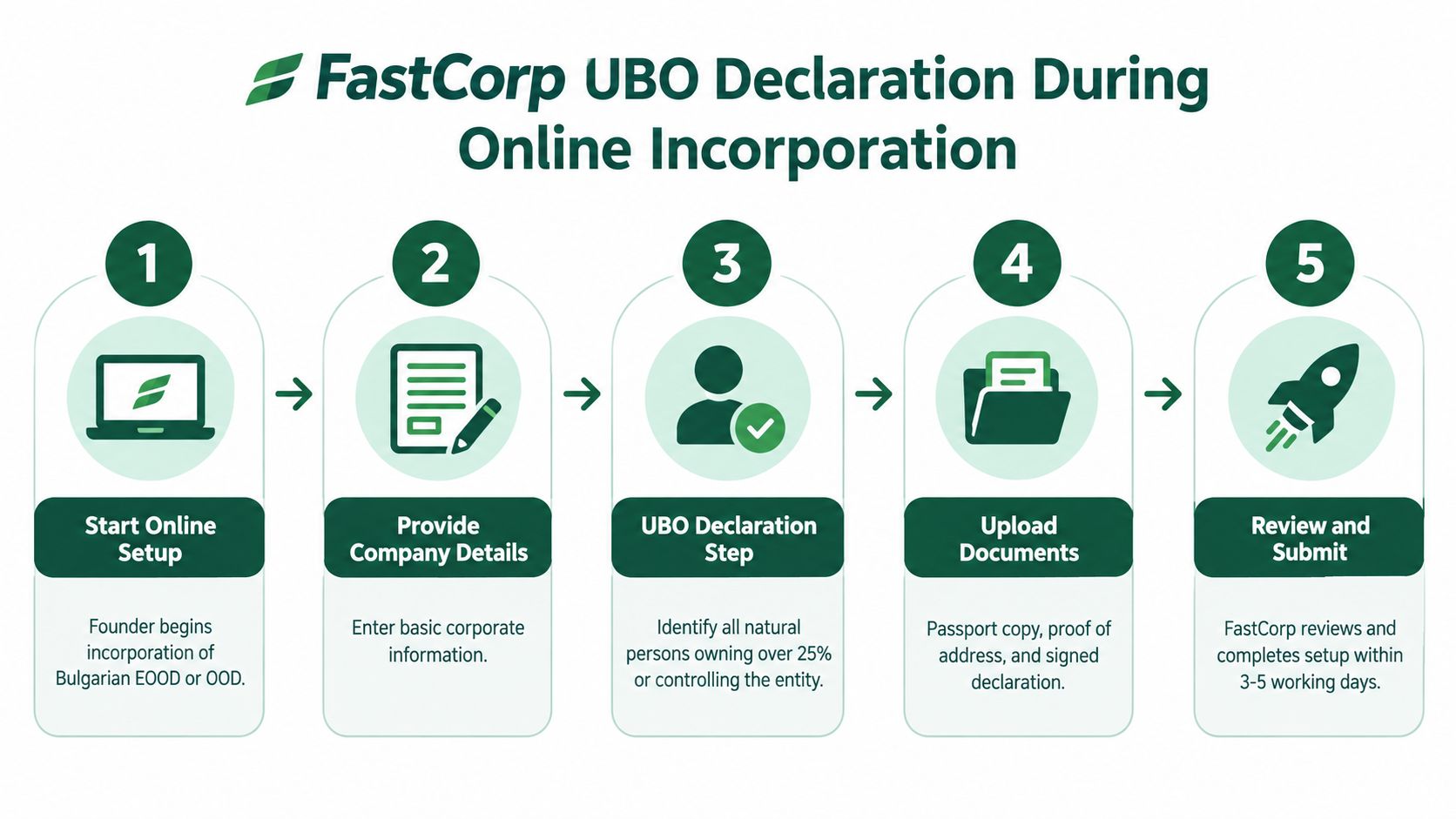
A Bulgarian EOOD or OOD can be set up online, and the UBO declaration should be treated as part of the same workflow, not a separate clean-up job later. FastCorp builds that into the incorporation process, along with identity verification, secure online signing, and submission to the Bulgarian registry. The result is a cleaner file and fewer bank corrections after formation.
What the founder needs to provide
The founder still has to supply the ownership evidence. I'd insist on five items every time:
- Current ownership chart. Show every direct and indirect layer clearly.
- Intermediate entity details. Include each entity's jurisdiction and registration number.
- Shareholder and voting-right evidence. Use the documents that show control.
- Governing documents. Articles, shareholder agreements, and similar control papers matter.
- Written control analysis. Do not leave the conclusion implied, state it.
That package gives the filing reviewer something real to work with. It also reduces the chance that the declared UBO and the share register drift apart when the structure gets more complicated.
What gets prepared on the filing side
The practical value is in consistency. The UBO form, the supporting annexes, and the share-register check all need to tell the same story. If one document says one person controls the company and another document suggests a different conclusion, the bank will spot it fast.
For founders who want the incorporation and the compliance file handled together, online incorporation of a company is the right model to follow. Everything being online matters because it cuts back-and-forth, keeps the paper trail in one place, and makes later updates easier when ownership changes.
The best filing is the one that doesn't need a rescue email after submission.
That's the standard worth aiming for. Online setup is only easy when the ownership data is right the first time, and the control story matches what the registry expects.
Three Mistakes That Bounce UBO Filings and Bank KYC
The same three errors keep showing up. They're boring, which is exactly why they're dangerous.
Treating the largest shareholder as the automatic UBO
The symptom is a filing that names whoever holds the biggest stake and stops there. The cause is a lazy reading of the threshold rule, where nobody checks indirect control or other rights. The fix is simple, trace the chain and ask who can direct decisions.
Using nominees without disclosing the nominator
The symptom is a file with a nominee director or shareholder and no explanation of who stands behind that role. The cause is a false assumption that legal title is enough. The fix is to disclose the nominee status and the nominator's identity, then keep the control analysis in the file.
Assuming a Bulgarian company changes your tax residence automatically
The symptom is a founder who thinks incorporation alone settles personal or corporate tax residence. The cause is mixing company formation with tax status. The fix is to review residence, substance, and cross-border tax exposure before the first invoice goes out.
If your bank account process is getting stuck, the ownership file is often the reason. The same applies when a non-resident founder tries to open a business account and the reviewer wants more than an incorporation certificate, as covered in this banking guide. A stale ownership chart can still pass a casual look, but it won't pass a real review.
Refresh the ownership chain whenever shares, directors, voting agreements, or control rights change. That's the habit that keeps the declaration accurate and keeps the KYC team from bouncing you back for avoidable corrections.
If you want the incorporation, UBO declaration, and banking setup handled in one clean workflow, FastCorp can do that for a Bulgarian company entirely online. It keeps the ownership file aligned with the registry, the bank, and the tax setup, which is exactly what you need when the first compliance question lands on your desk. Visit FastCorp and start with a structure that won't trip over its own paperwork.