What Are Corporate Taxes and How Do They Work
What Are Corporate Taxes. Learn what corporate taxes are, how they are calculated, and why the EU's lowest rate matters. A practical guide
Corporate tax is a government charge on a company's taxable profit, and the 10% headline rate in Bulgaria is not the same number most companies pay because taxable profit is adjusted for deductions, depreciation, and losses. If you're a founder, the key question isn't just what the rate is, it's how that rate interacts with the tax base, filings, and cross-border rules.
Table of Contents
- The Big Picture of Corporate Taxes
- How Corporate Tax Is Computed Step by Step
- Why the Headline Rate Is Not the Effective Rate
- Comparing Corporate Tax Rates Across the EU
- How Founders Handle Corporate Tax Online
- What Founders Get Wrong About Going Low-Rate
- Putting It All Together for Your Decision
- Founder Questions About Corporate Tax
The Big Picture of Corporate Taxes
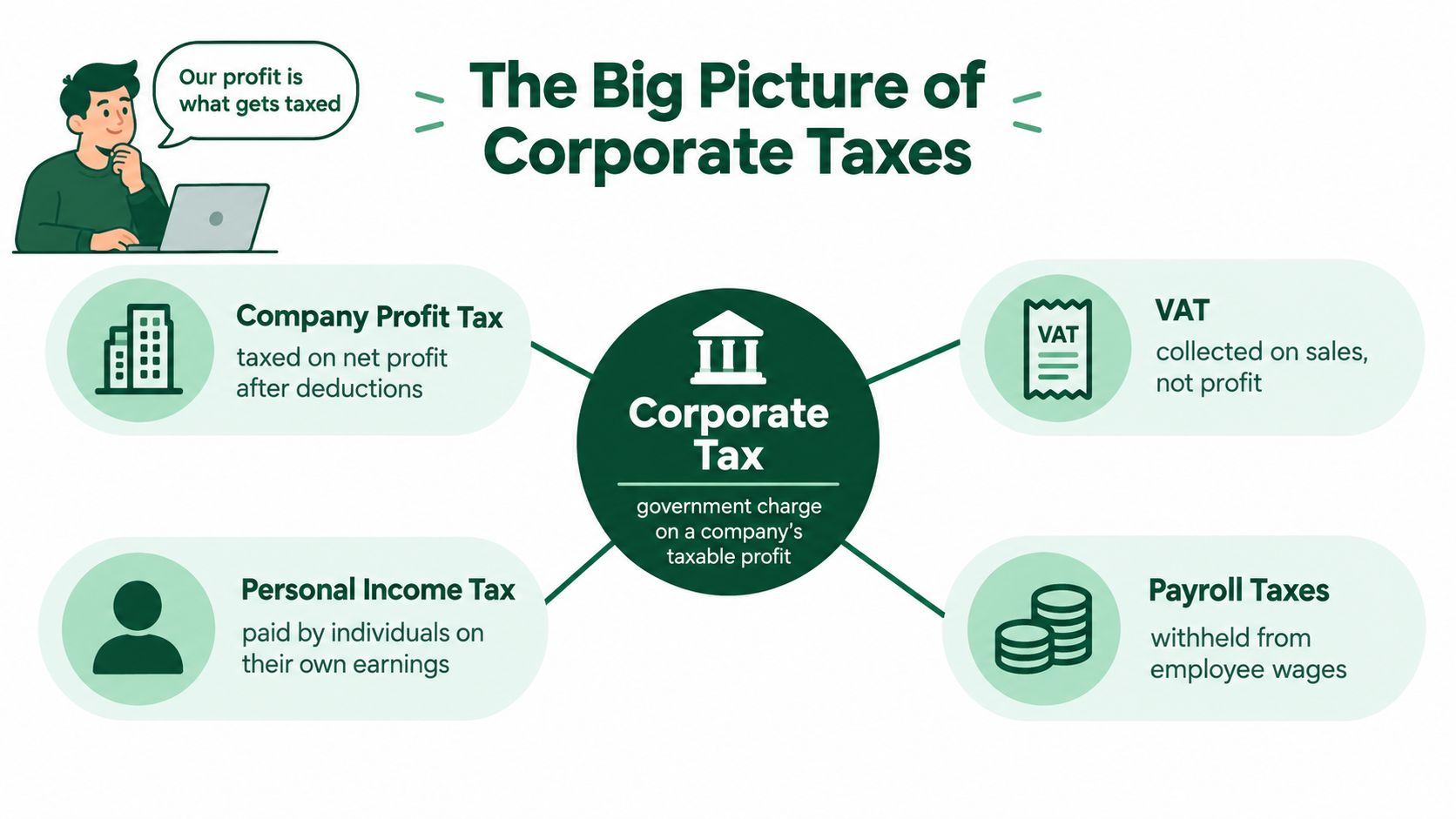
A lot of founders first meet corporate tax when they register a company and ask a simple question, “What does the state tax?” The answer is cleaner than you might expect. Corporate tax is a charge on company profit, not on sales, not on payroll, and not on the money sitting in your bank account.
That distinction matters because different taxes hit different parts of the business. VAT is collected on sales, personal income tax is paid by individuals on their own earnings, and payroll taxes are tied to wages. Corporate tax is aimed at the company's taxable profit after the law adjusts the accounting result.
Rate, base, and compliance are separate things
The working model is simple. First comes accounting profit, then the tax rules adjust that figure into taxable profit, and only then does the statutory rate get applied. A country can advertise a low headline rate and still produce a different real burden because deductions, depreciation rules, loss carryforwards, and incentives change the base.
Practical rule: When someone quotes a corporate tax rate, ask what the tax base looks like before you compare countries.
Bulgaria is a useful reference point because its standard corporate income tax rate is 10% and is imposed nationally, which makes the headline number easy to see. The catch is that the number on the page is only the starting point, not the final bill. For a founder, that means the essential work is not memorizing a percentage, it's understanding which profits are taxable and which records support the return.
How Corporate Tax Is Computed Step by Step
A founder can usually think about corporate tax as a bridge from the P&L to the return. Your accounting system gives you one profit figure, but tax law can change it before the state taxes it. That's why two businesses with the same book profit can end up with different tax bills.
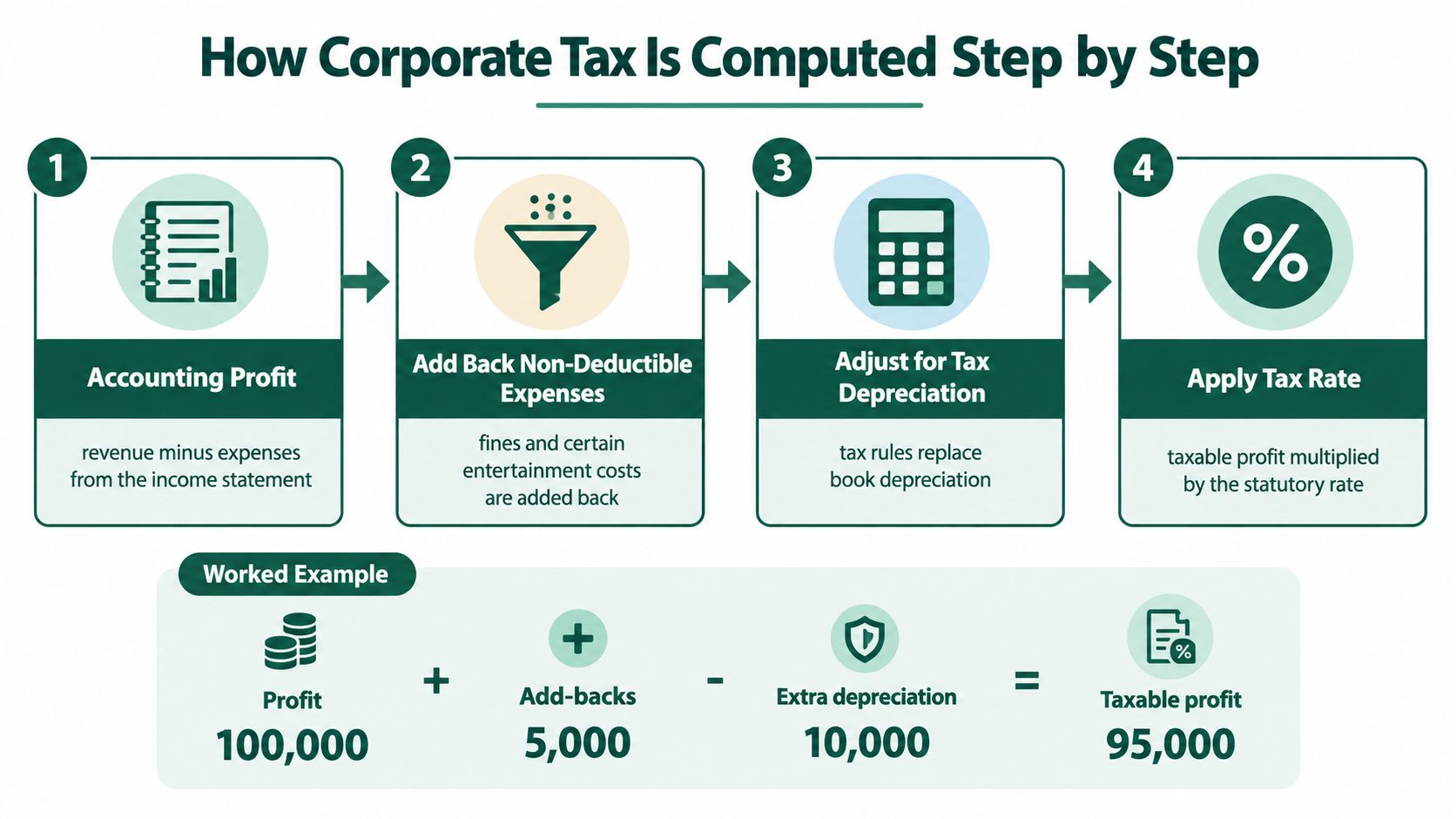
The basic sequence is straightforward. Start with accounting profit, then add back items the tax code doesn't allow, then replace book depreciation with tax depreciation where required, and then apply the statutory rate to the resulting taxable base. Under Bulgarian rules, the tax return is filed electronically by 30 June of the following year, and some companies also make advance payments depending on turnover thresholds, so the tax number is only one part of the process Bulgaria's corporate income tax filing rules.
A simple Bulgaria-flavoured example
If a company has €100,000 of accounting profit, tax adjustments can change that number before the tax authority gets involved. Suppose allowable deductions and timing differences bring the taxable base down to €90,000. At Bulgaria's 10% corporate tax rate, the bill is €9,000 before any incentives, withholding taxes, or other obligations.
That's the mental model founders should keep in mind. The tax authority doesn't just look at your revenue minus expenses and accept the result at face value. It looks at the evidence behind the numbers, the classification of expenses, and the local tax rules that modify the P&L result.
Keep your bookkeeping clean enough that you can explain every adjustment without guessing.
If you want a deeper look at the return itself, this overview of the corporate tax return process is a useful companion to the calculation.
What can change the final cash outflow
The final amount paid can still move after the core tax calculation. Withholding taxes on dividends, interest, or royalties can affect cash leaving the company, and advance payments can shift timing rather than total liability. Incentives can also reduce the amount due, which is why a founder should never equate “taxable profit times headline rate” with the full picture.
Why the Headline Rate Is Not the Effective Rate
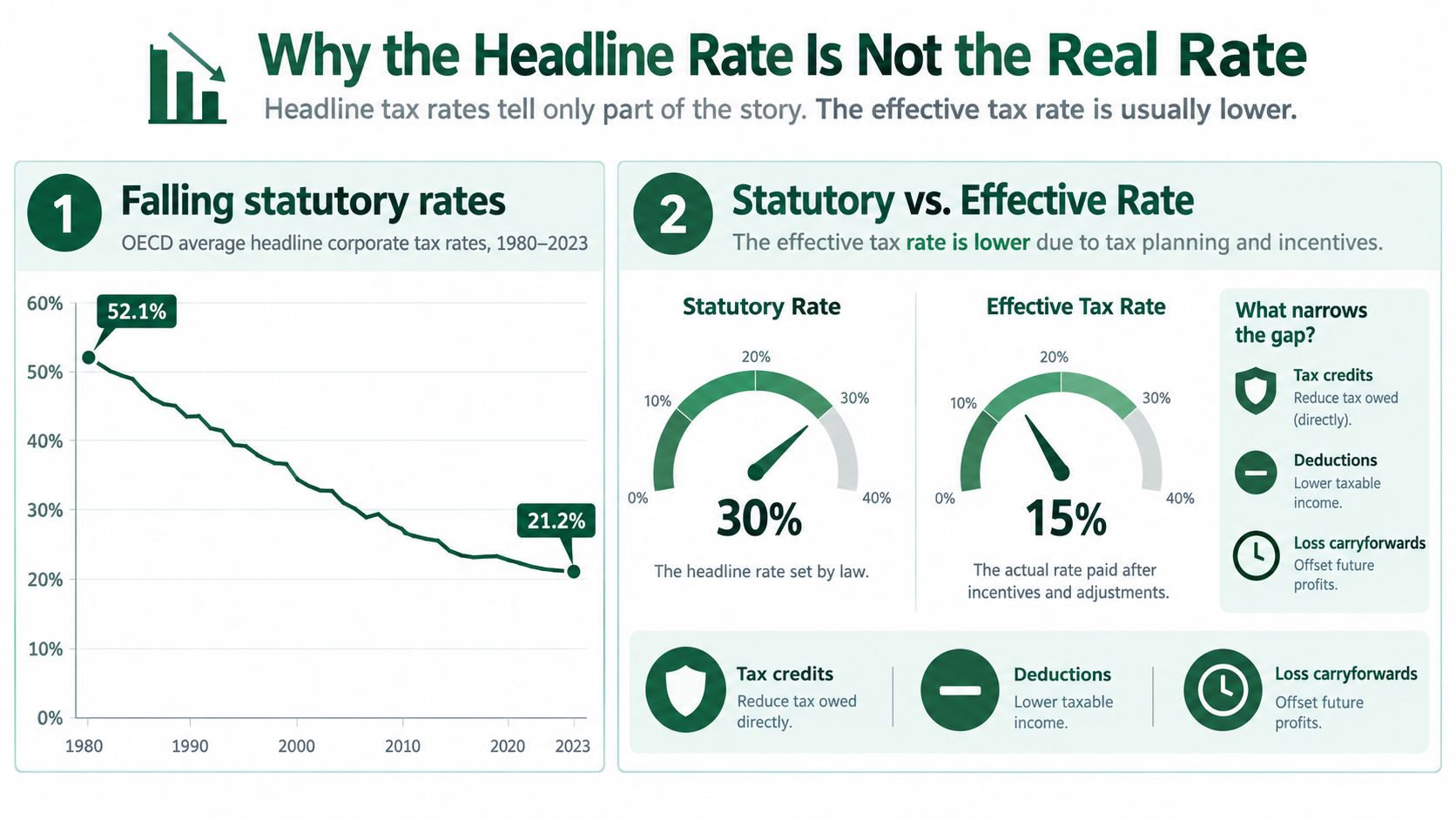
A statutory rate is the number written into tax law. An effective tax rate is what a company ends up paying after the tax base has been adjusted. The two are connected, but they are not the same, and founders run into trouble when they treat them as identical.
The OECD reports that average combined statutory corporate income-tax rates across jurisdictions in its Inclusive Framework fell from 28.0% in 2000 to 21.7% in 2019, a decline of 6.3 percentage points. OECD data also show that the average worldwide statutory rate stabilized at about 21.1% in the three years before the 2024 edition, after a long downward trend from 28% in 2000 OECD corporate tax statistics.
What pushes the effective rate up or down
The gap between the headline number and the amount paid comes from the rules that shape taxable profit. Depreciation schedules, deductible expenses, tax credits, loss carryforwards, transfer pricing, and withholding taxes on cross-border payments all affect the outcome. A country can advertise a low rate and still produce a heavier burden if deductions are limited or the tax base is narrow in the wrong places.
For founders reading rate charts, start with a full overview of corporate tax rates, then keep one question in mind: what is the company allowed to deduct, defer, or credit before the percentage is applied? That question usually explains more than the rate alone.
Bulgaria is a good reference case here. Its 10% corporate rate is easy to quote, but a founder still has to handle the filing mechanics, the local tax base, and cross-border substance. A low percentage does not remove the need to check loss carryforward rules, dividend withholding, royalty withholding, VAT registration, and the evidence behind each adjustment.
For larger multinational groups, the picture changes again. Under the OECD Pillar Two Global Anti-Base Erosion rules, groups with consolidated revenue of at least €750 million are subject to a 15% minimum effective tax framework OECD global minimum tax. A low statutory rate can still be useful for smaller firms, but it is only one part of the analysis for in-scope multinationals.
Practical rule: Compare the tax base and the compliance rules before you compare the headline rate.
Comparing Corporate Tax Rates Across the EU
What does a low corporate tax rate buy you? Bulgaria's 10% flat rate is easy to quote, but a founder still needs to compare the tax base, withholding rules, local filings, and the amount of evidence required to support each deduction. Two countries can look similar on paper and still create very different filing work in practice.
Selected statutory corporate tax rates by jurisdiction
| Jurisdiction | Headline corporate tax rate | Notes for founders |
|---|---|---|
| Bulgaria | 10% | Flat national rate, useful reference point for EU comparisons. Check VAT, withholding, and cross-border substance. |
| Hungary | 9% | Compare the tax base and filing obligations, not just the percentage. |
| Ireland | 12.5% on trading income, 15% for in-scope large groups | Rate depends on the type of income and, for some groups, the minimum tax framework. |
| Germany | Around 30% combined | Local and municipal layers can affect the effective burden. |
| France | 25% | Compare base rules, local charges, and cross-border withholding. |
Bulgaria stands out because the rate is flat and national, while many other systems layer extra local or municipal elements on top of the headline figure. That said, a low rate does not remove the need to check loss carryforward rules, dividend withholding, royalty withholding, VAT registration, and whether your home country still taxes foreign profits or distributions. If you are comparing EU company options, those details often matter more than the percentage alone. See this overview of the lowest corporate tax rate in Europe for the Bulgaria reference point.
The practical comparison checklist
Start with the tax base. A broad base can tax more of the company's profit than the headline rate suggests, while a narrow base may leave more room for deductions or timing differences. Then check whether dividends or interest trigger withholding tax, because a low corporate rate can be offset when money leaves the company.
Related-party transactions need clean records. If a founder pays a group company, a director, or a foreign supplier, the file should show what was bought, why the price is reasonable, and how the payment was classified. Cross-border substance matters too. A company that exists on paper but cannot show real activity, management, or supporting records may face problems in the country of incorporation and in the owner's home country.
A low rate works only when the company can support it with the right paperwork, substance, and filing discipline.
How Founders Handle Corporate Tax Online
Most founders don't want a tax lecture, they want a workflow that doesn't break. The good news is that corporate tax compliance is increasingly digital. OECD tax administration data show that roughly 95% of business taxpayers filed returns electronically across reporting jurisdictions in recent years, and 98% of administrations reported that online registration was available OECD Tax Administration 2025.
What the online workflow usually looks like
A founder typically starts with digital incorporation, then connects bookkeeping software, then keeps invoices, payroll records, and expense evidence in one place. VAT filings, annual corporate tax returns, and payments can then be handled through online portals, provided the company has the right credentials and a functioning bank account.
In Bulgaria, that online path is practical rather than theoretical. FastCorp handles company formation and ongoing compliance for Bulgarian limited companies, including incorporation, EU VAT registration, banking support, bookkeeping, VAT returns, and annual corporate tax filings. The basic idea is simple, one provider can handle the company setup and the recurring filing work without forcing the founder to chase multiple vendors.
What to keep ready all year
- Invoices and receipts: Keep every business expense supported by documentation.
- Bank statements: Reconcile payments so the accounting file matches the cash flow.
- Contracts and intercompany records: Show why related-party transactions are priced the way they are.
- Payroll data: Keep salary and withholding records current.
- VAT evidence: Store the documents that support input and output VAT positions.
The process only feels easy when the evidence is orderly. If the records are missing, the portal doesn't help much, because the return still has to be defended if the tax authority asks questions.
What Founders Get Wrong About Going Low-Rate
The biggest mistake founders make is thinking the lowest headline rate solves the tax problem. It doesn't. A low-rate jurisdiction can still create work if the company has weak bookkeeping, unclear substance, messy intercompany charging, or a mismatch between the company's structure and the founder's home-country tax position.
PwC's 2025 benchmark found that 50% of tax-function time was spent on compliance, and 79% of executives expected workload to rise over the following one to three years PwC tax benchmark survey. That's the part many founders underestimate. A low rate can be attractive, but someone still has to document it properly every month.
Common traps in low-rate setups
Treating a registered address as substance is a classic mistake. So is assuming that the company can ignore VAT, forget dividend withholding, or treat transfer pricing as something only large groups need to worry about. The founder's home country may also tax the profits or distributions even when the company is abroad.
Another mistake is separating tax from operations. The bank account, the payroll process, the invoices, and the accounting file all feed the tax return. If one piece is weak, the rest becomes harder to defend.
The low-rate country is rarely the hard part. Keeping the file clean is.
A founder who wants predictability should think like an auditor, not a tourist. The company needs records, real activity where required, and a filing rhythm that doesn't depend on memory.
Putting It All Together for Your Decision
What matters more than the headline rate? The answer is the full tax path your company will follow. Corporate tax applies to taxable profit, so deductions, depreciation, losses, and cross-border rules can change the effective rate from the number on paper. For larger groups, the OECD's 15% minimum framework can affect the analysis again, while Bulgaria's 10% flat rate remains a useful reference point for founders comparing EU options.
A founder should check the whole setup, not only the rate. The key question is whether the tax base, filings, bank setup, and local substance all fit the way the company will operate.
- Map your profits and activities. Decide where the business is managed, invoiced, and paid.
- Test the tax base. Check how depreciation, losses, and deductible expenses are handled.
- Review cross-border issues. Look at VAT, withholding tax, and home-country residency rules.
- Build the filing workflow. Make sure bookkeeping, banking, and returns can run online without gaps.
If you want an EU company structure that connects incorporation, banking, VAT, bookkeeping, and annual tax filings in one workflow, a Bulgaria-based setup handled end to end is worth reviewing before you commit. The right structure is not just about a low rate. It is about keeping the compliance chain predictable from day one.
Founder Questions About Corporate Tax
Does my home country decide where profits are taxed? Often, yes, at least in part. Tax residence and management location can matter just as much as where the company is incorporated, so founders should check both the company's local rules and their own country's rules.
How does VAT fit into corporate tax? VAT is separate. It's a tax on consumption, while corporate tax is a tax on company profit, so a business can owe one, the other, or both.
What about dividends paid by a Bulgarian company to a non-resident owner? Dividend withholding can apply, and the exact result depends on the local rules and any treaty relief that may be available.
Does Pillar Two affect a small single-shareholder company? Usually not. The OECD minimum-tax framework is aimed at large multinational groups meeting the revenue threshold, not ordinary small companies.
FastCorp helps founders set up Bulgarian companies, register for EU VAT, open banking, and keep corporate tax filings on track without making the process harder than it needs to be. If you're comparing EU options and want a structure built around Bulgaria's 10% corporate tax environment, start with FastCorp and see how the setup fits your plans.