VAT Return Filing Monthly or Quarterly: Which Fits You
Compare VAT return filing monthly or quarterly: deadlines, workload, cash flow and EU rules. Find your schedule and file on time.
The Spanish Tax Agency recorded 2,982,831 VAT returns in 2024. That volume should reset how you think about VAT return filing monthly or quarterly. Frequency isn't a lifestyle choice you toggle in your accounting software. The country that registered you for VAT sets the tax period, and you file on that calendar whether the admin feels light or not.
A SaaS founder with a Sofia company, a UK repayment trader, and a US seller can share one bookkeeping app and still run three different clocks. Name the country on the certificate first. The schedule follows from that line, not from the filing rhythm you'd prefer.
Table of Contents
- Which VAT Filing Schedule Applies in Each Country
- Monthly Versus Quarterly Filing in Cash and Workload
- How to Choose Your Schedule Step by Step
- Where Monthly Filing Pays Off and Where Quarterly Fits
- Practical Tips to File Every Return on Time Online
- Confirm Your Filing Schedule Before Your Next Deadline
Which VAT Filing Schedule Applies in Each Country
There is no universal choice. The schedule comes from the country of VAT registration and the tax period on that registration, not from how often you'd like to close the books. One accounting file can still produce several calendars when you sell in several countries.
| Jurisdiction | Default cycle | Filing deadline | Basis |
|---|---|---|---|
| Bulgaria (standard registration) | Monthly, every calendar month | 14th of the following month, with ledgers and any VIES declaration | Ministry of Finance |
| European Union framework | At least annual; many states use monthly or quarterly | No later than two months after the period ends | EU VAT Directive, Article 252 |
| United Kingdom | Quarterly for most businesses; monthly by choice | 1 calendar month and 7 days after the period ends | HM Revenue & Customs |
| United States | No federal VAT; state sales tax rules apply | The due date set by the state that taxes the sale | OECD comparative material |
Why each row looks different
Under Article 252 of the EU VAT Directive, every Member State must require VAT returns at least annually, while many countries require them monthly or every three months. The European Commission guidance on VAT returns notes that businesses with higher turnover generally face more frequent filing, and that a deadline normally can't fall later than two months after the period ends. Quarterly filing isn't an EU-wide default. A monthly or quarterly declaration also doesn't wipe out a separate annual return where a country still wants one. Jurisdiction, assigned tax period, deadline, and schemes such as the One Stop Shop are the variables that matter.
Bulgaria is the strict row. The Bulgarian Ministry of Finance states that the VAT tax period is one calendar month. Registered persons submit the reporting declaration, the sales and purchase registers, and any VIES declaration by the 14th day of the following month, and they submit that pack even when no supplies were made. January is a 14 February job. That's twelve cycles, and a nil month still sits on the list.
The UK row is a real choice for many traders. Quarterly is the usual assignment, and monthly is something you can request. The US row is a different tax. The OECD Consumption Tax Trends 2024 report treats VAT as widely adopted and the United States as the major exception, with no federal VAT and state retail sales taxes instead. The same comparative material identifies monthly or quarterly arrangements in Czechia and Slovakia. When you add another registration, read our note on VAT filing requirements and give that country its own row.
Practical rule: If the certificate says monthly, no software setting turns it into a quarter.
Three checks you can finish today. Read the period printed on the VAT registration certificate. Log in to the tax portal and confirm that period is still the live one. Note every country where sales, stock, or staff create a separate obligation, because that country gets its own deadline.
Monthly Versus Quarterly Filing in Cash and Workload
| Factor | Monthly filing | Quarterly filing |
|---|---|---|
| Returns per year | 12 | 4 |
| Typical deadline | 14th of the following month in Bulgaria | Within two months after quarter end where the EU ceiling applies |
| Records to close per return | One month of invoices and purchases | Three months of invoices and purchases |
| Refund timing for input VAT | Sooner, every month | Later, at quarter end |
| Error exposure | Caught within weeks | Can run for up to three months |
| Admin effort | Heavier, with twelve cycles | Lighter, with four cycles |
Twelve returns or four. That's the workload gap, and it's the wrong row to lead with if cash is the constraint. The row that should drive the decision is refund timing when you reclaim VAT, and payment size when you owe it.
What each schedule does to cash
Monthly filing means 12 cycles a year. Quarterly filing means 4. A coding error on a monthly return surfaces within weeks, while the same error on a quarterly return can run for up to three months before the next submission forces a look. Businesses that regularly reclaim input VAT usually see money back sooner on a monthly cycle. Businesses with steady VAT payable often find four closes easier to staff, with the same annual tax landing in fewer, larger payments.
HM Revenue & Customs annual UK VAT statistics show that in the United Kingdom, approximately 70% of taxpayers receiving regular VAT repayments submitted monthly returns in 2023–2024, while most of the remaining 30% submitted quarterly returns. Repayment traders are already voting for the shorter loop. If you consistently owe VAT, don't copy them. You'd be buying eight extra deadlines and no faster cash.
One quarter of VAT in a single payment
Say a company collects €8,000 of net VAT each month. On a quarterly calendar that becomes one €24,000 payment. Monthly filing splits the same tax into three payments of €8,000. The annual total doesn't move. The reserve does. A quarterly payer who spent the VAT slice in month one is short when the quarter closes, especially if customers pay late.
Move the VAT portion of every collected invoice into a separate account the day the cash arrives. That balance isn't spending money.
Build the next twelve months on one sheet. Expected output VAT, expected input VAT, net payable or repayable. Then rank three things and let the ranking pick the schedule where the country allows a choice. Cash asks whether you need refunds inside a month. Time asks whether someone can close the books twelve times without a scramble. Accuracy asks whether an error can safely wait a quarter.
If you're mostly domestic, invoices are steady, and input VAT is a small slice of what you charge, quarterly is the better fit wherever the authority allows it. You aren't buying a cash advantage. You're buying fatigue. Where refunds are the normal result, monthly is the schedule I recommend. Waiting a quarter to recover VAT you already paid to suppliers is an interest-free loan you handed the tax office. Take the twelve filings, and fund the reserve every month so the payment date never depends on the next customer.
How to Choose Your Schedule Step by Step
Your filing schedule is set by the country that issued your VAT number, not by what suits your bookkeeping habits. Work through these steps in order, because founders who skip ahead are the ones who discover a second registration after the invoices have already gone out.
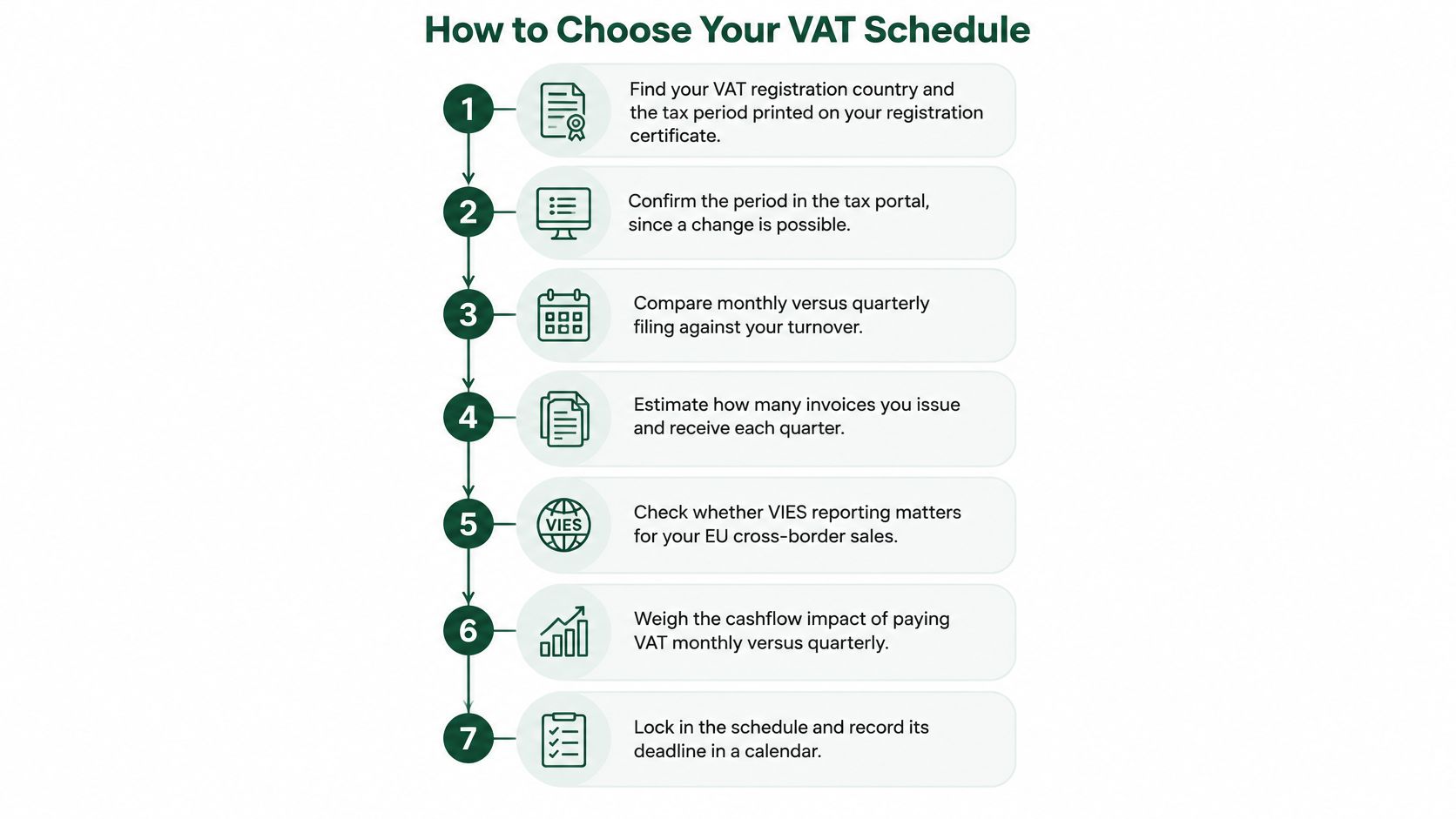
- Find the country and the printed period. Open the VAT registration certificate and write down the country plus the tax period. Every later argument is noise until those two lines are clear.
- Confirm the period in the portal. A change is possible only where that country's rules allow one. Bulgaria's monthly period is fixed, so don't sketch a quarterly switch the revenue portal won't offer.
- Estimate annual taxable turnover and typical input VAT. Large turnover and regular refunds usually push toward more frequent filing. A small domestic practice with little input VAT doesn't get that push.
- Check special schemes. The One Stop Shop can cover certain EU cross-border sales to consumers. It leaves the domestic return attached to your company registration unchanged.
- List every country where you sell, store stock, or have staff. Put frequency, deadline, and any electronic reporting duty in one matrix. A blank cell is an unknown obligation, not a free pass.
- Decide, then test the result on a Bulgarian calendar. Where your country allows a choice and you reclaim VAT often, pick monthly. For low, mostly domestic volume, pick quarterly where it's allowed. For a Bulgarian VAT-registered company the benchmark isn't a choice. The Bulgarian Ministry of Finance sets monthly filing: the return, sales ledger, purchase ledger, and any VIES declaration go in electronically by the 14th day of the following month. Payment is due the same day, a month with no taxable supplies still needs a return, and no extension is provided. January's return and any VAT due are generally handled by 14 February.
- Set a reminder seven days before each deadline. A week is enough to chase one missing invoice. Leave the night before the 14th for nothing but hitting submit.
That Bulgarian window is roughly two weeks after month-end across 12 cycles. Cut documents off, reconcile input VAT, check intra-EU data, and keep settlement cash aside even when collections lag. A quarterly admin habit won't save a filing the authority won't postpone.
Where Monthly Filing Pays Off and Where Quarterly Fits
Take a non-resident founder with a Bulgarian company selling SaaS across the EU. Monthly Bulgarian filing is fixed, and VIES matters whenever intra-EU supplies belong on that declaration. The product is digital, the buyers sit in several Member States, and the certificate is Bulgarian, so the calendar is Bulgarian. Our guide to VAT for digital services is the piece to read when those sales cross a border and the invoice treatment has to match.

Bulgaria's monthly rule is a national requirement, not a worldwide standard, so the schedule of each customer, warehouse, or marketplace country must be checked separately.
Stock in several countries. An e-commerce seller holding inventory in more than one Member State can end up with more than one VAT registration. Monthly filing in each registration country keeps input VAT refunds moving, instead of waiting on the slowest quarter in the group. Marketplace sales don't erase a local registration created by stock. They add a reporting line you still have to map.
A local consultant with steady domestic invoices. Little input VAT, no overseas warehouse, no EU dispatch of goods. Where the authority allows quarterly filing, take it. You aren't a repayment trader, and twelve closes won't buy faster cash. They'll only multiply the evenings you spend reconciling a simple practice.
A short Sofia presence. A touring events company that opens a brief base in Sofia still has to ask whether each period needs a return, including a period with no ticket revenue. Registration creates the duty. A quiet month doesn't cancel it by itself, and a tour that leaves town doesn't file itself either.
Use the country matrix so each market shows registration, frequency, deadline, and nil-return duty in one place. If a warehouse, a marketplace, or a customer country has a blank row, you don't know which schedule applies there yet. Fill the row before the next invoice, not after a reminder from the portal.
Practical Tips to File Every Return on Time Online
Online filing is standard, and it's straightforward when the records are ready. Each country runs its own portal, its own format, its own clock.
The OECD's Consumption Tax Trends 2024 reports that 35 countries require electronic transactional reporting, 17 require systematic transmission of transaction information to tax authorities, and 11 require transmission in near real time. Some systems want periodic returns, electronic ledgers, or transaction-level data. Your job is to make each portal boring.
- Close the books by the fifth working day. You then have about a week before a mid-month deadline. A close on the 13th is how a return goes in wrong.
- Collect invoices and purchase documents as they happen. Late paperwork is the usual reason a filing gets rushed. Chase a missing bill in week one, while the supplier still remembers the job, and the return builds itself instead of being assembled at midnight.
- Set up the electronic signature and portal access before the first deadline. Authentication is often the slowest step, and it has nothing to do with the VAT maths. A qualified signature that arrives on filing day is already late.
- Keep records in software that exports the ledger format the portal wants. Re-keying a month of invoices into a browser form is how totals drift. Match what you store to EU VAT invoice requirements so the document and the return tell the same story.
- Map each jurisdiction's portal, authentication method, data format, and deadline. Don't assume the Bulgarian login, file type, or calendar works in the next country. Write the map once and reuse it.
- Run the monthly checklist in under an hour. Confirm the cut-off, check the ledgers, file the return or file a nil return, and set the next reminder. If that hour blows up, the records weren't ready. Fix collection, not the night.
Confirm Your Filing Schedule Before Your Next Deadline
If the business is in Bulgaria, or you're planning to form one, the monthly schedule is fixed. Build a monthly close into the setup from the first period. Don't design cash flow around a quarterly habit the registration won't allow.
We form Bulgarian limited companies fully online, and VAT registration is included in all company formation packages. Remote company formation takes 3–5 working days after all required documents and payments are received. Bookkeeping, VAT returns, and annual filings are available as optional ongoing compliance after that, and the process is handled online. When the matrix shows more than one monthly or quarterly market, ask us to put every deadline on one calendar so a second country doesn't slip past the 14th of somebody else's month.
You remain legally responsible for the company's activities, tax obligations, and reporting accuracy. FastCorp isn't a law firm or a tax authority. We prepare and submit from the records you provide. We don't replace your duty to keep those records right, and a filed return is only as clean as the invoices behind it.
Three moves before the next deadline:
- Confirm your registration country on the certificate, not from memory or from the last invoice template.
- List every market you sell in, including warehouses, marketplaces, and any short-term presence.
- Start the setup, or ask about filing support, once those two lists exist and the first deadline is in the diary.
A calendar with one country's deadline and a blank for the rest is how a second return gets missed.
FastCorp forms Bulgarian companies and can keep the monthly VAT return, ledgers, and related filings on the calendar once you're registered. If you're weighing a Bulgarian monthly cycle against other countries' quarterly rules, we'll line the deadlines up with the registrations you hold. Visit FastCorp to start the company setup or to ask about filing support.