Non Resident Business Bank Account: 2026 Founder Guide
Learn how a non resident business bank account works in 2026: eligibility, documents, remote opening, fees and practical tips for international founders.
You've already done the hard part. The company exists, the incorporation certificate is in hand, and now the business needs the one thing that makes it usable, an account that can receive client money, pay suppliers, and survive compliance checks without stalling the operation.
That's where most non-resident founders get blindsided. They treat incorporation and banking like the same milestone, then discover they're separate problems with different rules, different providers, and different outcomes. The right move is to decide early whether you want a Bulgarian bank or an online EU IBAN provider, then build the file that matches that route.
Table of Contents
- The Bottleneck Most Founders Underestimate
- What a Non Resident Business Bank Account Is
- Documents and KYC That Actually Move an Application
- Bulgarian Banks vs Online EU IBAN Providers
- Tax Comparison That Actually Changes the Decision
- Remote Onboarding Without the Runaround
- After Approval What Changes
- A Practical 72-Hour Plan to Open the Account
The Bottleneck Most Founders Underestimate
The main bottleneck isn't forming the company. It's turning that company into something that can move money today and still remain bankable six months from now.
If you're a non-resident founder, you're probably in a familiar place right now. The entity is registered, the website is live or nearly live, invoices are waiting, and payment details are the last missing piece. That gap feels small on paper and brutal in practice.
Start with the banking question, not the incorporation story
A usable non resident business bank account is a compliance relationship first and a payment tool second. Banks and payment providers want to understand who controls the company, where the owners are tax-resident, why the company belongs in the chosen jurisdiction, and how money is expected to move. That's why an account opening file has to answer more than “does the company exist.”
The cleanest way to approach it is to separate the decision into two tracks. One track is a traditional Bulgarian bank, useful when you want local credibility, broader cash access, and a relationship inside Bulgaria. The other is an online EU IBAN provider, useful when speed, remote onboarding, and software-friendly payments matter more than branch access.
Practical rule: don't ask “Can I get an account?” first. Ask “Which type of account fits my business model, and what evidence proves that story?”
What this article will and won't do
It won't pretend every provider behaves the same. It won't sell incorporation as if that automatically solves banking. It will give you the practical split that matters, what documents move applications forward, how Bulgaria compares on tax, and what changes after approval.
Bring a consistent company file, a believable transaction story, and a clear answer to why the account jurisdiction makes commercial sense. If those three things are weak, the application will drag no matter how polished the form looks.
What a Non Resident Business Bank Account Is
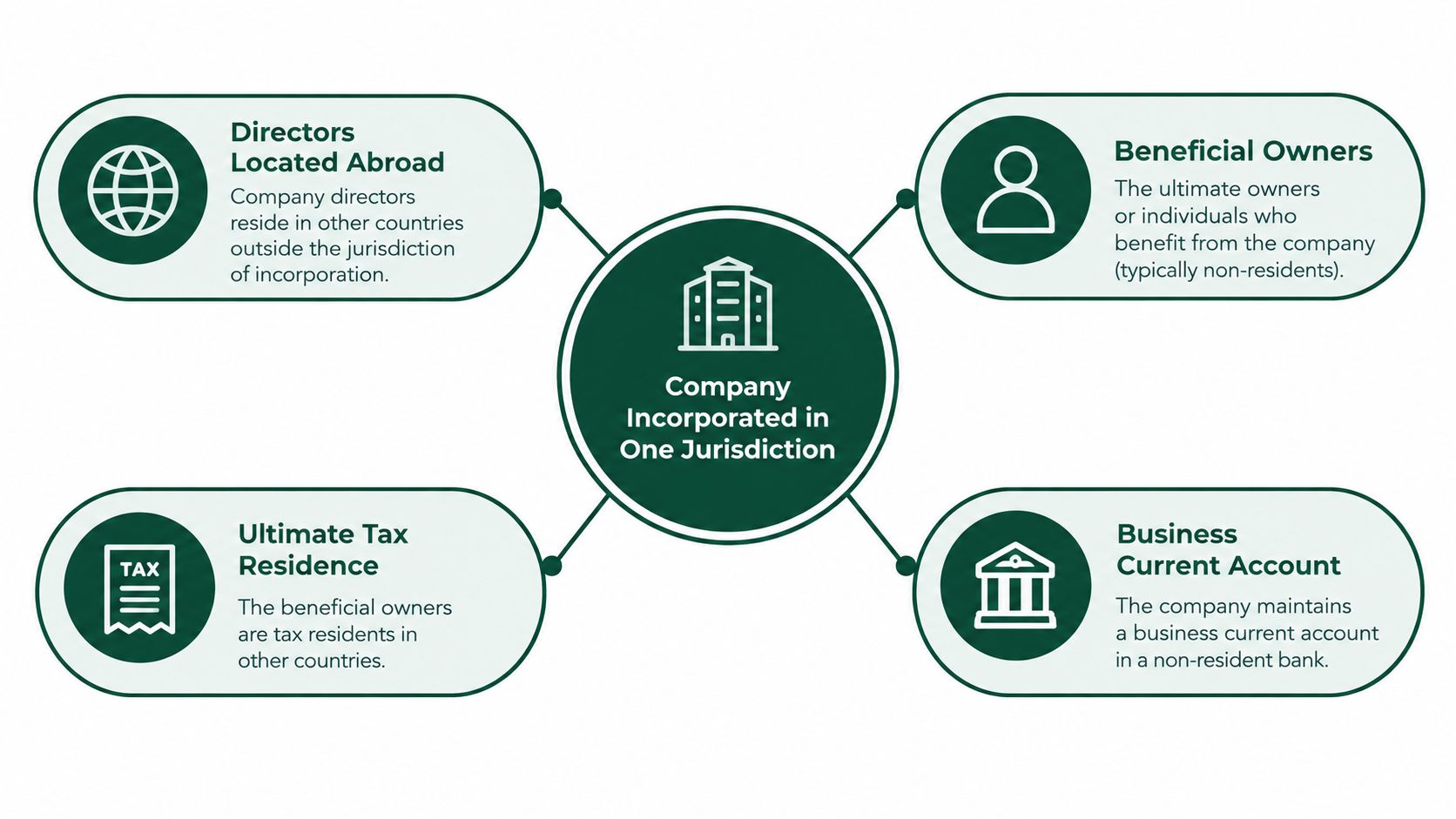
A non resident business bank account is a company current account opened in one jurisdiction while the people controlling it, directors, beneficial owners, or tax-resident controllers, are based elsewhere. That setup puts the account inside a reporting and due-diligence framework. It also explains why the opening file has to answer who controls the company, where those people are tax-resident, why the company belongs in the chosen jurisdiction, and how money will move. The OECD approved the Common Reporting Standard on 17 January 2014, and by December 2019, 97 jurisdictions had started exchanging information under it, with about 6,100 bilateral exchanges in 2019, according to OECD data in the framework document linked here: OECD CRS framework and exchange data47/en/pdf).
The EU turned that global model into a binding regional system through DAC2. Member States exchange reportable financial-account data annually, including balances and investment income. The first EU exchanges took place in September 2017, under the Directive on Administrative Cooperation, as summarized here: EU DAC2 administrative cooperation.
Bank account, EMI account, and payment account are not the same thing
A regulated bank account and an electronic-money or payment-institution account do not offer the same protection or the same day-to-day experience. Banks take deposits. E-money and payment institutions safeguard client funds under separate rules, so the money is protected differently and closure procedures can feel different too.
That distinction matters because marketing pages often blur it. Your card may work either way. Your balance treatment, deposit protection, and dispute path may not. For a founder holding operating cash, that difference is real, not academic.
“Non resident” describes the people, not the company itself
The phrase non resident tells you something about ownership and control, not the company's legal existence. That is why every serious application asks who owns the company, who signs for it, and where those people live for tax purposes. It also explains why account opening never stops at the certificate of incorporation.
If ownership, control, and tax residence are messy, the institution treats the account as a cross-border risk file. If the picture is clean, consistent, and documented, the reviewer has less work to do.
Documents and KYC That Actually Move an Application
Most account applications don't fail because one magic document is missing. They fail because the file doesn't tell a consistent commercial story. The bank can't reconcile the legal entity, the ownership chain, the expected payments, and the business rationale, so it slows the case down or escalates it.
Build the file in the order the reviewer thinks
Start with the corporate basics, then move into the operating reality. That means the certificate of incorporation, the constitutional documents, and a clean ownership chart first. After that, add certified passports, proof of residential address, tax identification numbers, and the business evidence that shows the company is real, such as a website, contracts, or invoices.
Then answer the business questions in plain language:
- What the company does and who pays it.
- Where customers and suppliers are located.
- How much money moves each month.
- Why this jurisdiction is commercially relevant.
- Where the initial funds came from and how the founder built them.
If those answers point in different directions, the file looks synthetic. If they line up, the case feels bankable.
The most useful checklist is short and specific. Prepare it before you apply, not after the provider asks for it.
- Entity evidence: incorporation certificate, constitutional documents, company register extract.
- Ownership evidence: ownership chart, beneficial-owner mapping, passports, residential address proof.
- Tax evidence: tax identification numbers, tax-residence declarations where requested.
- Business evidence: website, contracts, invoices, supplier and customer geography.
- Money trail: source-of-funds narrative, source-of-wealth explanation, expected transaction volumes.
Banks also keep checking after onboarding. FATF-aligned institutions run periodic and trigger-based reviews, so the onboarding file becomes the record you'll keep updating. That's why the documents need to be accurate and consistent from day one.
For a practical document list you can cross-check against, FastCorp keeps a useful overview here: business bank account documents required.
A messy file doesn't just delay onboarding. It tells the reviewer your operations may be messier than your incorporation documents suggest.
Bulgarian Banks vs Online EU IBAN Providers
This is the decision most guides flatten, and it's a mistake. A Bulgarian bank and an online EU IBAN provider serve different founder profiles, and they behave differently after the account opens. Choose based on how you trade, not on whichever route sounds easier on a landing page.
Traditional Bulgarian banks usually give you the stronger local footprint. You get SEPA payments, cash access, standing-order tooling, and a relationship that sits inside the Bulgarian market. The trade-off is friction. Expect stricter fit checks, more documentation pressure, and in practice at least one in-person touchpoint.
Online EU IBAN providers do the opposite. They're built for remote onboarding, app-based operations, and integrations with payment processors or SaaS billing tools. They're often a better fit for consultants, agencies, and software founders who want the account to function like part of their stack. The trade-off is that the provider sits outside Bulgaria, holds funds differently, and can be more cautious with sectors that look harder to monitor.
Which route fits which founder
Use the bank when you need local credibility, cash handling, or a clear Bulgarian operating presence. Use the online provider when you need speed, remote onboarding, and clean digital workflows. Don't pretend they're interchangeable, because the post-approval experience is what matters.
| Route | Strong point | Weak point | Best fit |
|---|---|---|---|
| Bulgarian bank | Local presence, SEPA, cash access, relationship management | Slower onboarding, stricter fit checks, often in-person | Import-export, regulated activity, founders wanting Bulgarian credibility |
| Online EU IBAN provider | Fast digital setup, remote onboarding, multi-currency workflows | Less local presence, different protection model, tighter sector filters | SaaS, agencies, consultants, lean cross-border teams |
If you're building a Bulgarian EOOD or OOD and your business is service-heavy, the online route often gets you trading faster. If you're handling physical goods, dealing with local counterparties, or want a bank that looks and feels rooted in Bulgaria, the local bank is usually the better long-term fit. FastCorp works in this lane too, handling company formation and banking assistance for founders who need either route, but the right choice still depends on the business model, not the formality.
For a more detailed look at the online route, see opening a business bank account online.
Tax Comparison That Actually Changes the Decision
Tax comparison matters because founders don't bank in a vacuum. The account choice, the company structure, and the operating jurisdiction all shape the tax story, so the headline rate is useful only if you read it properly.
Bulgaria's 10% corporate income tax is low by European standards, and the comparison is meaningful. The 2025 European Tax Policy Scorecard puts the average combined corporate tax rate across 32 countries at 21.9%, with France at 36.1%, Malta at 35%, and Portugal at 30.5%, while Hungary sits at 9%, and Cyprus and Ireland at 12.5%. For the source and comparison set, see Tax Foundation's 2025 European Tax Rankings.
Headline rates are the starting point, not the answer
| Country | Corporate income tax rate | Notes for non-resident founders |
|---|---|---|
| Bulgaria | 10% | Strong headline rate, useful for lean standalone companies |
| Hungary | 9% | Lower than Bulgaria, but structure and substance still matter |
| Cyprus | 12.5% | Competitive, but not the lowest-rate option |
| Ireland | 12.5% | Still attractive for some groups, especially with substance |
| France | 36.1% | High headline burden relative to Bulgaria |
| Malta | 35% | High headline burden relative to Bulgaria |
| Portugal | 30.5% | Above Bulgaria's rate by a wide margin |
That table should guide the conversation, not end it. Dividend taxation, social contributions, transfer pricing, accounting cost, and substance rules all change the actual effective burden. A low headline rate doesn't rescue a badly structured company.
There's also a large-group exception people miss. The U.S. Department of State's 2025 Bulgaria Investment Climate Statement says Bulgaria keeps a flat 10% corporate and income tax rate, but certain entities are subject to 15% in line with the EU Global Minimum Tax Directive. For the statement, see Bulgaria's 2025 Investment Climate Statement.
For a standalone EOOD, the 10% headline rate is the natural planning starting point. For a Bulgarian subsidiary inside a multinational group, the 15% question isn't optional. You need to model the top-up exposure before you decide that Bulgaria is the right home.
Remote Onboarding Without the Runaround
Remote onboarding is supposed to save time, but only if the file is clean. The European Banking Authority expects remote customer onboarding to use risk-sensitive processes that fit AML and data-protection rules, so a compliant digital workflow isn't just a video call with a compliance badge attached. The EBA's framework is here: EBA remote customer onboarding guidance.
What the digital path usually looks like
The provider checks identity documents, compares the person on screen with the documents, and may use biometric or liveness checks where its setup requires them. Then it maps the beneficial owners and signatories into the wider AML system, so the institution can monitor the account after approval. If the remote session drops, the document quality is poor, or the names don't match, the process usually gets pushed into review.
That's why the simplest habits matter most:
- Use the same legal name everywhere. Passport, incorporation record, tax documents, and payment beneficiary fields should match.
- Upload clean scans. Don't compress files into unreadable images.
- Keep the ownership chain obvious. Every beneficial owner should pass through the same verification path.
- Match the business story. The website, invoices, and expected transactions should all say the same thing.
If the compliance team has to guess who owns the company, the file is already in trouble.
The video identification step can be quick, but speed doesn't rescue ambiguity. A polished remote submission with bad data creates the same headache as a risky in-person applicant. Technical clarity beats marketing promises every time.

Later in the process, you'll usually see the same controls echoed in the signing flow, document upload, and ownership confirmation screens. That's normal. It means the provider is trying to keep the remote file aligned with its AML system, not treating onboarding like a one-off form.
After Approval What Changes
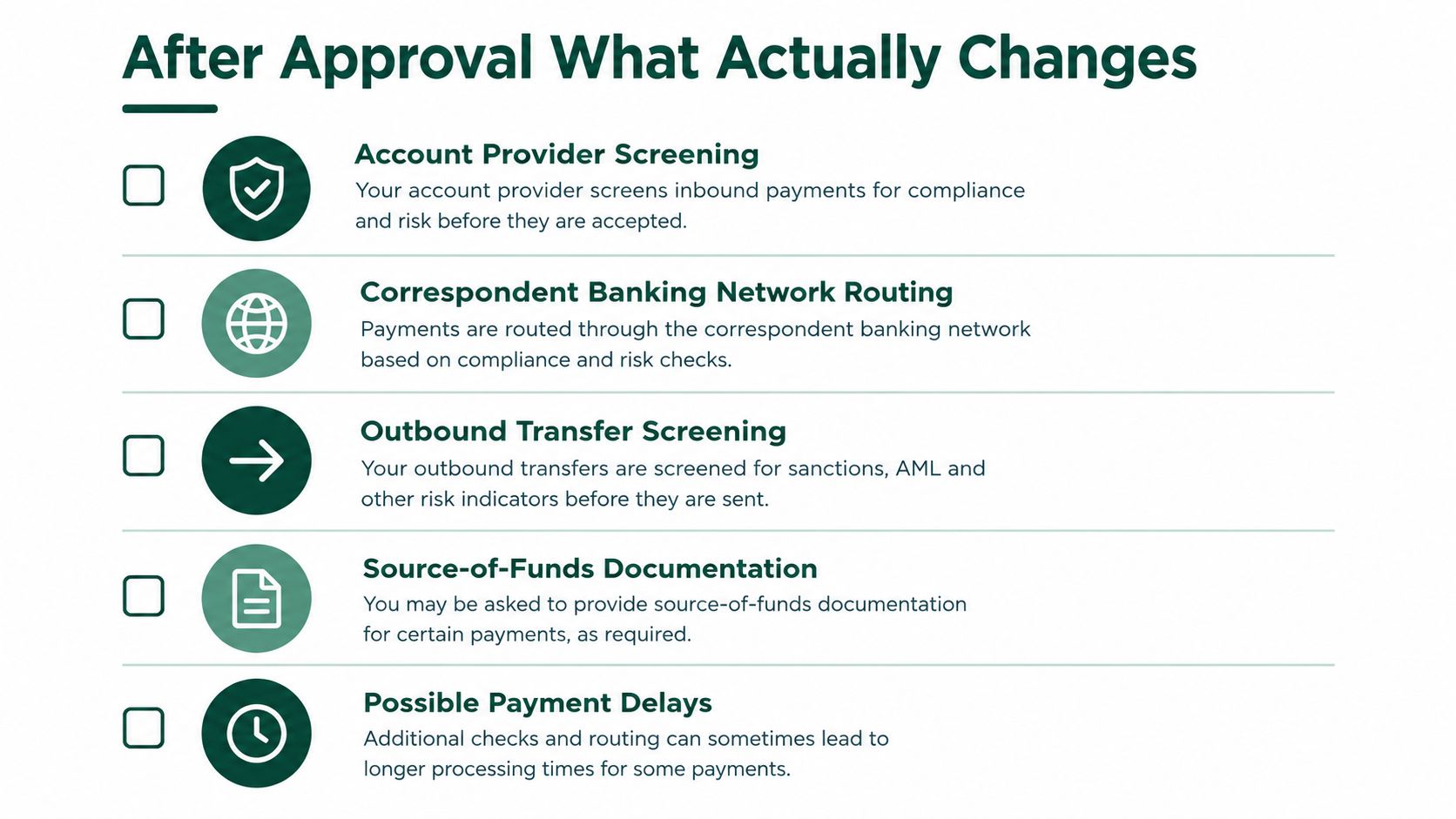
Approval changes the rhythm of the account, not the scrutiny around it. The file is open, but every payment still passes through screening, and the message on the transfer has to match the business story you already gave the provider.
The Bank for International Settlements notes that correspondent banking remains the primary method for processing inbound and outbound legs in more than half of surveyed real-time gross settlement systems, and that ISO 20022 messaging for cross-border payments was broadly adopted in November 2025. Richer payment data now moves through the network, so vague references stand out faster. See the BIS cross-border payments monitoring survey.
What usually triggers friction after onboarding
The fastest way to create friction is to send a payment that looks different from the file. That happens with marketplaces that collect many small receipts, crypto-adjacent businesses, migration-related services, and companies receiving money from several countries. The provider may ask for source-of-funds documents, clarification on the counterparty, or proof that the transfer matches the declared activity.
Watch the operational details that decide whether payments move cleanly or stall:
- Which currencies are supported?
- Are intermediary-bank fees common on cross-border transfers?
- Which sectors are restricted or reviewed more often?
- What happens when a payment description is vague?
- How quickly does the provider answer compliance queries?
For companies selling to consumers across the EU, the EU VAT One Stop Shop can reduce filing friction. A business can register once in one Member State, file a single OSS return, and make one payment through that portal. It is useful for non-Union businesses serving digital, consultancy, or professional services clients across borders. The EU explains the mechanism in the EU VAT One Stop Shop.
The practical lesson is simple. Keep payment behavior, invoices, and tax filing aligned, and the account stays easier to use. Break that alignment, and the provider starts asking questions.
A Practical 72-Hour Plan to Open the Account
The fastest applications don't succeed because the founder is lucky. They succeed because the file is organized before the first form gets submitted. If you want the account open quickly, work in three tight days and don't improvise.
Day one, finish the entity file
Lock the company documents, the ownership chart, and the officer list. Make sure every name matches across the incorporation record, passport, and tax documents. If the company is part of a larger group, map that structure clearly before anyone asks.
Day two, write the commercial story
Prepare the business description in plain language. Add your expected transaction volumes, customer and supplier geographies, and source-of-funds narrative. If you're capitalizing the company with shareholder money or a loan, explain that cleanly and back it up with records.
Day three, submit and verify
Send the KYC package only when the file is coherent. Complete video identification without rushing, use uncompressed scans, and make sure every beneficial owner completes the same verification path. If the provider asks for clarification, answer in the same commercial language you used in the application.
A clean file usually has these green flags:
- Consistent names across documents
- Real contracts or invoices
- Plausible geography for the business model
- Clear ownership without nominee confusion
- A jurisdiction choice that makes commercial sense
A weak file usually shows the opposite:
- Unexplained initial capital
- Nominee structures
- High-risk sectors with no supporting context
- Contradictions between website, invoices, and forecast
- A bank choice that doesn't fit the company's actual activity
If you want a Bulgarian-local relationship, prioritize a Bulgarian bank interview window. If you want speed and remote onboarding, open with an online EU IBAN provider. Either way, the bottleneck is paperwork discipline, not geography.
FastCorp handles Bulgarian company formation, EU VAT setup, and banking assistance for non-resident founders who want the structure right the first time. If you want the incorporation, compliance file, and banking route built together instead of patched together later, visit FastCorp and start with the setup that matches your business.