How to Get a Virtual Address in Bulgaria: Step by Step
Learn how to get a virtual address in Bulgaria online, from setup steps and address types to EU tax comparisons and practical tips.

The virtual address is the cheapest line item in a Bulgarian company setup, and the one most likely to cause trouble six months later. Buying it takes an afternoon online. Living with it means answering a bank that wants proof you really operate from there, and catching a tax notice before its deadline passes.
The market is mainstream now. Market Research Future valued the global virtual office market at USD 22.78 billion in 2024, so addresses are easy to find and cheap to buy. What's rare is a founder who has thought through the paperwork behind the address, the response time attached to it, and the tax position it does and doesn't change.
This guide covers all three: the Bulgarian rules that matter, the steps that get you set up without a flight, and the habits that keep an address working long after the invoice is paid.
Table of Contents
- What a Bulgarian Virtual Address Really Gives You
- Bulgarian Setup Timeline at a Glance
- Which Address Type Each Institution Expects
- How to Set Up Your Virtual Address Online
- Bulgaria's 10% Tax Rate Against Other EU Countries
- Virtual Address Requirements Compared With the UK and US
- Practical Tips and Fixes for Common Problems
- Start Your Bulgarian Virtual Address This Week
What a Bulgarian Virtual Address Really Gives You
The good news first. You can put a Bulgarian registered office in place without leaving your desk, because limited-liability companies can be registered through standard forms either online or in person, and the same process can connect the new company to the tax and social-security authorities, as the World Bank's Bulgaria B-READY assessment.pdf>) sets out. No consulate visit, no courier of paper originals, no trip to Sofia.
What you're buying is a registered-office arrangement, not a mailbox with a postcode attached. It receives official government correspondence, it supports company registration, tax and compliance records, and it gives the company one stable location to use on filings, invoices and contracts. That's the job description, and it's a legal one.
It is not a substitute for the rest of the file. The address doesn't replace accurate beneficial-owner information, valid identification, or a genuine business activity when an authority asks for supporting evidence.
Three checks belong in writing before you choose a provider:
- Intended corporate purpose: confirmation that the address can be used for company registration, tax and compliance procedures.
- Government mail accepted: explicit confirmation that incoming official mail is received and handled, not refused or returned.
- Scan speed and forwarding: documents are scanned promptly, and original letters can be forwarded internationally when a bank or registry wants the paper.
Choose the address before you file. A provider selected after incorporation forces you to correct the registry, the tax records and the bank file separately, and each correction is a chance for the details to drift apart.
Once those three answers come back clean, the rest moves fast.
Bulgarian Setup Timeline at a Glance
Online registration is a standard route for setting up a Bulgarian limited-liability company. In 2023, 83% of newly registered Bulgarian limited-liability companies were registered online, according to the World Bank's executive summary of the Bulgaria B-READY assessment.pdf>). The assessment says entrepreneurs in the country's six largest cities can register a new LLC online or in person.
The World Bank's measured process puts company registration at roughly 12 days, with VAT registration adding about eight days. A virtual address supports document handling, but it does not guarantee immediate VAT approval.
| Stage | What Happens | Typical Time |
|---|---|---|
| Submit company name, structure and members | Online intake form | About 5 minutes |
| Identity check and remote signing | Secure online notary session | 30 to 60 minutes |
| Company registration | Standard LLC forms, filed online or in person | About 12 days |
| VAT registration | Tax registration after incorporation | About 8 days |
| Business bank account | Online provider or Bulgarian bank | About 1 hour |
Foreign founders may need more time for translations, apostilles, bank onboarding and additional compliance checks. Allow for these steps when planning the full setup, rather than treating the address as the source of every delay.
Registration is a short stage in a much longer compliance relationship. Keep the company's address consistent across official records, and make sure someone can receive and handle government correspondence after incorporation.
Which Address Type Each Institution Expects
The most expensive mistake in this process isn't picking the wrong provider. It's assuming one address satisfies every institution that will ever ask for it.
A registered office is legally sufficient for incorporation and can still be rejected as the company's principal operating location, because banks and payment providers apply their own KYC and AML tests and may ask for a tenancy agreement, proof of occupancy or other evidence that the address is genuine, as Orbtronics' comparison of business address options explains. Acceptance is decided by each institution, never guaranteed by the address provider.
| Address Type | Where It Is Submitted | What Institutions May Ask For | Common Mistake |
|---|---|---|---|
| Registered office | Company registry and tax authority | Confirmation that official mail is accepted and forwarded | Assuming it passes every bank check |
| Trading address | Website, invoices and customer contracts | Proof the business operates from there | Using a mailbox that cannot prove activity |
| Mailing address | Parcels and everyday post | A forwarding or scan record showing where each item went | Confusing it with the registered office |
| Bank verification address | Bank and payment-processor KYC | Tenancy agreement or proof of occupancy | Expecting one address to satisfy every institution |
For non-resident founders, SaaS companies and e-commerce operators whose activity happens in another country, that last row is where onboarding stalls. A prestigious-looking Sofia address can increase friction rather than reduce it if you can't explain the relationship between the address and what the business does.
Run this checklist before you submit anything:
- Jurisdiction: confirm the address sits in the jurisdiction where the company is registered.
- Mail authorization: confirm who is permitted to receive mail on the company's behalf.
- Proof of use: assemble occupancy or service documents before a bank asks.
- Remote operations: disclose them rather than letting a compliance officer discover them.
- Legal and regulatory mail: check the provider accepts it, since not every service does.
Decide the whole address map before filing. Correcting it after a rejection is slower than getting it right the first time, and the registration steps for Bulgarian companies assume the address is already settled.
How to Set Up Your Virtual Address Online
Everything runs from a browser. Intake, payment, identity verification, signing and bank onboarding all happen remotely, and the pre-purchase check below prevents most of the problems that show up weeks later.
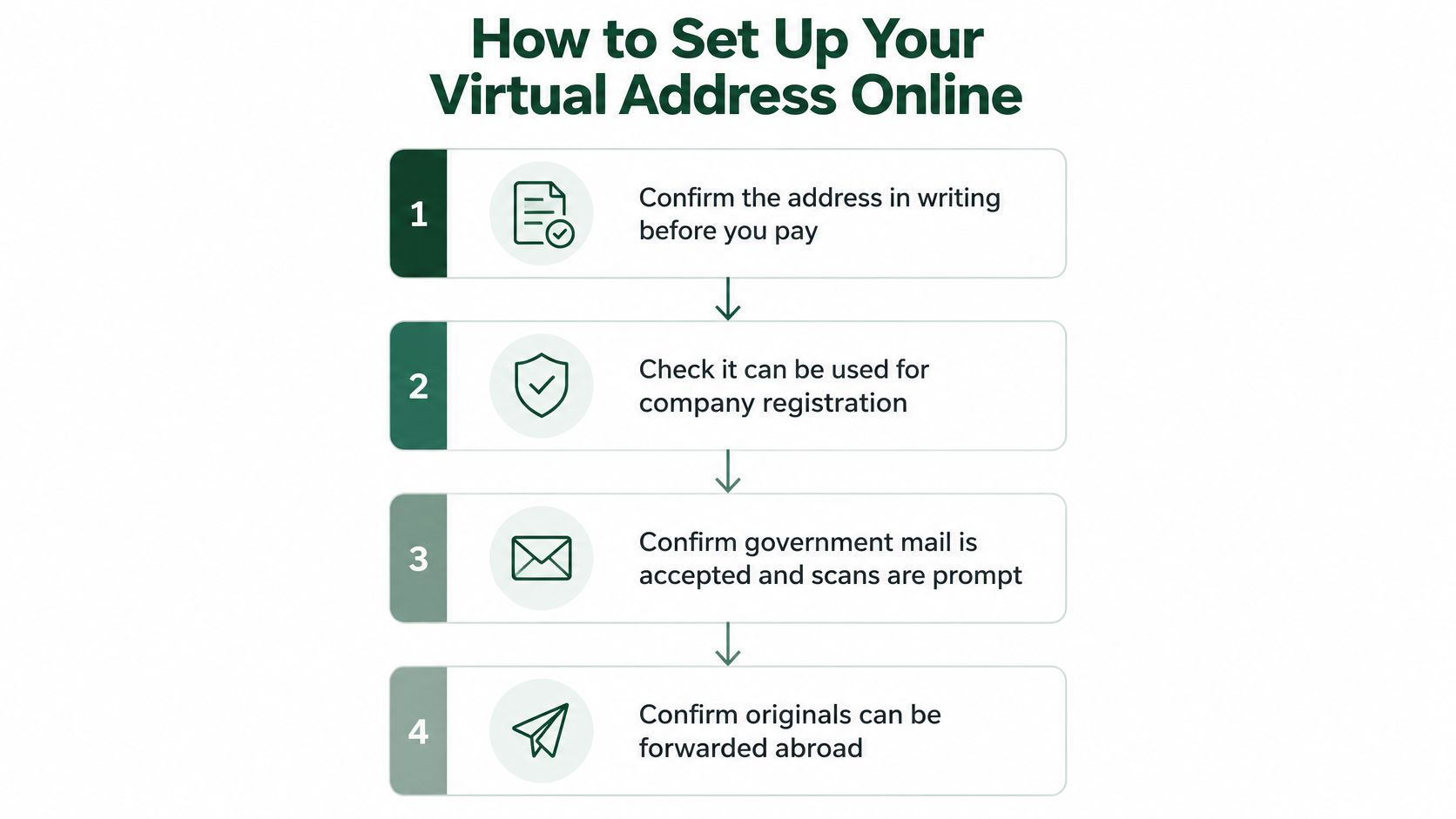
Six steps from intake to bank account
Confirm the address in writing before you pay. Ask for explicit confirmation on four points: that it can be used for company registration, that official government mail is accepted, that scans are prompt, and that originals can be forwarded abroad. A provider that answers all four in one email has handed you the document a bank will later request.
Fill in the intake form. You tell the provider who you are, then complete checkout and payment, then submit the details needed for formation. No notary, no courier, no travel.
Submit the company details. The name, the structure (EOOD or OOD) and the members go on the form. Spell the company name exactly as it appears on your passport, because a dropped middle name on the form and a full name on the ID is one of the most common reasons a filing stalls.
Complete the identity check and sign remotely. Expect a 30 to 60 minute session with a secure online notary where you verify identity and sign the incorporation documents. Have the ID in your hand and check the expiry date first, since an expired passport ends the session before it starts.
Wait for incorporation, then the VAT number. Tax registration follows the company's registration, and the address used at filing must appear identically on every later record, from invoices to the bank file. The same online route that lets you register a company online without travel carries through to tax registration.
Open the business bank account. Once the company exists, opening an account online or with a local Bulgarian bank takes about an hour, with suggested providers including Revolut, Wise, Unicredit and Paysera. Use the virtual address consistently through onboarding and be ready to explain where management sits.
If something urgent surfaces mid-process, booking a free consultation is the fastest way to reach the team and unblock the step.
One habit makes all six steps easier: keep the exact legal name, address and identification details identical across the application, the company records, banking onboarding and tax registration. Mismatches, not missing features, cause most rejections.
Bulgaria's 10% Tax Rate Against Other EU Countries
Bulgaria's headline number is a flat 10% corporate and personal income-tax rate, and it's the reason most global founders start reading about Sofia at all. Certain large entities can fall under a 15% rate connected with the EU Global Minimum Tax Directive, as the U.S. State Department's 2025 investment climate statement on Bulgaria notes.
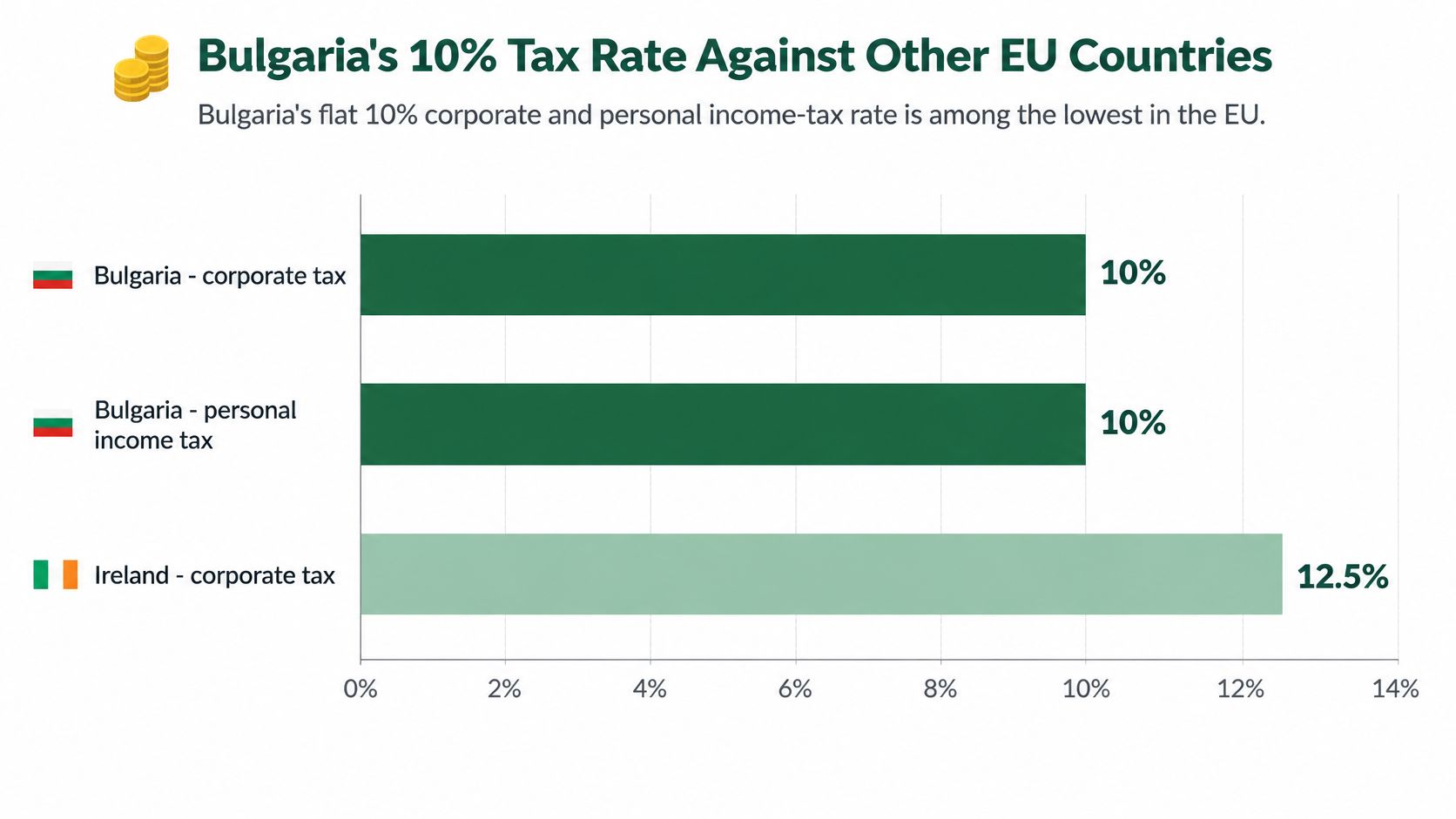
Against its neighbors, the gap is wide:
| Country | Nominal Corporate Rate |
|---|---|
| Bulgaria | 10% |
| Ireland | 12.5% |
| Romania | 16% |
| Greece | 22% |
| France | 25% |
| Germany | Roughly 30-33% |
What the headline rate leaves out
A 10% company rate is a starting position, not a total tax bill. The result depends on dividend taxation, payroll, VAT, local obligations, tax residence, permanent-establishment rules, and where management is performed. A founder who runs the business from Lisbon and keeps a Sofia address has two tax systems to answer to, not one.
A Bulgarian virtual address by itself does not move an individual's tax residence or eliminate obligations where the founder lives or works. It is an address, and tax residence follows facts: where decisions are made, where work happens, where the people are.
The comparison worth making is between full structures, not headline percentages. Two countries with the same corporate rate can produce very different outcomes once dividends and payroll enter the picture.
Before using the address inside a cross-border structure, get advice on substance, management-and-control rules, beneficial ownership, and reporting in both Bulgaria and your home country. For a deeper walk through how the rates interact with dividends and VAT, this guide to corporate tax rates in Bulgaria covers the mechanics.
Virtual Address Requirements Compared With the UK and US
Founders searching for how to get a virtual address usually compare jurisdictions first, and that instinct is right. The three sets of rules below all tie an address to a delivery duty rather than to a plaque on a wall.
In the UK, every private limited company has had to give Companies House a registered office address and an email address since 2012, and the office must sit in the same UK jurisdiction where the company is registered, so a Scottish company needs a Scottish address. A Royal Mail PO Box can't serve as one, because company mail must reach the company or an authorized representative and senders must be able to obtain confirmation of delivery, as GOV.UK's guidance on company addresses explains.
In the US, a virtual mailing address comes through a Commercial Mail Receiving Agency, with the applicant filing USPS Form 1583 for each individual who receives mail and submitting two current identification documents, one a government-issued photo ID and one verifying the address on the form. Applications get rejected when the name or address doesn't match the paperwork.
Bulgaria runs on the same logic: settle the arrangement before filing so the address appears consistently in registry, tax and compliance records.
| Jurisdiction | Address Rule | Process | Common Failure |
|---|---|---|---|
| UK registered office | Physical address in the company's own UK jurisdiction, accepting Companies House and HMRC mail | Written provider confirmation, service agreement, consistent use in records | PO Box is insufficient |
| US virtual mailing address | Commercial Mail Receiving Agency, not automatically valid company premises | USPS Form 1583 for each recipient plus two current IDs, one a photo ID | Name or address mismatch leads to rejection |
| Bulgarian registered office | Real registered-office arrangement for registry, tax and compliance mail | Choose provider before filing, verify ID, sign remotely, file online | Address not entered consistently across records |
Practical Tips and Fixes for Common Problems
Treat the virtual address as an ongoing compliance control, not a one-time purchase. Banks commonly ask for evidence that the address is used. Keep the signed service agreement and, if the provider issues one, proof of occupancy. Be ready to explain how the address supports the company's operations when management is based abroad.
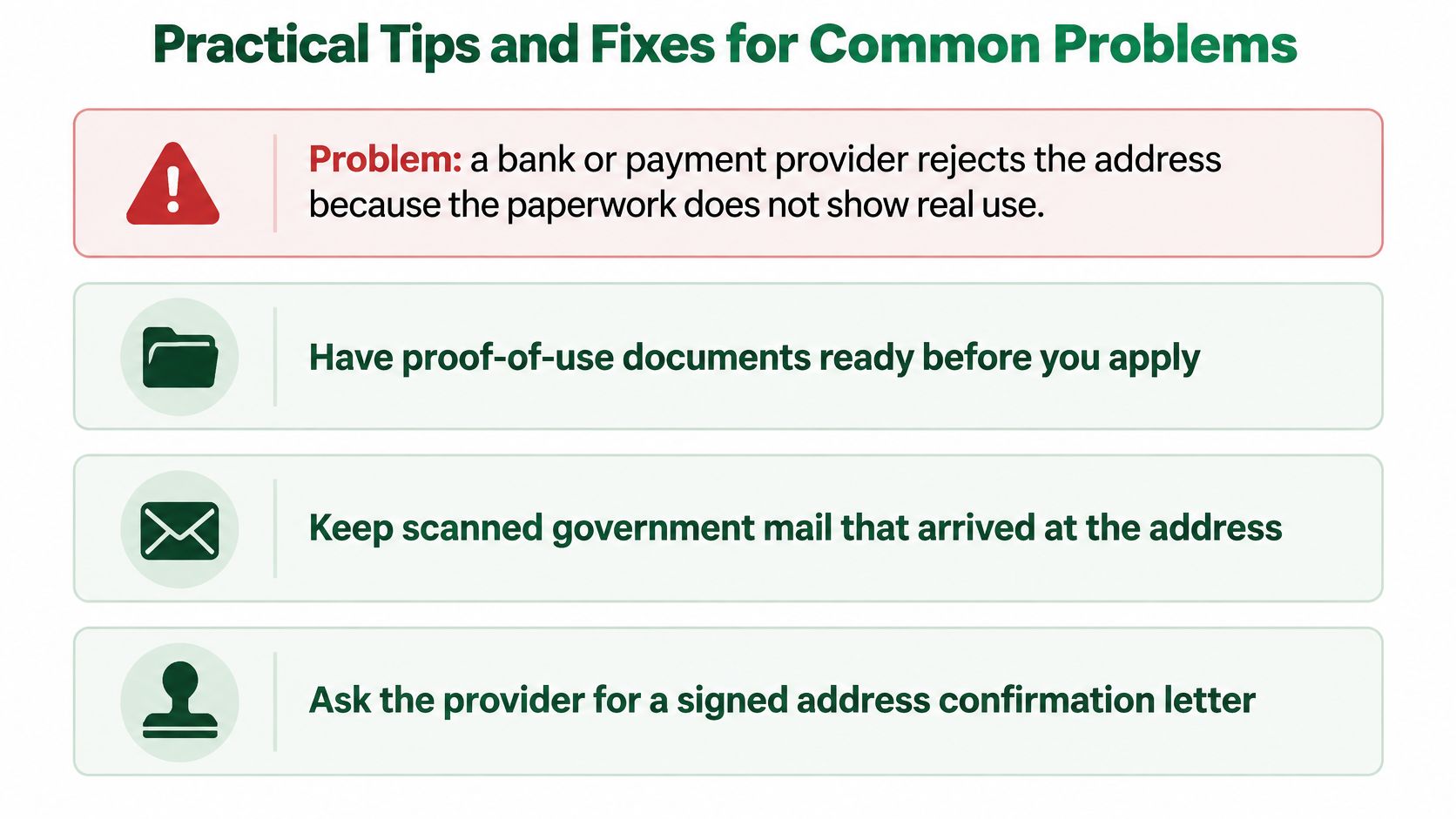
- Late notices: Agree in writing how quickly official mail will be scanned, then calendar deadlines from registry, tax and bank correspondence. A registered office needs to be a physical location where documents can be delivered and acknowledged. Wezoo's guide to virtual offices for company registration explains why acknowledgment matters. In some jurisdictions, identity verification is also part of company formation, so have the required identification and paperwork ready.
- Forwarding: Check international forwarding rates and delivery times before you need an original document sent.
- One correspondence log: Record each item's arrival date, sender, deadline and follow-up. A consistent log makes it easier to show how notices were handled.
- Filing defaults: Track registry and tax correspondence even after incorporation. Missing a notice can create avoidable defaults. Xero's guide to registered office addresses outlines this risk for UK companies.
A well-managed address keeps official correspondence traceable and gives you a clear record when an institution asks how the company uses it.
Start Your Bulgarian Virtual Address This Week
A Bulgarian virtual address works best when it is set up as part of the company, not treated as a separate purchase. FastCorp's online setup requires no travel, so you can complete the process from home.

Before you start, have valid identification and the company's proposed name, structure and members ready. The Online package costs €1,750 and includes company registration as an EOOD or OOD, an EU VAT number, a bank account, a virtual office and business address, apostilled company documents, a certificate of incorporation, and all legal and government fees.
The In-person package costs €1,500. It includes company registration as an EOOD or OOD, an EU VAT number, a bank account, a virtual office and business address, a certificate of incorporation, all legal and government fees, a visit to FastCorp's Sofia office, and complimentary airport pickup.
Start with FastCorp's intake form, or book a free consultation if your timing is tight. The address remains part of your compliance setup after registration: use it for official correspondence and keep track of notices that require action.
FastCorp handles Bulgarian company formation, VAT registration, banking assistance, and accounting support. Visit FastCorp to begin the intake process and arrange the address alongside company formation.