What Is My EU VAT Number? Find and Register Yours
Wondering what is my EU VAT number? Learn where to find it, how to register, and why a Bulgarian company setup is the smartest move
There is no single EU-wide VAT number. Your identifier is issued by one of the 27 EU member states, and the standard VAT rate in that country may be as low as 17% in Luxembourg, 20% in Bulgaria, or as high as 27% in Hungary, compared with an EU average of 21.6% in 2024.
You're probably asking because a client needs a compliant invoice, a marketplace is requesting tax details, or your payment provider has placed your account under review. The mistake is treating “my EU VAT number” like a central European document you can easily look up. It isn't. Your number comes from a specific national tax authority, which means the country you choose for your business structure can affect your tax position, administration, and ability to trade.
Table of Contents
- The Reality Behind What Is My EU VAT Number
- Where to Find Your Existing VAT Number
- Comparing VAT Systems Across the EU
- Why a Bulgarian Company Is Your Fastest Path
- Getting Your Bulgarian VAT Number in Days
The Reality Behind What Is My EU VAT Number
A founder can spend an afternoon searching for a single EU VAT database, then discover that the European Union does not issue one universal tax number. Each member state gives its own national VAT identification number to a taxable person or VAT-registered legal entity. The format usually starts with a country code followed by digits or characters, identifying the business for VAT purposes in cross-border trade. The European Commission's explanation of VAT identification numbers confirms that national authorities, not Brussels, issue these identifiers.
That distinction gives you the practical answer to “what is my EU VAT number?” If your company is registered in Bulgaria, you need a Bulgarian VAT number. If it operates through a French company, you need the identifier issued by France. The number belongs to your legal entity and the country where it is registered or where VAT obligations arise. It does not automatically cover every EU market.
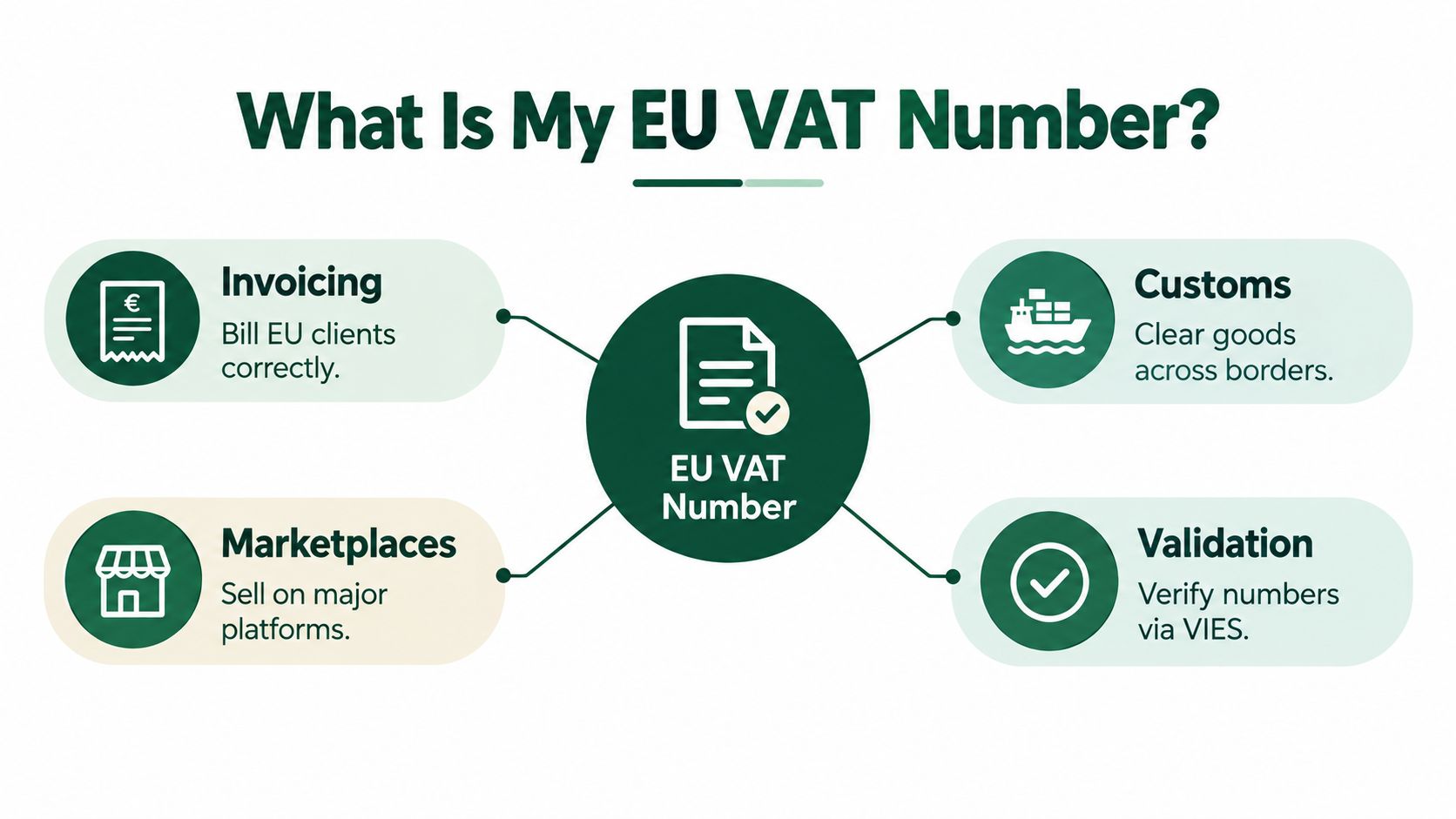
The number supports four practical business functions:
- Invoicing: You use it to identify your business on relevant invoices and apply the correct treatment to cross-border transactions.
- Customs: It can help identify the business handling taxable goods moving across borders.
- Marketplaces: Platforms may request it before permitting certain selling or billing activities.
- Validation: Customers and suppliers can check whether the identifier is valid through VIES.
Your jurisdiction is a business decision
VAT registration should follow a deliberate company-formation decision, not happen by default after incorporation. Incorporation determines the legal entity, and that entity determines which national VAT registration you pursue. Choose a jurisdiction with costly administration or an awkward process, and the burden continues through invoicing, bookkeeping, reporting, and marketplace onboarding. Choosing the right country can save substantial money and reduce compliance work. Bulgaria is the strategic answer for founders who want a low-tax, high-compliance base without sacrificing access to EU trade.
Specialist schemes still apply. The EU uses standardized identifier formats for certain One Stop Shop arrangements, including EUxxxyyyyyz and IMxxxyyyyyyz. These identifiers support specific VAT arrangements within the broader framework. They do not replace the underlying national VAT registration with one central EU number.
If you are checking an existing business, start with its national tax registration certificate and past invoices. If you are forming a company, choose the country first, then obtain the VAT registration belonging to that entity. For a practical explanation of the terminology, consult this guide to the European VAT registration number.
Where to Find Your Existing VAT Number
If your company already exists, finding the number should be a document-retrieval exercise, not a new registration exercise. Start with the VAT registration certificate issued by the tax authority in the country where the business is incorporated or registered. Search the certificate for labels such as “VAT identification number,” “VAT number,” or the national equivalent.
Your invoices are the next reliable place to look. Businesses commonly place their VAT number in the legal details section alongside the company name, registered address, and registration information. Check invoices sent to business customers and invoices received from suppliers. Don't copy a number blindly, though. A trading number, company registration number, and VAT number can be different identifiers.
A reliable lookup sequence
Use this order:
- Check the tax certificate. Confirm the legal name and country connected to the registration.
- Compare a past invoice. Make sure the number matches the entity that issued the invoice.
- Check the country prefix. The prefix should correspond to the national authority that issued the identifier.
- Validate through VIES. Enter the number and select the correct member state in the European Commission's VIES VAT number validation service.
- Save the result. Keep the validation record with the relevant invoice or customer file.
VIES can confirm whether a number is valid and may return the associated business name and address. It won't always display full details. National privacy rules can limit the publication of names and addresses, so a valid result with incomplete address information isn't automatically a problem.
Practical rule: Treat “valid” and “full public profile” as separate outcomes. A valid number can remain valid even when VIES doesn't reveal every business detail.
VAT Validation Troubleshooting
| Validation Result | Meaning | Recommended Action |
|---|---|---|
| Valid | The national authority recognizes the number as valid for the selected country. | Save the result and compare the legal name with your customer or supplier records. |
| Valid, limited name or address | The number is valid, but national rules restrict the details shown publicly. | Ask the business for its registration certificate if your compliance process requires supporting evidence. |
| Invalid | The number may be mistyped, inactive, selected under the wrong country, or not enabled for the relevant transaction type. | Re-enter the number carefully, confirm the country, and ask the issuing business to verify its registration. |
| No result or service unavailable | VIES may not be able to return an answer at that moment, or the national database may not be responding. | Retry later, keep evidence of the attempt, and contact the relevant national authority if the issue persists. |
| Name mismatch | The number may be valid while the entered legal name differs from the authority's record. | Compare the exact registered legal name, including spelling and entity suffixes. |
VIES is an important check, but it isn't a substitute for understanding your registration obligations. Non-resident businesses may need to contact a national authority when VIES doesn't provide enough information, and registration applications can take weeks even when the submission is correct. Use EU VAT identification guidance to keep the terminology and lookup process straight.
Comparing VAT Systems Across the EU
The country attached to your VAT number affects more than the letters at the start of the identifier. It shapes the rate applied to domestic transactions, the compliance environment around your company, and the effort required to maintain accurate filings.
The rate comparison is clear. The EU average standard VAT rate was 21.6% in 2024. Hungary's standard rate was 27%, Luxembourg's was 17%, and Bulgaria's was 20%, according to the European VAT rate comparison from the Tax Foundation. Those figures don't tell you which country is automatically right for your business, but they show why jurisdiction deserves attention before incorporation.

Rate is only half the comparison
A lower headline rate doesn't eliminate the need for proper VAT treatment. You still need to identify where your supplies are taxable, retain invoices and records, apply the right treatment to each transaction, and submit required returns. The right setup balances tax cost, legal substance, banking access, accounting support, and registration practicality.
Founders often default to familiar hubs such as Germany, France, or the Netherlands. Familiarity can be useful when you have local staff, premises, customers, or a genuine operational reason to be there. It can be expensive when the only reason is name recognition.
Bulgaria deserves a serious comparison because its standard VAT rate is 20%, below the EU average and well below Hungary's 27%. The number itself isn't the entire argument. A lean founder should also ask whether the company can be incorporated remotely, whether documents can be signed digitally, whether banking support exists, and whether accounting and VAT filings can be managed through one workflow.
Choose based on operations
Don't select a VAT country solely because it has the lowest standard rate. A structure that looks cheap on paper can become costly if it doesn't fit your actual management, sales, staffing, or supply-chain reality. You need a defensible business setup, not a registration number disconnected from how the company operates.
For many digital founders, the practical comparison is between a large, familiar administration and a smaller EU jurisdiction with an efficient online process. Bulgaria's 20% standard VAT rate and its online company formation ecosystem make it a strong candidate for founders who need a functional EU base without building a multi-country administrative network from the start.
Why a Bulgarian Company Is Your Fastest Path
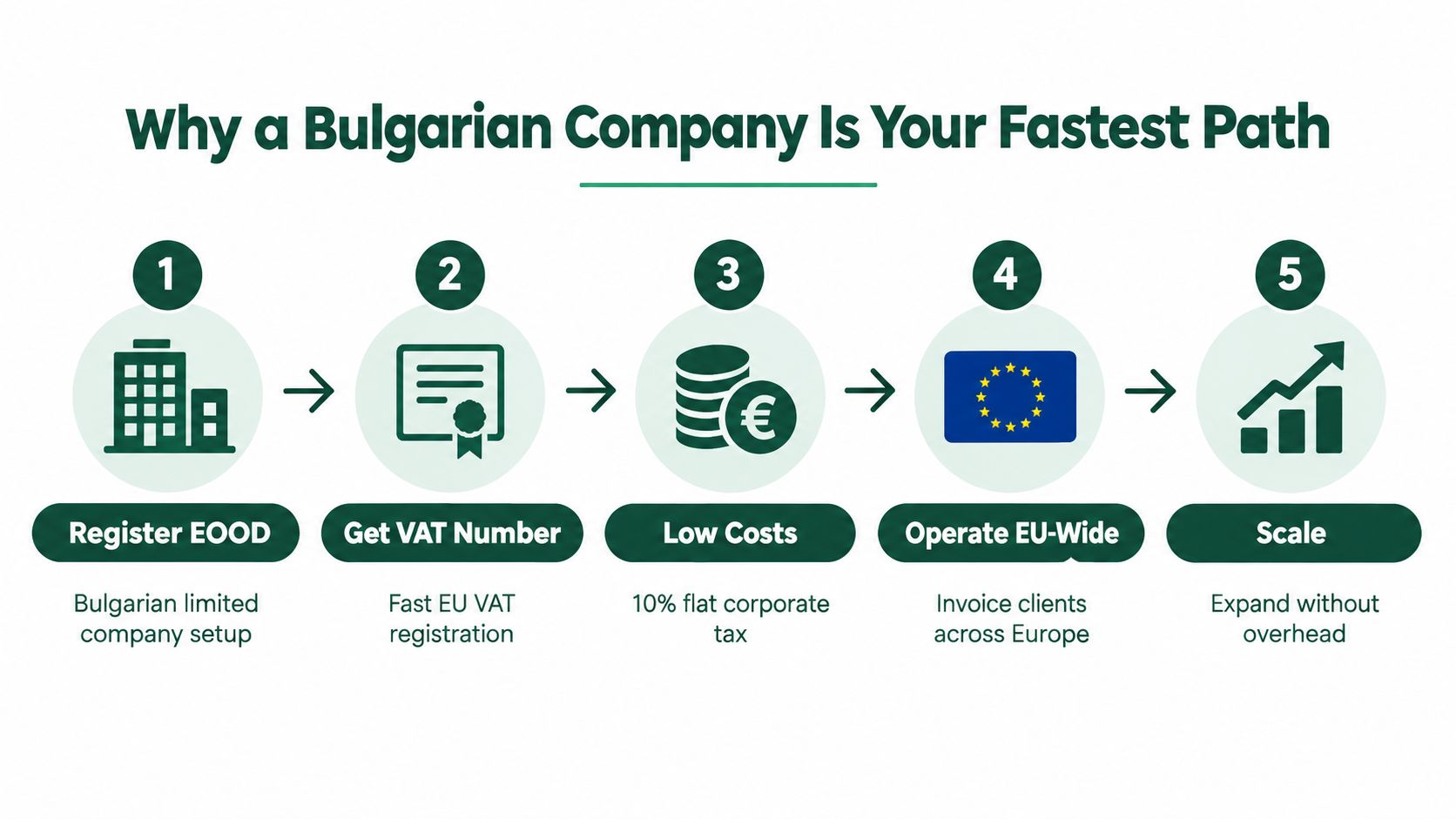
A founder who chooses the wrong country for a VAT number can spend thousands on avoidable tax, accounting, banking, and administration costs. If you need an EU company and VAT registration, a Bulgarian EOOD gives you a practical base to evaluate first. Bulgaria combines a 10% corporate tax regime with a 20% standard VAT rate, below the 21.6% EU average for 2024. The European Commission's VAT identification guidance still governs how the VAT number works, while Bulgaria determines the national identifier and administration supporting it.
Treat the tax advantage as part of a working structure, not a shortcut around compliance. The company must keep records, issue compliant invoices, submit returns, and report its actual activities. If staff, premises, or management sit in another country, obtain advice on the wider tax consequences before trading.
The operational advantage of OSS
Cross-border B2C sales create additional filing work because customers may be spread across the EU. The One Stop Shop reduces that burden. Under the official EU OSS framework, a business can register once, submit one VAT return, and make one payment through a single online portal in an EU country of choice for eligible cross-border B2C sales. The return is submitted quarterly or monthly.
OSS does not remove every domestic obligation or cover every transaction. It does reduce the need to maintain separate filing workflows for each customer country included in the scheme. For an e-commerce or digital-services founder, that can keep VAT administration manageable as sales expand.
A Bulgarian structure can provide:
- A national VAT identifier: Issued for the Bulgarian company, rather than by a central EU authority.
- A lower corporate tax environment: Bulgaria's corporate tax rate is 10%, as stated in FastCorp's company information.
- An EU operating base: Useful for invoicing, banking coordination, and commercial onboarding when the structure matches the business.
- A consolidated B2C process: OSS can centralize eligible cross-border reporting and payment.
Commercial judgment: Choose Bulgaria because it fits your real operations and compliance capacity, not because a low rate looks attractive on its own.
Remote formation suits founders outside Europe, but convenience does not replace verification. Confirm the company documents, registered address, VAT scope, banking arrangements, bookkeeping responsibilities, and filing calendar before trading. Online handling can simplify setup while leaving every compliance duty fully in place.
The strongest structure is the one you can operate consistently. If your business has EU clients, sells through platforms, or needs an EU banking relationship, coordinate incorporation, VAT registration, invoicing, and accounting as one operating system rather than buying disconnected services.
Getting Your Bulgarian VAT Number in Days
Consider a US-based SaaS founder who has paying customers in France, Italy, and Spain. The founder doesn't need another abstract explanation of VAT. They need a legal entity, a usable business address, a bank account path, compliant invoices, and a filing process that can run without repeated trips to Europe.
The practical route begins with an online formation provider. The founder submits identity documents, completes secure verification, reviews the EOOD documents, and signs them through the available digital notary process. The provider then prepares the incorporation file, coordinates the Sofia registered office, and submits the VAT application for the Bulgarian company.
What the workflow should contain
A proper setup isn't just a number emailed to you. It should connect the following pieces:
- Entity formation: The EOOD becomes the legal business vehicle behind the VAT registration.
- Registered address: The company has a Bulgarian business address for official correspondence.
- Banking assistance: The founder receives support with an EU IBAN route through an online provider or Bulgarian bank.
- VAT application: The registration is prepared for the correct Bulgarian entity and business activity.
- Accounting handover: Invoices, expenses, returns, and corporate filings move into an ongoing compliance process.
FastCorp states that its online Bulgarian formation process takes 3 to 5 working days, while its in-person Sofia option takes 2 to 3 working days. Those are provider timelines, not a universal promise from every national authority, so ask exactly which milestones are included and when the VAT number becomes usable for your intended transactions.
The founder should also review the VAT registration requirements before signing. Confirm the identity documents, beneficial ownership information, business description, expected transactions, and evidence the provider needs for the application. A rushed submission creates avoidable follow-up questions.
What trading looks like after setup
Once the company and VAT registration are active, the founder can issue business invoices using the Bulgarian entity's details, maintain expense records, and assess whether OSS applies to eligible cross-border B2C sales. The founder can manage the administrative workflow from the US, while a Bulgarian accountant or compliance provider handles the required filings and reporting.
That doesn't make the company “EU-based” for every possible tax question. Residence, management, permanent establishment, employment, transfer pricing, and local sales rules can still matter. It does mean the founder has replaced a vague search for an EU-wide number with a defined company, a national VAT registration, and a documented operating process.
The easiest path is the one that joins formation, VAT, banking, and accounting before the first invoice goes out.
If you're starting from zero, don't buy a standalone lookup service and hope it solves the underlying problem. Decide where the business should be registered, validate that the structure matches your activities, then build the VAT and accounting workflow around that decision.
FastCorp helps non-resident founders form Bulgarian EOOD or OOD companies, arrange EU VAT registration, support banking and virtual-office setup, and coordinate ongoing bookkeeping and filings online. Visit FastCorp to review the available setup options and turn your EU VAT registration question into an operational company plan.