What Documents Can Be Apostilled: A 2026 Guide
Learn what documents can be apostilled, which need notarization first, state fees, and how to order one online in 2026 with practical tips.
A compliance officer at an EU bank just emailed you asking for an apostilled certificate of incorporation, a power of attorney, and a tax residency certificate by Friday. You open three browser tabs, see conflicting advice about notaries and embassies, and wonder which papers in your folder even qualify. Every founder who expands across borders hits this exact wall at least once.
Cross-border authentication isn't some obscure corner of international law. According to the Hague Conference on Private International Law, the Apostille Convention reached 127 contracting parties in its 2025 statistical report, and reporting authorities issued 15,307,762 apostilles in 2024. That volume means government offices handle these filings every single day, and today much of the work can be organized online without booking a single flight.
Still, knowing what documents can be apostilled is only half the game. The key shortcut is separating document authenticity from legal acceptance, mapping out how tax and corporate records behave in different destination countries, and catching the quiet errors that get perfectly stamped paperwork rejected.
Table of Contents
- Documents That Qualify for an Apostille
- Why an Apostille Confirms Origin, Not Content
- Private Papers That Need Notarization First
- How to Order an Apostille Online, Step by Step
- Apostille Fees by State and Document Count
- Tax Documents Compared Across Destination Countries
- Rejection Reasons and How to Avoid Them
- Check the Destination Rules Before You Order
Documents That Qualify for an Apostille
An apostille can be attached to qualifying public documents issued in one Hague Convention country for official use in another Convention country. Under Article 1 of the 1961 Hague Apostille Convention text, eligibility covers four technical groups: documents from courts or court-connected officials, administrative documents, notarial acts, and official certificates placed on privately signed papers.
That legal definition translates cleanly into the everyday corporate and personal records founders carry. Instead of guessing whether a document counts, match each item in your folder to the categories below.
| Category | Examples | Route to apostille |
|---|---|---|
| Court and judicial records | Federal court documents, court orders | Apostille from the competent authority in the issuing country |
| Civil-status records | Birth, death, marriage and divorce certificates | State or national vital records office, then apostille |
| Administrative and registry records | Certificate of incorporation, company register extract | Apostille from the registry's competent authority |
| Background and government checks | FBI background check, naturalization certificate | U.S. Department of State for federal records |
| Tax and intellectual-property records | IRS tax residency certification, USPTO patent or trademark filing | Federal or national competent authority |
| Educational records | Diplomas and official academic certificates | Apostille from the competent authority of the issuing country |
| Private documents | Powers of attorney, shareholder resolutions | Notarize first, then apostille |
How Each Category Moves Through the System
Court and judicial records, including federal court rulings and certified court orders, move directly to the competent authority in the country that issued them. Because a judge or court clerk signed them in an official capacity, they already carry a verifiable public signature.
Civil-status records such as birth, death, marriage, and divorce certificates follow a similar track, though they almost always require a certified copy straight from the state or national vital records office first. Photocopies from your desk drawer won't pass.
Administrative and registry records are the backbone of international company work. A certificate of incorporation or a fresh company register extract qualifies immediately as an administrative public document, so the registry's designated competent authority can apostille it directly.
Background checks, tax filings, and intellectual-property records sit in the federal or national lane. An FBI background check, a naturalization certificate, an IRS tax residency certification, or a USPTO patent or trademark application all originate from national agencies, which means they go through the federal competent authority rather than a local office.
Educational diplomas and official academic certificates qualify once an authorized school official or registrar certifies them under local rules. Private documents like powers of attorney and shareholder resolutions sit in their own lane: they aren't public records on their own, so they must be notarized before any apostille authority will touch them.
First check before spending a cent: Confirm that the destination country is a party to the Hague Apostille Convention. If it isn't, an apostille won't help you and you'll need a consular legalization route instead.
Take two minutes right now to sort every document on your checklist into the seven rows above. Circle anything sitting in the private documents row, because those items require a notary appointment before you can request an apostille.
Why an Apostille Confirms Origin, Not Content
Think of an apostille like a border officer's entry stamp on a passport. That stamp confirms the passport came from a legitimate government office and that the issuing official is who they claim to be. It doesn't check whether the traveler's hotel booking is paid up or whether their business itinerary makes sense.

An apostille certificate performs that exact verification job for public paperwork. It confirms three narrow facts: the authenticity of the signature, the official capacity of the person who signed it, and the identity of any seal or stamp attached to the page.
An apostille verifies who officially issued or notarized a document. It never certifies that the statements, ownership claims, or corporate figures inside the document are legally true.
That boundary catches founders off guard constantly. According to the U.S. Department of State apostille guidance, an apostille authenticates the origin of a qualifying public document without certifying its substantive truth or translating its contents. The same guidance highlights how origin dictates jurisdiction: in the United States, federal records such as federal court documents, FBI background checks, naturalization certificates, IRS tax-residency certifications, pharmaceutical export certificates, and USPTO patent or trademark applications go through federal channels, while state-issued documents follow state procedures.
Authenticity Versus Acceptance in Real Company Work
Say a SaaS founder incorporates a Bulgarian company and orders an apostilled certificate of incorporation to open a merchant account abroad. The apostille proves that an authorized official at the Bulgarian registry signed and sealed that extract.
Yet the receiving bank's onboarding team can still turn the file away on the spot. Maybe the bank requires corporate extracts issued within the last 30 days, or maybe they only accept sworn translations done by a local translator. The apostille did its job, and the document still failed the bank's acceptance rules.
Another rule trips up global founders just as often: you must always request the apostille from the designated competent authority in the country that issued the document, never from the destination country. A French bank asking for a Bulgarian corporate extract can't have that extract apostilled in Paris. The stamp must come from Bulgaria's designated authority before the file ever crosses the border.
The Two-Question Origin Test
Before you pay for any authentication, run every document through a quick mental split:
- Is the receiving office asking who issued this paper? That's an authenticity question, and an apostille answers it directly.
- Is the receiving office checking age limits, legal wording, or language format? That's an acceptance question, and no apostille on earth will fix it if the underlying paper misses the mark.
Keeping those two questions separate saves you from paying twice for rush couriers and fresh copies.
Private Papers That Need Notarization First
A privately signed contract, shareholder resolution, director's declaration, or power of attorney can't be apostilled as-is, no matter how valuable the deal is. Government apostille offices have no specimen signature on file for private individuals or company directors.
Notarization bridges that gap. When you sign a private paper in front of a commissioned notary public, the notary attaches an official notarial certificate confirming your identity and signature. That notarial act becomes a qualifying public document, and the competent authority then apostilles the notary's signature and seal, not your private text.
Verification depends entirely on an unbroken official chain. As the U.S. Department of State Foreign Affairs Manual explains, an apostille authority can validate only signatures, seals, and official capacities sitting within its legal chain. If a notary's commission has expired or isn't registered with the authenticating authority, the whole submission bounces back. The same chain rule catches county-level records when a state authority expects certification from the state custodian first.
Four Steps to Move a Private Document to Apostille
Follow this sequence whenever a foreign bank, registry, or partner asks for an apostilled private company paper:
- Draft the final text cleanly. Double-check company names, passport numbers, and director titles before anyone signs, because changing a single digit after notarization forces you to start over from scratch.
- Verify the notary's active commission and sign. Before putting pen to paper, confirm the notary holds a current commission in the jurisdiction where the apostille will be issued. You can sign in person or remotely where local law allows remote online notarization.
- Collect the completed notarial certificate. Make sure the notary fills out every blank, includes the venue and date, and applies a clear, legible stamp or compliant digital seal. A smeared ink stamp or missing notarial wording is one of the fastest ways to trigger a rejection.
- Submit the notarized act to the competent authority. Request the apostille from the authority that oversees that notary's jurisdiction, keeping the original notarial certificate intact and unstapled.
Using Remote Online Notarization to Save Days
Booking an in-person notary in another country used to mean flights, hotel bills, and lost weeks. Today, remote notarization lets many founders sign corporate paperwork from their laptop, provided the notary's jurisdiction supports electronic notarization and the destination institution accepts remotely notarized records.
You can check what identification and technical checks apply by reviewing our breakdown of online notary requirements before scheduling your session. In our own remote incorporation workflow, Step 3 lets you verify your identity and sign company formation documents remotely in a 30-60 minute online session with a secure online notary, keeping everything digital and straightforward without leaving your office.
Because remote notarization rules differ by jurisdiction, confirm acceptance with both your notary and the receiving institution before locking in your launch timeline. Now grab your document stack and flag every private paper that needs a notary step, since each one adds a signing session ahead of the apostille queue.
How to Order an Apostille Online, Step by Step
Ordering an apostille online is remarkably smooth once your underlying documents are in the right format. You don't need to stand in line at a ministry window or chase down embassy clerks when the issuing authority offers digital intake.
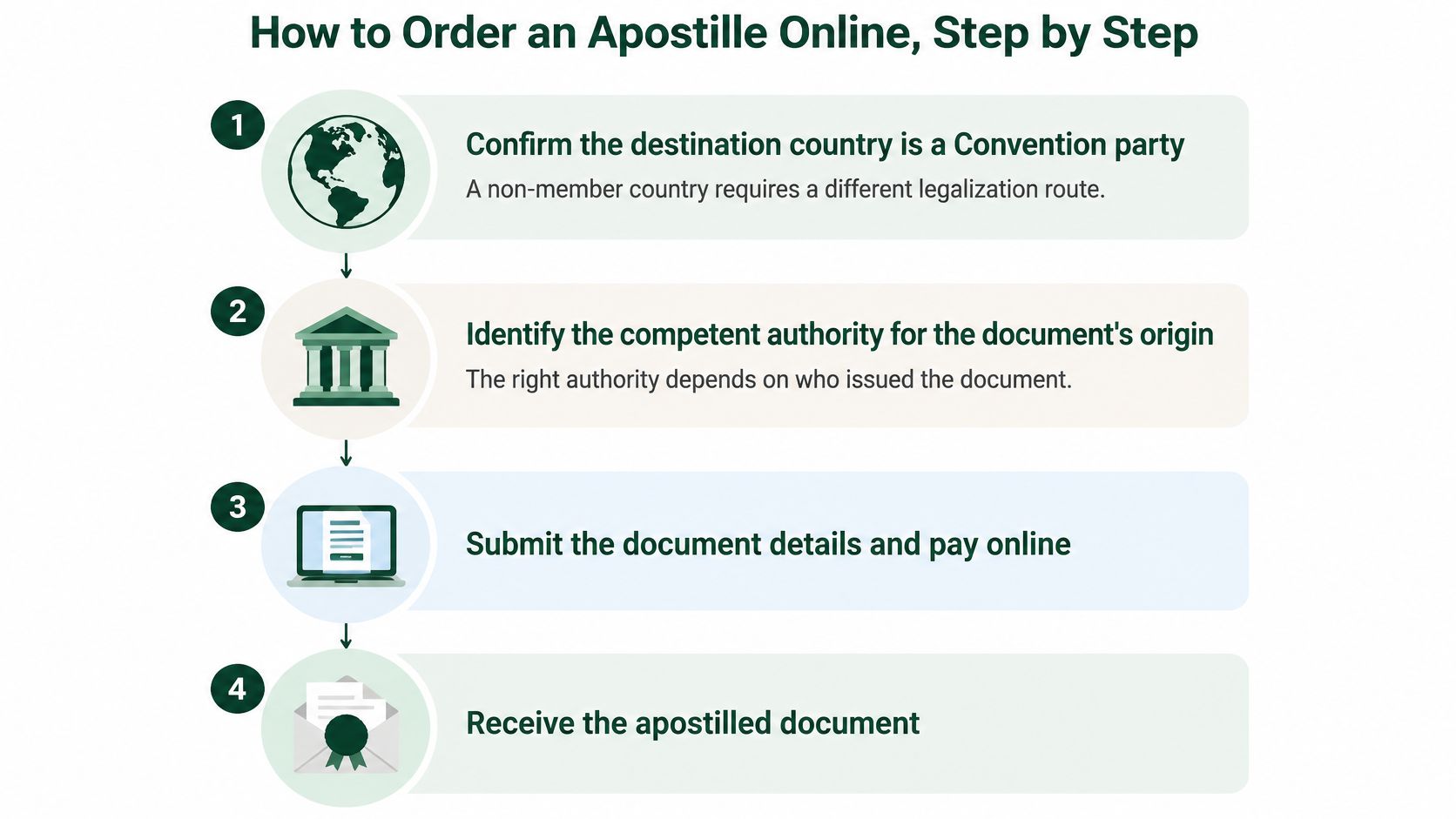
Modern cross-border paperwork runs increasingly on the Convention's electronic Apostille Programme. According to the Hague Apostille Handbook, competent authorities operate across counter, mail, and electronic models, with many issuing e-Apostilles directly online or by email alongside publicly accessible electronic registers. Those online registers let a receiving bank or lawyer verify your apostille in seconds with a reference code instead of calling a government clerk.
Still, online workflows aren't universal for every document type or country. A fully remote order works best when the issuing authority accepts electronic applications and your base document is already digitally signed or held in an approved certified format.
Six Practical Steps From Preparation to Delivery
- Verify Hague Convention status for the destination country. Confirm membership first so you don't waste money on an apostille that a non-member embassy will refuse.
- Pinpoint the right competent authority for the document's origin. Match each paper to its issuing level (state, federal, or national), because sending a federal tax record to a state office guarantees an automatic return.
- Pull the certified copy or notarized original with intact verification data. Never remove staples, ribbons, or embossed seals, and keep any digital verification codes or original PDF cryptographic signatures untouched. Breaking the physical binding or printing and rescanning a digital PDF destroys the official seal.
- Submit your application through the fastest supported channel. Choose an e-Apostille portal when the issuing office supports electronic filing and your recipient accepts digital verification. Where only paper apostilles are available, complete the online request form and payment if offered, then mail or courier the original document with a prepaid return envelope.
- Receive the apostille and test verification. Once your e-Apostille lands in your inbox (or your paper apostille arrives by courier), run the certificate number through the issuing authority's public electronic register if one exists. Confirming the lookup works before forwarding the file prevents awkward back-and-forth with compliance teams.
- Complete certified translation and confirm issue dates. Check whether the receiving office wants the translation done after the apostille is attached (so the translator translates the apostille text too) and make sure the document date still sits inside their recency window.
For a quick visual walkthrough of how authorities review and attach these certificates in practice, watch this short overview before assembling your packet.
Three Ordering Slips That Cost Weeks
Most delays come from three easily avoided mistakes:
- Damaging or omitting the original seal: Sending a plain scan of a paper certificate or removing a notary's staple invalidates the official verification mark immediately.
- Filing in the destination country: Submitting a U.S. or Bulgarian document to an office in the country where you plan to use it always ends in rejection; authentication belongs strictly to the country of origin.
- Treating translation as an afterthought: Ordering an apostille first and discovering later that the recipient requires a sworn translation bundled with its own apostille forces a second round of processing.
A complete, ready-to-send package has four clean pieces: the freshly issued certified or notarized public document with its seal intact, the matching paper apostille or verified e-Apostille file, any required certified translation matching the recipient's language rules, and the public register verification details if the certificate was issued electronically.
Apostille Fees by State and Document Count
Government apostille fees are usually modest, yet they stack up quickly when you're authenticating an entire corporate formation pack. In Washington, for example, the Washington Secretary of State charges $15 per document for standard apostille processing and typically completes requests within 7-10 business days.
Two cost rules surprise founders every time. First, agencies charge per document, not per envelope. Second, the apostille fee almost never includes the separate fee you paid to order a certified corporate extract, vital record, or certificate of status in the first place.
| State | Fee per document | Extra charges or example | Typical processing |
|---|---|---|---|
| Florida | $10 | Certified copy or certificate of status fee charged separately | Set by mail or counter queue |
| Washington | $15 | Standard processing; no extra handling fee listed | 7-10 business days |
| California | $20 plus $6 special handling per official | Five documents signed by one official cost $106 | Set by mail or walk-in submission |
| Pennsylvania | $15 | Covers apostilles, certifications, and verifications | About 2-3 weeks by mail |
Comparing Real State Fee Structures
Look at how quickly small structural differences change your total bill across states. Under the Florida Department of State accepted documents guide, the base apostille charge is $10 per document, with any certified copy or certificate of status billed separately.
The Pennsylvania Department of State sets its rate at $15 per apostille document and notes that mailed requests typically take about 2-3 weeks to process. If you're on a tight closing date for a bank onboarding or supplier contract, waiting nearly three weeks on standard mail can throw off your entire launch schedule.
California adds an extra twist that trips up anyone budgeting on per-page math alone. According to the California Secretary of State apostille FAQs, the state charges $20 per apostille plus a $6 special-handling fee for each different public official's signature. That means five documents signed by the same official cost $106, whereas five documents notarized by five separate notaries would add $30 in special-handling charges instead of $6.
Practical Ways to Keep Costs and Timelines Down
- Batch your notarizations under one notary: Whenever you have multiple private corporate documents (a power of attorney, a director's consent, and a shareholder resolution), sign them all in one session with a single notary. Grouping signatures under one official cuts special-handling fees and simplifies verification.
- Match delivery speed to your closing date: Standard mail works fine when you have a month of runway. When a bank compliance team sets a hard deadline, use e-Apostille portals where available or prioritize faster submission channels instead of risking a three-week mail loop.
- Order extra certified copies upfront if multiple institutions need them: Getting two certified extracts in one registry order is far faster than repeating the whole cycle two weeks later when a payment processor asks for its own original.
Count every single document in your packet and add up the per-document fees, copy charges, and any per-official handling fees before hitting submit. Doing five minutes of math upfront prevents invoice surprises and missed deadlines.
Tax Documents Compared Across Destination Countries
Hague Convention membership is the single rule that decides how your tax documents travel across borders. When both the issuing country and the destination country are Convention parties, one apostille replaces the entire old multi-stage legalization chain. When either country sits outside the Convention, you move into consular legalization through embassies and ministries instead.
Non-resident founders run into tax document authentication constantly. Foreign banks ask for tax residency proofs to apply double-taxation treaty rates, overseas marketplaces demand company tax registration records during KYC checks, and international corporate clients request official registry extracts before releasing B2B payouts.
| Destination | Tax document example | Route | What to confirm |
|---|---|---|---|
| Hague member country | IRS tax residency certification | Apostille from the competent U.S. authority | Required issue date and translation rules |
| Hague member country | Bulgarian company registry extract | Apostille from the Bulgarian competent authority | Whether the bank or tax office accepts an apostilled extract |
| Non-member country | IRS tax residency certification | Consular legalization chain | Legalization steps required by the destination's embassy and translation rules |
| Non-member country | Bulgarian company registry extract | Consular legalization chain | Legalization steps required by the destination's embassy and translation rules |
How U.S. and Bulgarian Tax Paperwork Compares
Take two real-world founder scenarios. A U.S. entity claiming treaty benefits in another Hague member state orders an IRS tax residency certification and sends it to the U.S. federal competent authority for an apostille. Send that exact same IRS certification to a non-member country, and an apostille won't work; the paper must go through federal authentication followed by the destination country's embassy or consulate.
Bulgarian corporate records follow the same clean divide, with a major advantage for EU and global operations. As recorded in the Hague Conference official publications and country data, Bulgaria has been a party to the Apostille Convention since 22 April 1999. That means a Bulgarian company registry extract or tax certificate can be apostilled in Bulgaria and used across every other Hague member country without embassy visits.
Even better, the Convention allows either the person who signed the document or any bearer to request the apostille. In day-to-day corporate work, that bearer rule is huge: an authorized local representative can submit and collect your Bulgarian company filings on your behalf online while you stay focused on running the business. If you're preparing cross-border treaty paperwork, review how to obtain a tax residency certificate cleanly before booking authentication.
Pre-Filing Checklist for Cross-Border Tax Paperwork
Before requesting an apostille or legalization on any tax or corporate registry paper, lock down four details with the receiving institution:
- Accepted document format: Confirm whether the foreign bank or tax office wants a formal tax residency certificate, a VAT registration printout, or an official company registry extract.
- Tax year and recency window: Check which calendar or fiscal year must appear on the certificate and how recently it must have been issued.
- Language and sworn translation rules: Verify whether English is accepted or if you need a certified translation into the destination country's official language.
- Destination Convention status and authority chain: Confirm the destination country's Hague status, the exact competent authority in the issuing state, and that the official's signature or notarial seal is registered for verification.
Pull up the comparison table above and match your destination country before ordering a single tax document. Getting the route right on day one avoids paying for an apostille that an embassy later asks you to replace.
Rejection Reasons and How to Avoid Them
Many founders assume that once an apostille is attached, a foreign bank or government agency has to accept the document. That assumption costs businesses weeks of stalled onboarding.
Under the Hague Conference Apostille FAQ, an apostille authenticates only the origin of a public document, never the truth or legal sufficiency of its contents. That brings up the question almost every founder eventually asks: "Does an apostille make my company document valid in the destination country?" The answer is no. A Bulgarian incorporation extract with a valid apostille proves an authorized official issued it, yet a foreign bank, marketplace, or tax authority can still reject it if it fails their substantive rules.
Five Causes of Rejection and How to Prevent Them
An apostille authority can verify only signatures, seals, and official capacities sitting within its own legal chain. It can't spot or fix mistakes made upstream or downstream. Watch out for these five common failure points:
- The document is too old for the recipient: Banks and foreign registries frequently enforce strict age limits on corporate extracts and background checks. Ask the recipient for their exact maximum document age, and order a brand-new certified copy before paying for the apostille.
- The translation is missing or improperly certified: Sending an untranslated document or using an uncertified translation agency stalls compliance reviews immediately. Confirm early whether you need a sworn translator recognized in the issuing country or in the destination country.
- The wrong competent authority issued the apostille: Submitting a federal document to a state office, or authenticating a document outside its country of origin, produces an invalid filing. Match every document to its originating authority before submitting.
- The notary's commission was expired or unrecognized: If a private power of attorney was notarized by someone whose commission lapsed or wasn't registered on the state database, the apostille office will refuse it. Check the notary's active commission status before signing.
- A county record skipped state custodian certification: Some local clerk records require certification from a state-level custodian before the state apostille office can verify the signature. Confirm which certification tier your issuing office requires before mailing anything in.
Before ordering any apostille, send one short email to the receiving institution asking for their exact document list, maximum document age, and translation rules. That five-minute email prevents almost every refusal.
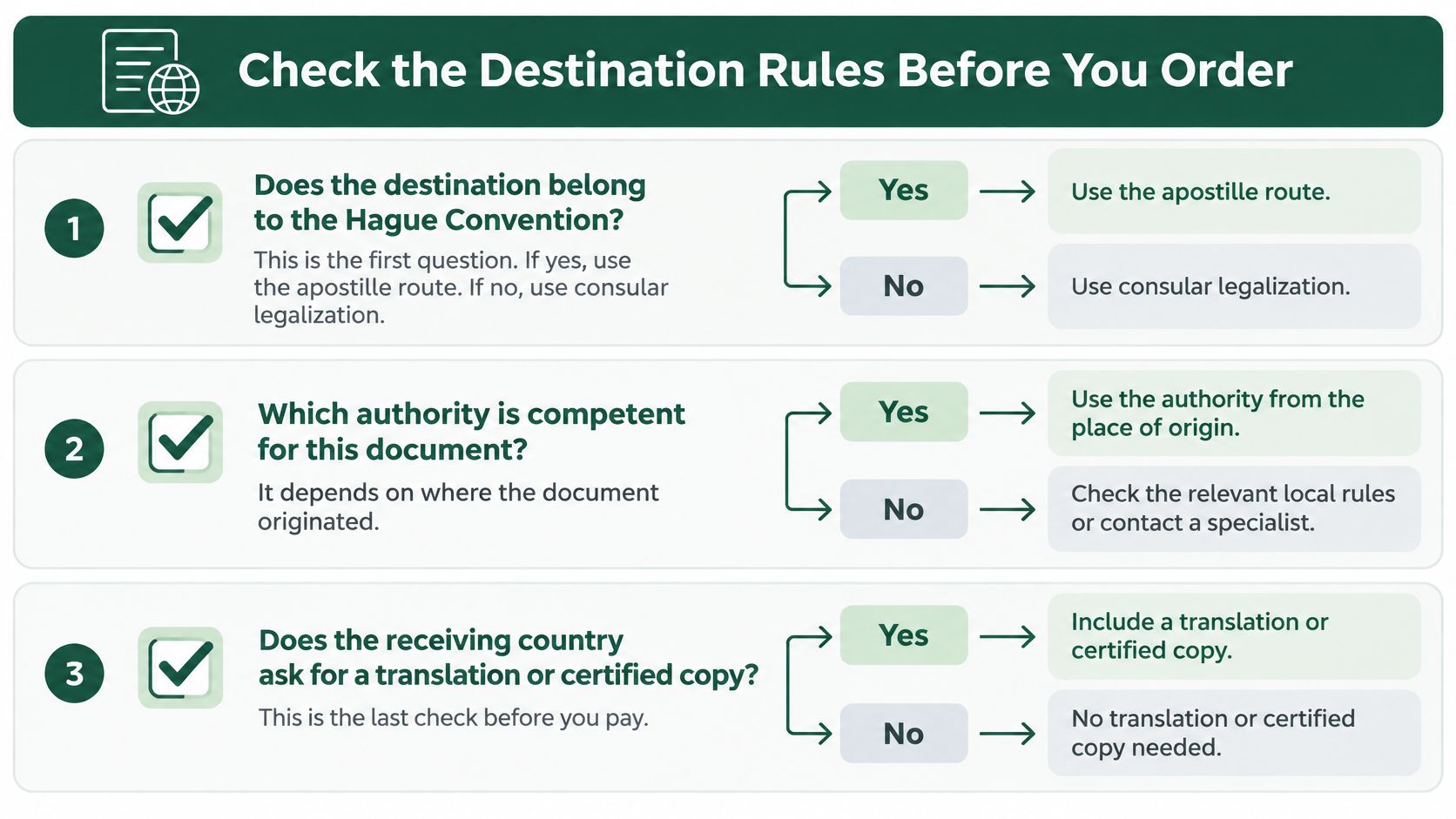
Check the Destination Rules Before You Order
Everything gets simpler when you turn apostille prep into a strict three-question pre-order filter. Work through these three checks in order before paying a single government fee.
Three Questions to Answer Before Submitting
1. Does the destination country belong to the Hague Convention? If yes, follow the apostille route. If no, budget extra time and steps for a consular legalization chain through the destination country's embassy or consulate.
2. Which competent authority holds each document, and does it need notarization first? Sort every paper into public versus private. Public registry extracts, court rulings, vital records, and federal tax certifications go straight to their designated competent authority, while privately signed resolutions and powers of attorney go through a commissioned notary first.
3. Which delivery format, translation standard, and budget match your deadline? Check whether the issuing office offers an e-Apostille, counter pickup, or mail service, then calculate your total outlay by adding per-document apostille fees, certified copy charges, and any special-handling fees for separate signers. At the same time, confirm the recipient's language rules and prepare your certified files properly by checking our guide on how to translate legal documents.
Handling Corporate Formation and Apostilles Online
If you're launching a European company and want the incorporation paperwork and apostilles coordinated from start to finish without juggling notaries, translators, and government offices yourself, handling everything online makes the process effortless. Our Online package of €1,750 includes Bulgarian company registration (EOOD or OOD), EU VAT number, bank account, virtual office and business address, apostilled company documents, certificate of incorporation, and all legal and government fees. Remote company formation takes 3-5 working days after all required documents and payments are received, keeping your timeline predictable from day one.
Take your first concrete step today: list every document you need to send abroad, mark each one as public or private, and write the destination's required issue date and translation rule right beside it. Once that one-page sheet is done, ordering your apostilles becomes a clean, stress-free checklist instead of a guessing game.
FastCorp coordinates remote Bulgarian company formation, EU VAT registration, online notarization, certified translations, and apostilled corporate documents through one online workflow so global founders can start operating without travel or paperwork headaches. Whether you need a new EOOD or OOD ready in days or properly authenticated company records for international banks and partners, our Sofia team handles every filing directly. Explore our online company setup and document services at FastCorp to get your paperwork moving today.