Non Resident Company Formation Your Easy EU Launch Guide
Non resident company formation made simple. Learn how to set up your EU company online, handle VAT, banking and compliance fast with practical tips.
You've registered a company abroad, received the incorporation documents, and then discovered that the difficult question isn't “Can I form it?” It's “Can I open an account, pass KYC, register for VAT, and start invoicing without flying across Europe?”
That distinction changes how you should approach non-resident company formation. Incorporation is only the legal starting point. A usable company needs a credible ownership file, a registered address, clear business activity, suitable banking, VAT planning, and ongoing accounting. Bulgaria stands out because it combines EU incorporation, a 10% corporate income tax rate, remote handling, and a practical online workflow for foreign founders.
Table of Contents
- Why Non Resident Founders Choose an EU Company Now
- How Bulgaria Compares for Tax VAT and Hidden Friction
- Your Online Formation Journey From Documents to Ready Company
- Getting Operational With VAT Registration Banking and Address
- Timelines Costs and Ongoing Compliance Made Simple
- Launch Confidently and Keep Your EU Company Thriving
Why Non Resident Founders Choose an EU Company Now
A freelance consultant in the Middle East may want to invoice European clients through an EU entity. A SaaS founder in Asia may need a company that works naturally with European customers and payment providers. An e-commerce operator may want an EU structure without moving residence. Their goals differ, but the operational problem is similar: they need a company that can function across borders, not merely appear in a register.
An EU company can provide a familiar legal framework for European customers, suppliers, and partners. It can also support access to EU VAT processes and payment infrastructure, depending on the business model, ownership profile, and provider's approval criteria. The company's location won't automatically change the founder's personal tax residence or eliminate reporting obligations at home, but it can create a useful base for international operations.

The founder's real decision
The right question isn't merely, “Which country has the lowest incorporation fee?” Ask instead:
- Can I complete formation remotely? You'll want remote identity checks, electronic document handling, and no unnecessary travel.
- Can the company support my commercial activity? Your business description, customer locations, contracts, and money flows must make sense together.
- Can I satisfy bank or payment-provider KYC? Formation documents alone may not be enough.
- Can I maintain compliance from abroad? Accounting, VAT returns, annual filings, payroll, and statutory reporting need dependable ownership.
Estonia's e-Residency programme is an important historical example of digital identity supporting non-resident company creation. It launched in December 2014 and had granted about 90,000 permits to applicants from 174 countries by February 2021. Those applicants had established more than 20,000 companies, according to UNCTAD's discussion of Estonia's digital company formation model. The lesson is clear: remote company administration is no longer an unusual concept.
Bulgaria appeals to founders who want that remote convenience with a conventional EU limited company structure. The EOOD suits a single owner, while the OOD works where there are multiple owners. In both cases, the practical objective is the same, a properly documented company that can move from registration to commercial activity without creating avoidable friction.
Practical rule: Choose the jurisdiction based on the company you need to operate, not the company that looks cheapest before banking and compliance are added.
The United Kingdom shows how meaningful non-resident participation has become in established formation markets. Official data cited for Q1 2026 recorded 204,612 incorporations in one quarter, roughly 2,500 per working day, and about 30% of new companies had at least one Person with Significant Control who wasn't a British national, as reported in the UK subsidiary analysis. Non-resident formation is mainstream. The smart move is selecting a structure that remains usable after registration.
How Bulgaria Compares for Tax VAT and Hidden Friction
If the company looks attractive on paper but the bank rejects its file, the tax rate has little practical value. Bulgaria works best when founders assess formation as an operational and banking decision first, then compare tax and VAT treatment. Its flat 10% corporate income tax rate is among Europe's lowest in Tax Foundation's 2026 European comparison, giving founders a clear cost advantage over larger EU markets such as Germany, France, Italy, and Spain.
The comparison is broader. A low rate can be offset by a resident-director requirement, a bond, complicated identity checks, or an in-person bank appointment. Ireland demonstrates that trade-off. Without an EEA-resident director, founders need a Section 137 bond, and those without an Irish PPSN may also need a Verified Identity Number, according to this practical Ireland formation guide.
A practical jurisdiction comparison
| Jurisdiction | Corporate Tax | VAT Threshold and Rate | Hidden Friction |
|---|---|---|---|
| Bulgaria | 10% | Mandatory registration at BGN 100,000, roughly €51,130. Standard rate 20%, reduced rate 9% | Remote formation is available, but banking and beneficial-owner checks still require preparation |
| Ireland | Not stated here | Not stated here | Section 137 bond where no director is EEA-resident, plus possible identity-number requirements |
| United Kingdom | Not stated here | Not stated here | UK address, identity verification, and bank acceptance can remain practical hurdles for foreign-owned companies |
| Estonia | Not stated here | Not stated here | Digital administration is strong, but payment acceptance can vary by provider |
| United States | Depends on entity and activity | Not an EU VAT framework | State selection, federal filings, EIN handling, registered-agent arrangements, and banking KYC |
U.S. LLCs show why familiarity does not equal EU usability. Wyoming and Delaware together account for about 90% of foreign-owned LLC formations, according to industry formation research. That concentration reflects founder preference for known legal and administrative systems, yet a U.S. LLC does not automatically provide EU VAT positioning or an EU company presence.
Bulgaria's VAT framework is predictable enough for planning. The standard rate is 20%, the reduced rate is 9%, and mandatory registration begins at annual turnover of BGN 100,000, approximately €51,130, as outlined in the available formation guidance. Businesses below that threshold can assess voluntary registration based on their clients, supplier invoices, and cross-border work.
Remote ID and online formation can remove travel from the setup process, often allowing a company to be established in 3-5 days when the file is complete. Banking remains the main usability test. The company needs a clear activity description, credible ownership information, and evidence that its expected transactions make commercial sense.
For a focused explanation of the tax framework, see Bulgaria's corporate tax rate. The recommendation is direct: founders seeking an EU company should put Bulgaria near the top of the shortlist when they can document operations clearly, accept Bulgarian accounting, and prepare properly for bank and beneficial-owner checks.
Your Online Formation Journey From Documents to Ready Company
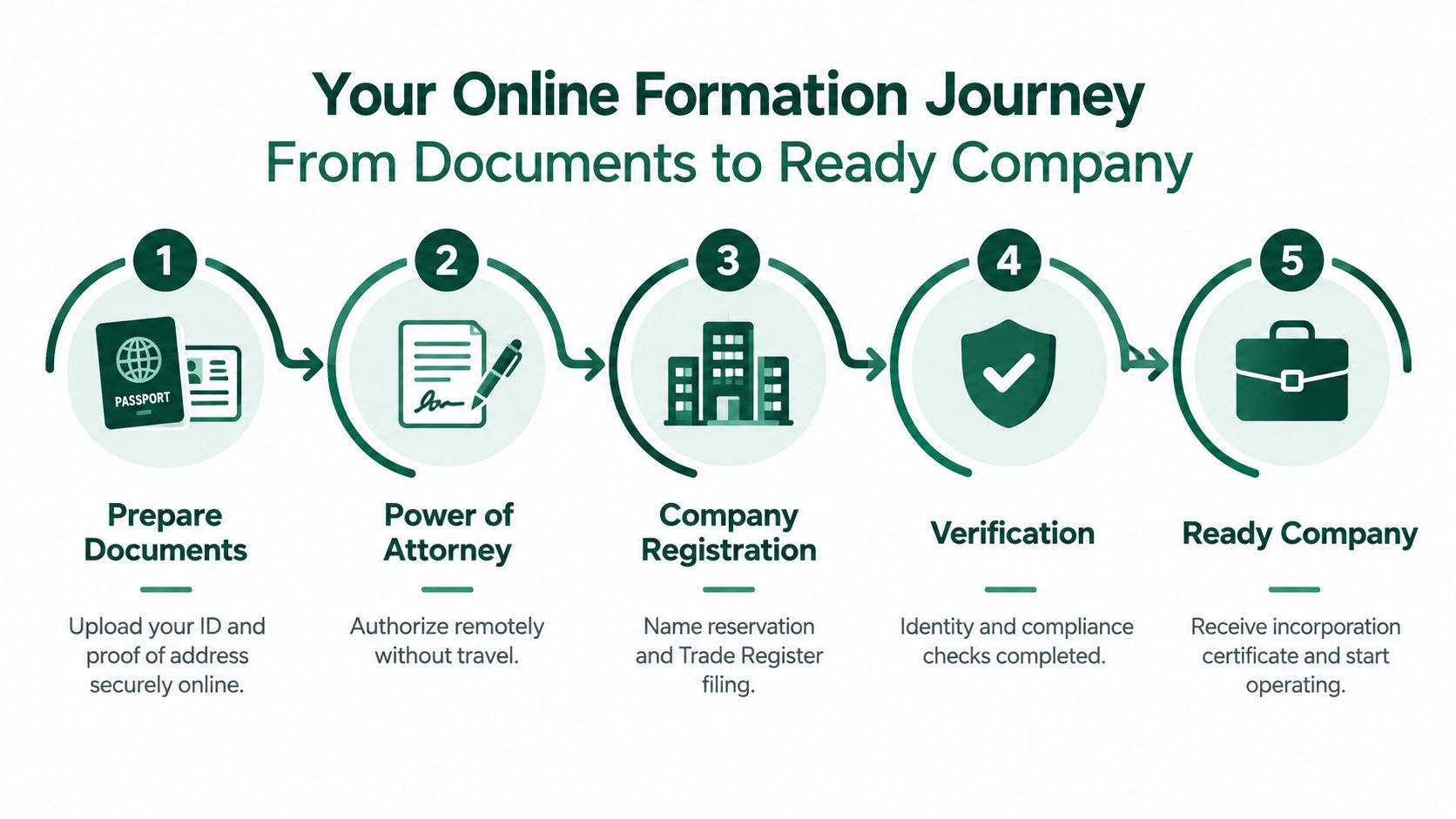
A clean application starts with a clean file. Prepare your passport, proof of residential address, ownership details, proposed company name, business activity, shareholder information, and a concise explanation of how the company will earn and spend money. The purpose isn't bureaucracy for its own sake. These documents form the same factual story that accountants, banks, payment institutions, and compliance teams will later review.
A remote identity process can then verify who you are without requiring travel. Secure online notary procedures and remote signing allow the corporate documents to be prepared and authorized from abroad. If a receiving institution needs legalized or apostilled papers, request those documents as part of the formation workflow rather than treating them as an afterthought.
What the process feels like in practice
A consultant with a simple service business usually has a relatively clear file. The founder can explain the services, identify the client regions, provide contracts or invoices where requested, and show how revenue will reach the company. A SaaS founder should add product information, subscription terms, payment flows, and the locations of key customers. An e-commerce seller should be ready to explain inventory, fulfilment, suppliers, marketplaces, and expected transaction patterns.
The corporate documents are prepared around the agreed ownership and management structure. The filing then moves to the Bulgarian Trade Register. Once registration is complete, the company receives its Certificate of Incorporation and related corporate papers. Where a bank, marketplace, or contracting party asks for formal legalization, apostilled documents can be coordinated at the same time.
A fast filing only helps if the ownership and operating profile are consistent from the first document to the first bank application.
A Sofia virtual office and registered address can provide the company's official local address and mail-handling function. That doesn't turn a virtual office into a place where the company conducts every activity. Describe your real operations accurately, especially if you work from another country, use contractors, store goods elsewhere, or sell through online platforms.
FastCorp's online incorporation service describes a fully online setup in 3–5 working days. That timeline depends on receiving complete information, signing promptly, and avoiding complications in identity or document verification. Remote formation is possible because the process uses prepared statutory documents, online coordination, remote identity verification, and electronic signing instead of repeated visits to Bulgaria.
The company registration itself is only one part of the journey. Before you sign, decide who will own the company, who will manage it, what activities it will conduct, where customers are located, whether VAT registration is needed, and which account providers fit the business. Those choices make the post-incorporation stage much smoother.
The process can also be supported visually through this overview:
Getting Operational With VAT Registration Banking and Address
A company becomes usable only when it can invoice customers, receive funds, pay suppliers, and meet reporting duties. A founder may complete incorporation, then face questions about ownership, source of funds, customers, business activity, and day-to-day management from a bank or payment provider. Treat banking readiness as part of formation, not as an administrative task to handle later.
Bulgaria's VAT rules should shape that plan from the start. The standard rate is 20%, the reduced rate is 9%, and mandatory registration begins at annual turnover of BGN 100,000, roughly €51,130. A company below that threshold can still consider voluntary registration based on its customers, suppliers, cross-border transactions, and expected growth. Review the Bulgaria VAT registration requirements before choosing the timing and structure of the application.
Prepare for the banking file
Possible routes include an online financial provider offering an EU IBAN, a Bulgarian bank, or both. Incorporation does not guarantee approval. Each institution applies its own risk appetite, onboarding rules, and enhanced due diligence requirements.
Prepare a concise banking pack:
- Ownership evidence: Passport copies, shareholder details, and a clear explanation of who controls the company.
- Source of funds: Explain how the initial capital and incoming revenue are generated.
- Operating profile: Describe the product or service, customer locations, suppliers, marketplaces, and expected payment flows.
- Commercial evidence: Keep contracts, invoices, website details, business plans, or platform records available where relevant.
- Address information: Separate your personal residence, registered office, operating location, and correspondence address.
Current KYC guidance shows that providers examine ownership, source of funds, and actual operations rather than relying only on formation documents, as explained in current offshore company bank-account KYC guidance. Some institutions offer remote identity verification. Others may request personal attendance for complex or foreign-owned structures. Choose the provider after reviewing its requirements, not because it advertises an EU IBAN.
Use the address properly
A Sofia virtual office can provide the registered address and mail handling the company needs. It does not prove that the business conducts all trading activity there. State where management works, where goods are stored, and where services are delivered. Banks respond better to a consistent operating profile than to an address that appears disconnected from the business.
Payment acceptance also varies by jurisdiction and provider. A comparative 2026 report found different verified Stripe acceptance rates across U.S. LLCs, UK Ltds, Ireland Ltds, and Estonia OÜs, while UAE-domiciled merchants were not natively supported, according to the global non-resident setup report. Those figures do not predict individual approval. They do show why registration and payment readiness must be assessed separately. A usable company needs a credible VAT position, a clear address story, and banking documents that match the business.
Timelines Costs and Ongoing Compliance Made Simple
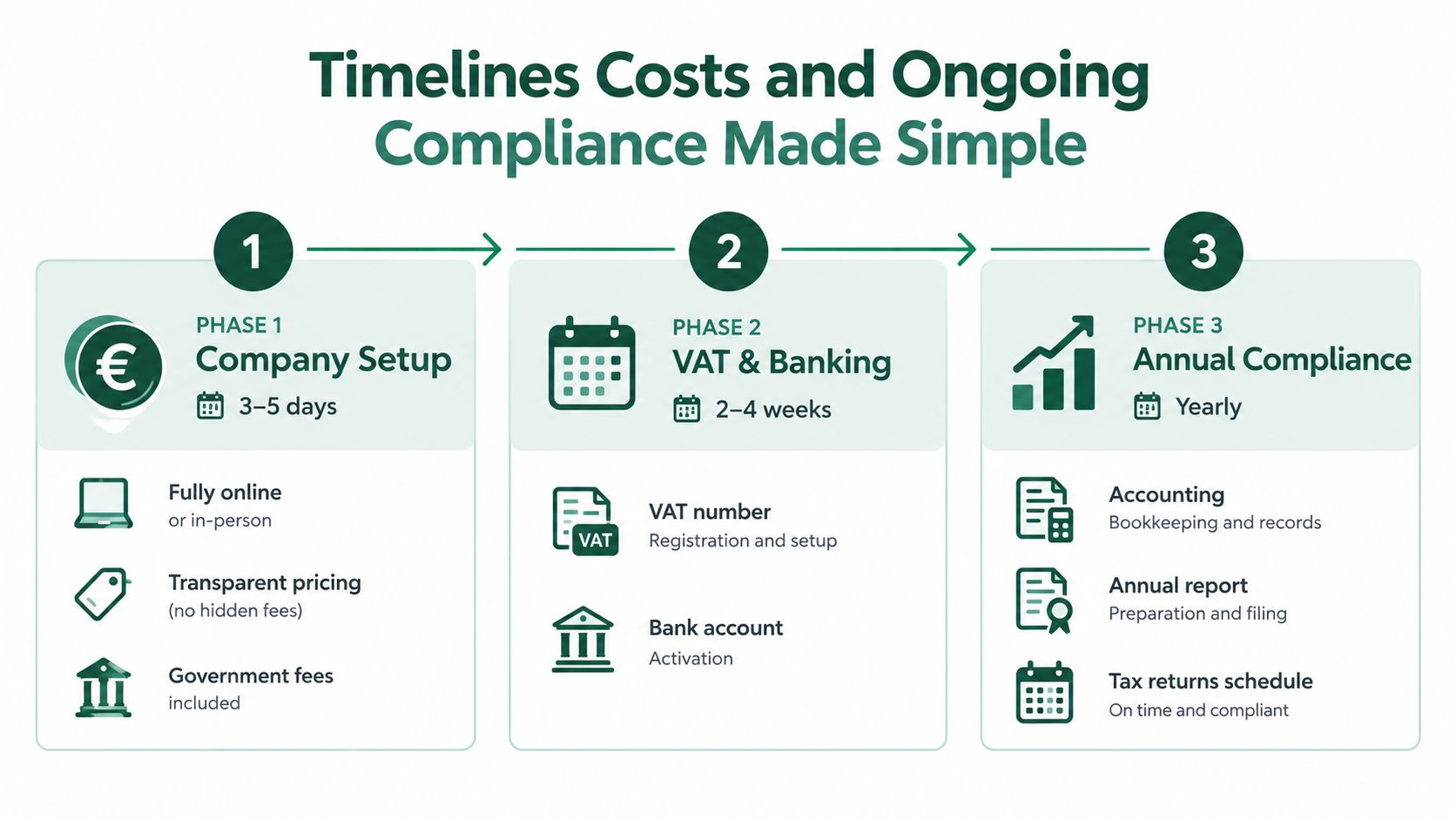
Bulgaria's remote process is designed for founders who want to avoid travel. Fully online setups are presented at €1,750, while in-person setups are €1,500, with legal and government fees included in the relevant package, according to FastCorp's service information. The online route is completed in 3–5 working days, while the in-person Sofia route is completed in 2–3 working days and includes airport pickup in the in-person package.
Those are formation timelines, not a promise that VAT registration or bank activation will finish at the same speed. The bank and tax authority review their own applications, and the timetable depends on documentation, business complexity, identity checks, and the chosen provider.
Budget for the full operating cycle
Your budget should account for more than incorporation. A sensible planning list includes:
- Formation: Company documents, filing coordination, identity verification, and any included government or legal charges.
- Address: Registered office and mail handling in Bulgaria if you don't maintain a suitable local address.
- VAT: Application preparation, registration support, and recurring VAT reporting where applicable.
- Banking: Account-opening assistance and any provider charges, subject to approval.
- Accounting: Bookkeeping, annual accounts, corporate tax filing, and management reporting.
- People: Payroll administration and statutory reporting if the company employs staff.
Annual compliance is easier when one calendar tracks bookkeeping deadlines, VAT returns, annual corporate tax filings, payroll tasks, and statutory reports. Keep business and personal transactions separate, retain contracts and invoices, reconcile accounts regularly, and tell the accountant when ownership, activities, customers, or payment flows change.
Key takeaway: The cheapest formation route isn't the cheapest company if you later pay for rushed banking applications, missing filings, or corrective accounting.
Everything can be handled online when the provider has a coordinated workflow and you submit complete documents. That convenience depends on discipline from both sides. Respond quickly to verification requests, keep your business description current, and don't treat compliance as a once-a-year administrative chore.
Launch Confidently and Keep Your EU Company Thriving
Bulgaria offers a compelling combination for the right non-resident founder: 10% corporate tax, a defined VAT framework, EU incorporation, remote identity and document handling, and an online formation route completed in 3–5 working days, as documented in Bulgaria's remote formation guide. The advantage isn't a low tax rate in isolation. It's the ability to connect formation with address support, VAT preparation, banking assistance, and ongoing accounting.
Use this launch checklist before you file:
- Define the activity: Explain exactly what the company sells, who buys it, and where customers are located.
- Choose the structure: Select an EOOD for a single owner or an OOD where multiple owners are involved.
- Prepare the KYC file: Gather identity, address, ownership, source-of-funds, and commercial documents.
- Plan VAT early: Decide whether the turnover threshold or cross-border activity makes registration appropriate.
- Select banking realistically: Apply with a provider whose onboarding model fits your ownership and operating profile.
- Protect good standing: Arrange bookkeeping, VAT returns, annual corporate tax filings, payroll, and statutory reporting before trading begins.
Non resident company formation doesn't need to become a complicated relocation project. With accurate documents, a credible operating explanation, and one coordinated online workflow, you can establish an EU company without unnecessary travel and build the compliance habits that keep it useful as your business grows.
FastCorp helps non-resident founders incorporate Bulgarian EOOD and OOD companies, arrange EU VAT support, assist with EU IBAN banking, provide a Sofia registered address, and manage ongoing accounting and compliance online. Visit FastCorp to review the online formation route and start preparing your company documents.