Dividend Withholding Tax Made Easy: Rates and Treaties
Learn how dividend withholding tax works, compare rates by country, and cut what you pay with treaties, EU rules and Bulgarian certificates.

The 2024 OECD average statutory dividend withholding tax rate for low- and middle-income jurisdictions was 12.2% (OECD Corporate Tax Statistics 2024). Treat that figure as context, not a payout forecast. The cash deducted depends on the shareholder's tax residence, the treaty or EU rule that applies, and whether the required proof is in the payment file before the transfer.
A reduced treaty rate does not guarantee that the cash arrives at that rate. If the paperwork is missing or late, the payer may withhold more and the shareholder may need to seek a refund, tying up funds in the meantime. A headline rate alone cannot show the timing or cash-flow cost.
The practical focus is the rate by country, the rules that may reduce it, Bulgaria's default rate, the documents that support relief, and the steps for applying it or recovering an overpayment. Treat withholding as both a rate calculation and a file-readiness problem.
Table of Contents
- What Dividend Withholding Tax Is and Why It Comes Out First
- Dividend Withholding Rates Compared Across Countries
- How Tax Treaties and EU Rules Lower the Bill
- Bulgaria's Withholding Rules for Non-Resident Shareholders
- Documents That Decide Whether Relief Applies
- Cutting Withholding Step by Step and Recovering Overpayments
- Set the Payout Once the File Is Ready
What Dividend Withholding Tax Is and Why It Comes Out First
A toll booth sits between the profit and the shareholder, and the country where the profit was earned staffs it.

Dividend withholding tax is a source-country tax, deducted by the company or paying agent before a dividend reaches a non-resident shareholder. That definition comes from the OECD's Corporate Tax Statistics 2025, whose dataset covers 146 jurisdictions. It isn't a second tax invented by the shareholder's home country. It's the paying country taking its share first, at the moment the cash crosses the border.
Six facts decide how much of that toll you pay. Change one of them and the number moves.
- The shareholder's tax residence. A German-resident parent and a UAE-resident parent holding identical shares don't face the same source-country rate.
- Whether a bilateral treaty exists. Treaty-based dividend rates cluster well below 5% in the OECD data, against standard domestic rates that run far higher.
- The shareholder's legal form. A company and an individual can sit under different rules for the very same distribution.
- The ownership percentage. Treaties routinely split a direct corporate parent from a portfolio investor and price them differently.
- Beneficial ownership. If the recipient is a conduit rather than the true owner, relief doesn't follow the paperwork.
- Whether the evidence is in the file before payment. This is the expensive one, because missing documents force the domestic rate first and the refund argument second.
Say the domestic rate on a dividend is 15%. Under a treaty it might drop to 5%, and under an EU rule it might disappear entirely, but only after residence, ownership and beneficial-owner status are tested and documented. Relief is not automatic; it is granted on evidence, and the payer is the one holding the evidence.
Practical rule: the headline domestic rate is the starting line, never the finish. Budget on the domestic rate and treat any relief as cash you have to qualify for.
So work in this order: the standard rate in the paying country, the rule that applies to your specific recipient, the evidence behind that rule, and only then the payment date.
Dividend Withholding Rates Compared Across Countries
A 35% domestic rate leaves €30 less from a €100 dividend than a 5% rate. The table compares illustrative standard domestic rates at source; actual treatment depends on the rules for the recipient.
| Country | Standard dividend rate | What it means for a shareholder |
|---|---|---|
| United Kingdom | 0% | No standard withholding at source |
| Brazil | 0% | No standard withholding at source |
| Peru | 5% | Low standard rate |
| Greece | 5% | Low standard rate |
| Bulgaria | 5% | Standard rate; recipient-specific rules may apply |
| Germany | 25% | High standard rate |
| Ireland | 25% | High standard rate |
| Chile | 35% | Highest rate in this comparison |
| Switzerland | 35% | Highest rate in this comparison |
On a €100 dividend, the amounts left after standard withholding are €100 at 0%, €95 at 5%, €75 at 25% and €65 at 35%. These figures show the initial cash withheld, not the final tax cost if relief or a refund applies.
The averages behind the table
The OECD's 2024 Corporate Tax Statistics reports a 12.2% average standard dividend withholding rate across 146 jurisdictions (OECD Corporate Tax Statistics 2024). This is a domestic-rate benchmark, not a rate that predicts the withholding on a specific payment.
Bulgaria's 5% standard rate is lower than the 25% and 35% rates shown above. For a shareholder, the difference between the rate withheld and the rate ultimately due can remain tied up as cash until the required documents support relief or a refund.
Record the standard rate and the amount withheld for each planned dividend. Then compare the withholding with the rate that applies to the recipient. A lower eligible rate helps only if the paperwork is ready in time; otherwise, the initial cash deduction may have to be recovered later.
How Tax Treaties and EU Rules Lower the Bill
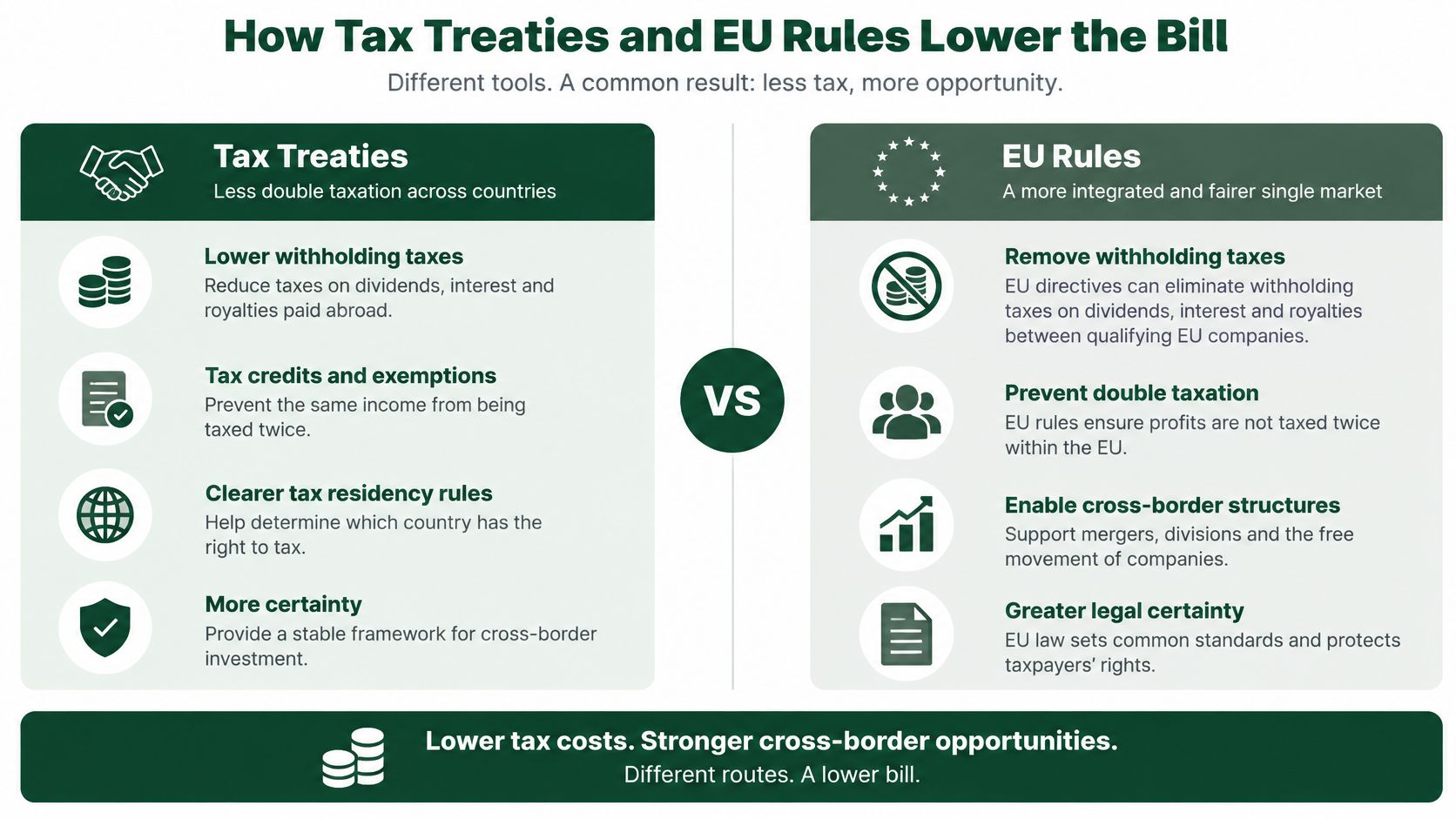
Two routes bring the bill down, and they work in different ways. One trims the rate; the other can remove it.
Here's how the two compare side by side.
Route one is the bilateral treaty
A treaty between the source country and the shareholder's residence country lowers the source-country rate, and it usually does so by category. A direct corporate parent holding a specified percentage often gets a better rate than a portfolio investor holding a small stake. Model both versions for your shareholding, because the threshold decides which one you get.
Route two is the EU Parent-Subsidiary Directive
The European Commission states that the directive exempts dividends and other profit distributions paid by a subsidiary in one Member State to its parent in another Member State from withholding tax, subject to the directive's conditions (European Commission, Parent-Subsidiary Directive). Its modern anti-abuse framework comes from Council Directive (EU) 2015/121, adopted on 27 January 2015, with the amended system in force since 17 February 2015.
That difference matters. A treaty turns a 15% or 20% rate into something like 5%. The directive can take the tax off the table entirely for a qualifying group. But it isn't universal: you need a qualifying parent, an eligible subsidiary, EU residence on both sides, and satisfied ownership and anti-abuse tests. Cross-border structures live or die on those tests, and the structure has to be decided before the dividend, not after. Our cross-border tax planning walkthrough covers how holding layers change which route is even available.
If you'd rather see the mechanics laid out, this walkthrough covers the two routes quickly.
Neither route is automatic. Map both for every recipient before you assume either one applies, and write the conclusion into the payment file.
Bulgaria's Withholding Rules for Non-Resident Shareholders
Bulgaria starts at 5% and, for individuals, stays there. Bulgaria generally applies a 5% withholding tax to dividends and liquidation proceeds paid to resident or non-resident individuals, and the Ministry of Finance states that dividends paid to non-resident legal entities are also subject to a 5% rate under Article 194 of the Corporate Income Tax Act, subject to applicable exemptions and treaty provisions (Bulgarian Ministry of Finance).
Turn that into money. A €10,000 dividend to a non-resident individual means €500 withheld at source and €9,500 landing in the shareholder's account. No form rescues the €500 after the fact unless a treaty says otherwise, so the check happens before the transfer.
Who is on the other side of the payment
| Recipient | Bulgarian withholding | What to verify before payment |
|---|---|---|
| Individual, resident or non-resident | 5% final tax | Tax residence and treaty provisions if claimed |
| Non-resident legal entity, default case | 5% under Article 194 of the Corporate Income Tax Act | Applicable exemptions and a current residence certificate |
| EU or EEA corporate recipient, qualifying case | Exemption may apply | Qualifying status and beneficial-owner declaration |
| Non-resident legal entity, treaty country | Treaty rate, depends on the country | Ownership threshold and beneficial-owner evidence |
Walk your own case down that table. An individual shareholder is the simplest file: 5%, final, done, and the only question is whether any treaty provision is being claimed. A non-resident company lands on Article 194 at 5% unless an exemption or a treaty applies, which is where the residence certificate earns its keep. An EU or EEA corporate recipient is the case worth chasing hardest, because a qualifying exemption can mean nothing is withheld at all. The treaty row is the one that needs the most evidence, not the least, since the rate depends on ownership and on who owns the income.
Three habits keep this clean. Confirm the recipient category in writing before you approve the distribution, record which rule you applied and why, and keep the residence certificate inside the payment file rather than in an email thread. Our guide to corporate tax filings for Bulgarian companies covers how this sits alongside your annual reporting.
Compared with the 25% and 35% rows in the international table, Bulgaria's default is modest. That's precisely why the next check matters: a missed document turns a 5% starting point into a refund claim.
Documents That Decide Whether Relief Applies
A low rate you can't prove is a high rate you'll pay. That's the assumption almost every rate comparison gets wrong, because a treaty rate is an entitlement you have to evidence, not a price list you can point at.
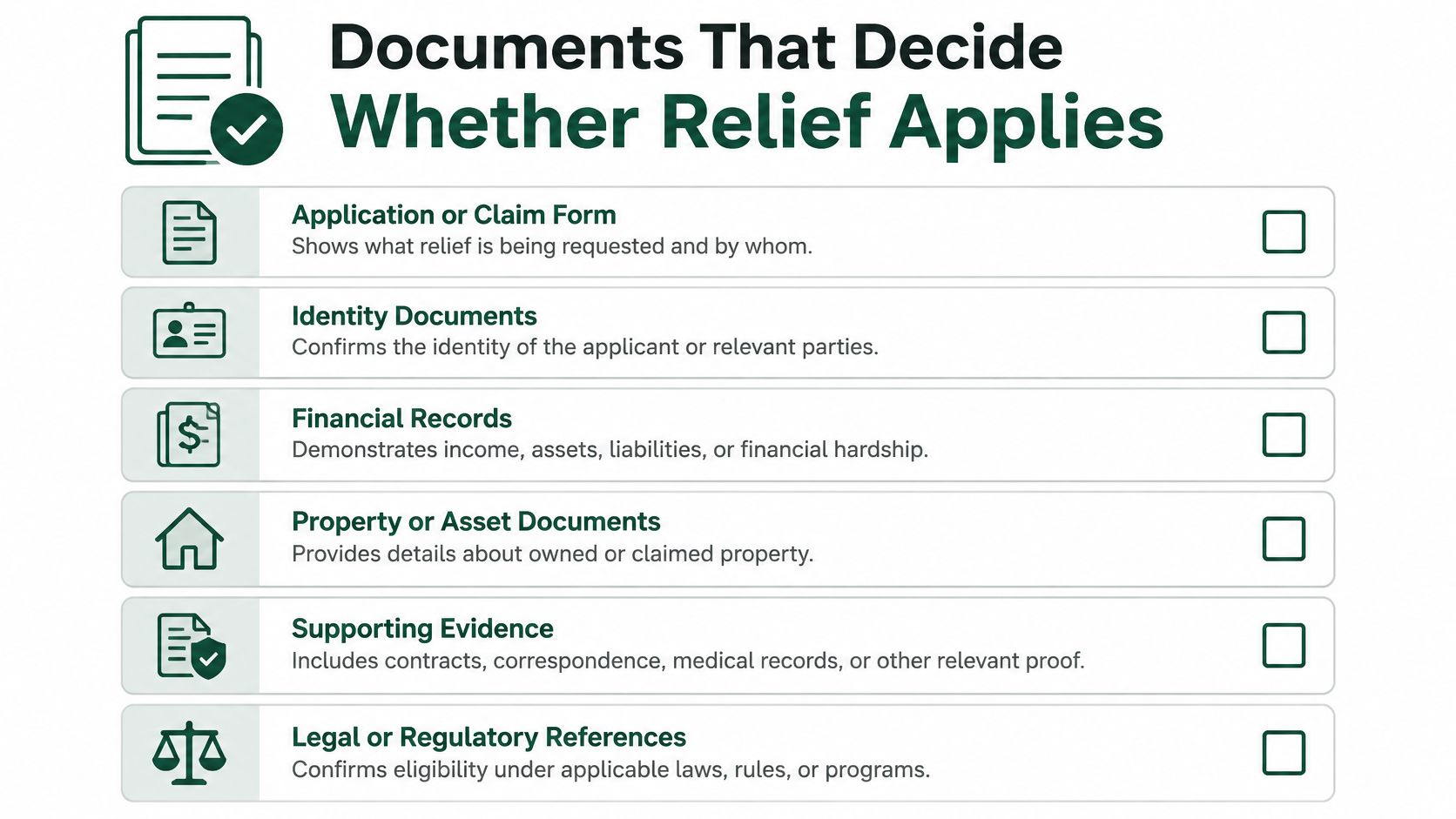
EU rules require evidence such as a tax-residence certificate, entitlement to treaty or domestic relief, and, where required, a declaration that the investor is the beneficial owner. The framework links eligibility to the registered owner being entitled to relief, while Bulgarian practice can require evidence of residence, beneficial ownership, the contractual relationship, and the actual accrual or payment of income (EU Directive 2025/50).
Build one evidence file per payment, and put these in it:
- A current tax-residence certificate issued by the shareholder's own tax authority for the relevant period.
- Proof of entitlement to the treaty rate or domestic exemption you're applying, matched to the recipient's legal form.
- A beneficial-owner declaration, signed by someone authorised to bind the recipient.
- The contract and payment records that show the income accrued to that entity.
The questions rate tables never answer
Who signs the beneficial-owner statement? A director or authorised representative of the recipient, and the signatory has to match the entity named in the share register and the payment instruction. When does the residence certificate need renewing? Most authorities issue it by tax year, so treat a January certificate as evidence for a January payment and refresh it for a distribution declared in December.
What records support the claim? The shareholder resolution, the payment instruction, the shareholding records and the contract behind the receivable. How do nominee, holding or pass-through arrangements change the analysis? They put beneficial ownership squarely in play, and that's where relief is most often refused.
The cash-flow consequence is blunt. Failed paperwork forces withholding first and recovery later, which turns a tax question into a loan you made to a tax authority at 0% interest. Documents you submit may also be shared with Bulgarian government authorities such as the Commercial Register and the National Revenue Agency, so accuracy matters beyond the payment itself. Our guide to the tax residency certificate covers what a valid one contains.
Cutting Withholding Step by Step and Recovering Overpayments
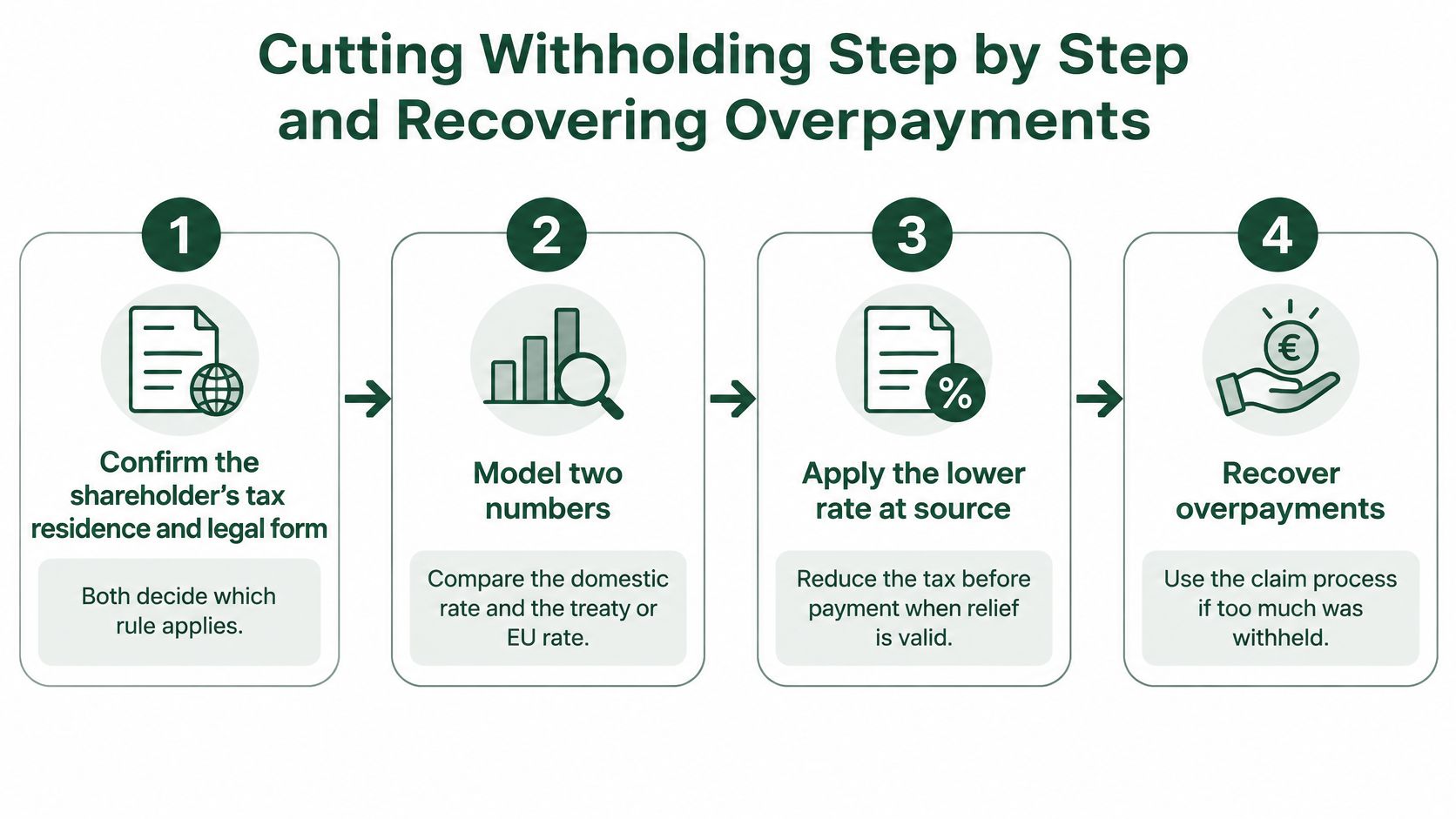
The rate on paper does not guarantee the cash you receive. Six steps help you apply relief correctly and recover excess tax if the payment has already been made.
- Confirm the shareholder's tax residence and legal form. These determine which domestic rate, treaty provision or exemption may apply. A mistake here undermines every later step.
- Calculate both rates before declaring the dividend. Compare the domestic rate with the treaty or directive rate you may qualify for. The difference shows how much cash is at stake. If you pay first and claim relief later, the excess stays out of your hands until the refund arrives.
- Check every condition for the lower rate. Review ownership thresholds, beneficial ownership and anti-abuse rules. Record how the recipient meets each requirement so the basis for relief is clear.
- Prepare the residence certificate and declaration before payment. Make sure the certificate covers the relevant period and the beneficial-owner declaration is signed by someone authorised to represent the recipient.
- Apply the supported rate at source and keep the evidence with the payment record. This keeps the eligible amount in the company's cash flow instead of tying it up in a refund claim.
- Claim a refund if too much tax was withheld. Follow the applicable forms, deadlines and evidence requirements. The refund process takes place on the tax authority's timetable, not yours.
How refunds actually work now
The EU's FASTER Directive, published in January 2025, introduces standardized fast-track relief for excess withholding tax through relief at source or a quick-refund process. The European Commission describes reimbursement within 50 days from payment, while the EU summary of the FASTER rules describes a 60-calendar-day deadline after the refund-request period. Check the applicable national rules before counting on a refund date, because that timing determines how long the cash may remain tied up.
The framework focuses on qualifying cross-border portfolio dividends and registered intermediaries. It does not automatically cover every private-company dividend or every founder using a newly formed EU entity. Check whether the dividend qualifies and whether the bank or broker is a certified intermediary in the EU registration system.
Cash-flow tip: Add the expected refund window to the payment calendar. If relief is not available at source, account for the withheld amount as cash you cannot use until the refund is paid.
Set the Payout Once the File Is Ready
Everything else on this page is paperwork, and paperwork is now a desk job. The residence certificate, the beneficial-owner declaration, the shareholder resolution: all of it can be prepared, signed and stored without a flight to Sofia. FastCorp sets up Bulgarian companies fully online, with remote identity verification and a secure online notary handling signatures, and registration takes 3 to 5 working days once the required documents and payments arrive. The same all-in-one service covers company registration, VAT, banking, accounting and a virtual office, so the dividend file sits beside the books instead of in a folder someone forgets.
One boundary is worth stating plainly. FastCorp is not a law firm or a tax authority, and the company remains legally responsible for its own withholding, reporting and accuracy. Confirm any treaty or exemption position with a qualified adviser before you rely on it.
Then do the one thing that sets the payment date. Match the recipient's residence and legal form to a row in the Bulgarian table, apply only the rate that row and its evidence support, and leave the transfer unscheduled until the row and the file agree. Online setup is quick; the tax decision stays with the company.
A Bulgarian company can be registered remotely in 3 to 5 working days, with EU VAT, banking, accounting and a virtual office handled under one roof, so the dividend file and the books stay in the same place from day one of trading. If you're planning a distribution to a non-resident shareholder this year, build the recipient evidence before you build the payment instruction. Visit FastCorp to start the setup online and get your Bulgarian company reporting on schedule.