Accounting for SaaS Companies: A Practical 2026 Guide
Learn accounting for SaaS companies step by step: revenue recognition, deferred revenue, EU VAT OSS, tax comparisons and a practical month-end close.

Your bank balance looks healthy. An annual subscription has just landed, your billing dashboard shows a strong month, and you're deciding whether to hire. Then your accountant asks how much of that money you've actually earned, which customers belong on an OSS return, and why the payment processor's payout doesn't match your invoices.
Accounting for SaaS companies starts with three separate records: cash, invoices and earned revenue. Keep them connected, but don't treat them as interchangeable. That separation gives you usable management accounts, defensible tax reporting and investor metrics you can explain without rebuilding a spreadsheet.
Table of Contents
- How Revenue Recognition Works for SaaS Subscriptions
- Handling Multi-Currency Billing and FX Differences
- How to Run a Month-End Close That Reconciles Revenue
- EU VAT and the OSS Return for Cross-Border Software Sales
- Corporate Tax Compared Across Popular EU Locations
- The Rule of 40 and Retention Metrics Investors Check
- Pick an Accounting Setup for Your EU SaaS Company
How Revenue Recognition Works for SaaS Subscriptions
Say 12,000 EUR arrives on 1 March for continuous platform access over the next twelve months, excluding VAT. It's tempting to call the whole deposit March revenue. But the customer has prepaid for a service you still owe.
Record the receipt as a contract liability, commonly called deferred revenue. As you provide access, release the appropriate amount into revenue. Your bank account measures available cash, your invoice register records what you've billed, and your revenue schedule records what you've earned.
Start with the promises in the contract
For companies reporting under U.S. GAAP, ASC 606 uses a five-step model, described in Stripe's revenue recognition guide: identify the contract, identify performance obligations, determine the transaction price, allocate it using relative standalone selling prices, and recognize revenue as each obligation is satisfied.
Don't apply a subscription template before reading the agreement. Hosted access, implementation, training and premium support may represent different promises. A setup task that only prepares your own platform doesn't automatically deliver a distinct benefit to the customer.
Revenue treatment by SaaS contract type
| Contract scenario | Cash timing | Revenue pattern | Ledger entry |
|---|---|---|---|
| Annual subscription paid upfront, 12,000 EUR | Day 1 | 1,000 EUR per month over 12 months | Dr Cash, Cr Deferred revenue, then monthly release |
| Monthly subscription | Each month | In the month the service is delivered | Dr Cash or AR, Cr Revenue |
| Distinct implementation fee | At signing | As the work is delivered | Dr Cash, Cr Revenue on delivery |
| Non-distinct setup fee | At signing | Over the subscription term | Dr Cash, Cr Deferred revenue |
| Usage consumption fees | After period close | As consumed, estimated when data is late | Dr AR, Cr Revenue with accrual |
| Refund or service credit | Later | Reduces the transaction price | Dr Revenue, Cr Refund liability |
The annual amounts are the hypothetical contract above. The entries are simplified: an invoice may create accounts receivable before cash arrives, advance implementation payments remain deferred until delivery, and unbilled usage may require a contract asset rather than receivables.
Make the journal entries match delivery
For that annual example, the monthly release is Dr Deferred revenue, Cr Subscription revenue. Keep VAT outside the subscription revenue calculation.
For usage charges, set a documented cut-off for product telemetry. If usage arrives late, retain the estimate, its calculation and the later adjustment. Don't overwrite last month's calculation when the final usage file arrives.
Practical rule: A billing event isn't evidence that you've satisfied a performance obligation.
Refunds need similar care. A credit relating to future access may reduce deferred revenue rather than current-period revenue. Review what the credit compensates for before choosing the account.
Pull your largest annual invoice from last year today. Compare its service dates with the revenue schedule and confirm that recognition followed delivery, rather than the invoice date.
Handling Multi-Currency Billing and FX Differences
Multi-currency accounting goes wrong when teams translate the invoice, settlement and service schedule independently. Start by determining the entity's functional currency from its operating circumstances. Don't assume it's EUR solely because the company is registered in the EU.
Store the contract's billing currency, payment terms and original amounts. Record the applicable exchange rate alongside each accounting event so another person can reproduce the entry.
Separate settlement gains from sales
Consider a hypothetical customer invoiced 1,000 USD in January at 0.92 EUR per USD. The receivable is 920 EUR. If payment arrives in February at 0.94 EUR per USD, the cash received is 940 EUR, creating a 20 EUR exchange gain, assuming no intervening remeasurement or fees.
That gain isn't additional subscription revenue. It belongs in the foreign-exchange account, with a clear link to the settled receivable.
Be careful with deferred revenue. A non-refundable advance for future services is generally a non-monetary liability, so it isn't automatically retranslated at every month-end. Open foreign-currency receivables are monetary balances and require a different treatment. Refundable obligations may need separate analysis.
Use these checks before closing:
- Preserve the rate evidence. Store the rate source, applicable date and retrieval timestamp with the transaction.
- Classify balances correctly. Remeasure open monetary receivables and payables; review deferred balances under the applicable accounting policy.
- Reconcile gross settlements. Match processor payouts to invoices, fees, refunds and currency conversions.
- Flag currency mismatches. Review payments arriving in a different currency from the customer's invoice.
A bookkeeping software comparison should test these capabilities using an actual invoice and settlement, not just a feature checklist.
A clean FX account contains explainable translation and settlement differences, not unexplained billing discrepancies.
If there's no exchange-rate difference, conversion spread or relevant remeasurement, the transaction shouldn't produce an FX entry. Require a written explanation for any residual amount rather than forcing it into revenue.
How to Run a Month-End Close That Reconciles Revenue
Build the close around reconciliations, not a dashboard screenshot. Rillet's SaaS revenue recognition guide identifies the essential connections between invoices, receivables, cash, deferred revenue and active service periods.
Set an owner and deadline for each reconciliation before month-end. Lock the books only after the reviewer has cleared exceptions or documented approved adjustments.
Follow the transaction through the books
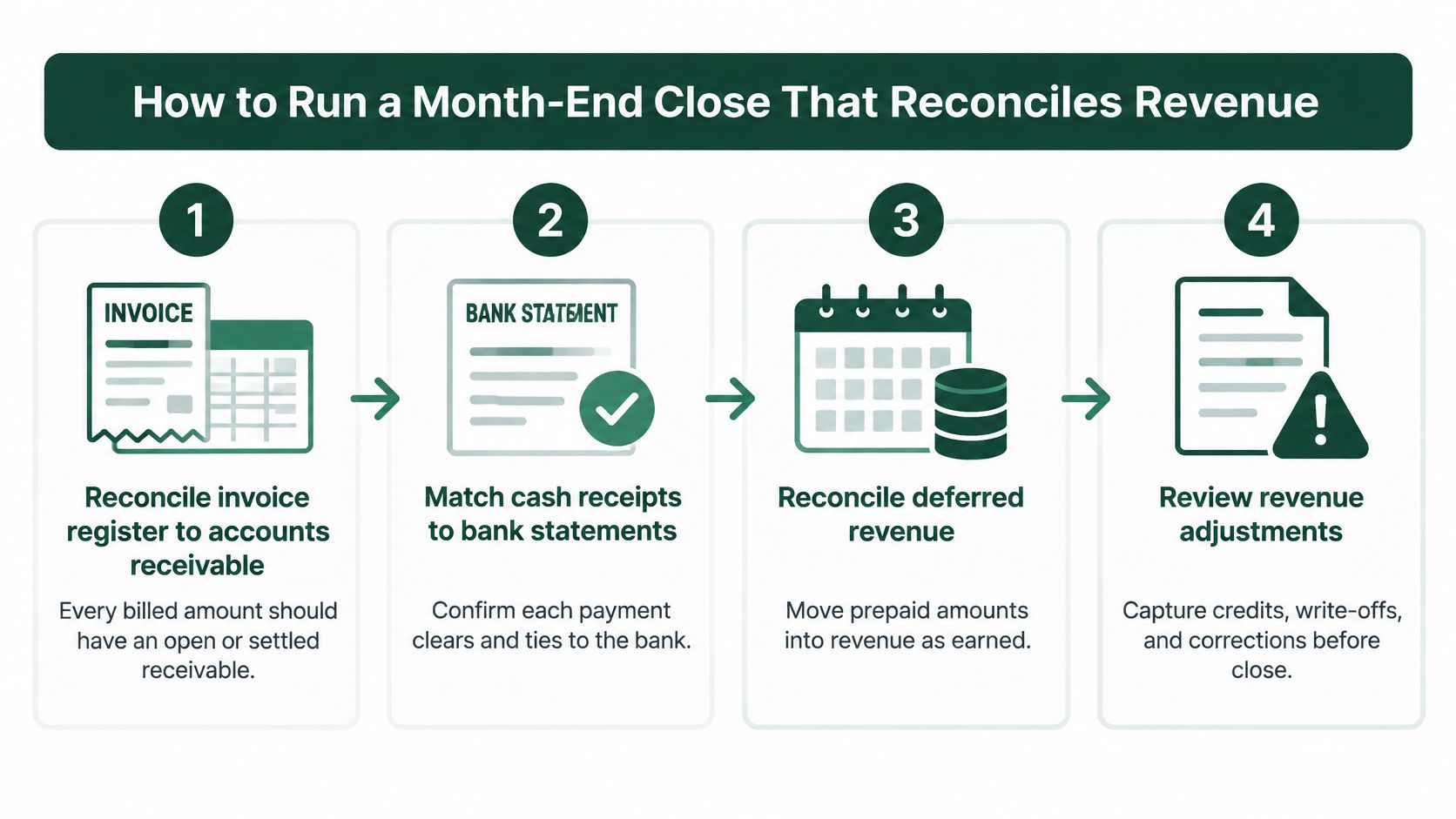
Reconcile invoices to accounts receivable. Every invoice must have an open balance, settlement or documented credit. Missing credit notes and duplicated imports are common causes of differences.
Match cash to banks and processors. Reconcile gross customer payments, processor fees and net payouts separately. Don't reduce revenue by processing fees when gross presentation is required.
Roll forward deferred revenue. Connect the opening balance to contract-level movements and the closing ledger balance. Immediately recognizing annual prepayments leaves this reconciliation incomplete.
Validate service periods. Tie recognized revenue to contract start dates, end dates, renewals and plan changes. A renewed invoice doesn't justify continuing an expired service schedule unchanged.
Review exceptions. Investigate negative deferred balances, revenue after cancellation, missing service dates, unusual discounts and manual journals. Assign each exception to someone who can resolve the underlying source record.
Keep operating metrics separate. Reconcile ARR, MRR, retention and acquisition-cost reports to their source records without posting them as accounting revenue. A management dashboard isn't a journal-entry instruction.
The visual below summarizes the main reconciliation flow.
Use a controlled deferred-revenue waterfall
Opening deferred revenue + billings posted to deferred revenue − recognized revenue − refunds charged against deferred revenue ± applicable FX adjustments = closing deferred revenue.
Use signed movements consistently. Exclude VAT and invoices recognized directly as earned revenue, and don't subtract the same credit through both billings and refunds.
Maintain a written policy for implementation costs and sales commissions. Assess whether each category should be expensed or capitalized under the applicable framework, rather than choosing whichever treatment improves this month's margin. Review manual journals and integration duplicates monthly.
Our approach to automation in accounting should be judged by the audit trail and exception handling it supports. At FastCorp, we handle registration, VAT, banking and bookkeeping for companies we set up, with ongoing services agreed separately.
Automation can accelerate matching and schedule generation. Staff still need to review unusual pricing, tax treatment and customer-location evidence. The sign of a clean close is every variance explained before the books lock.
EU VAT and the OSS Return for Cross-Border Software Sales
A Bulgarian SaaS company selling to customers in Germany, France and Spain doesn't automatically charge Bulgarian VAT on every invoice. Customer status, location and the nature of the service determine the treatment.
For qualifying cross-border consumer sales, destination-based VAT means applying the rate relevant to the customer's country. The EU's One Stop Shop guidance explains how eligible businesses register through a member state, submit a single periodic OSS return and pay through that country, which distributes the amounts to the countries of consumption.
Build tax evidence into checkout
Don't leave customer classification until filing time. Make the billing workflow collect the information finance needs before issuing the invoice.
- Identify the customer. Establish whether the buyer is a business or consumer and validate relevant VAT details. For qualifying cross-border business supplies, assess reverse-charge VAT rather than treating every foreign customer alike.
- Collect location evidence. Use two non-conflicting pieces where required, such as billing address, bank information or IP-derived location. Investigate contradictions rather than automatically accepting the cheapest tax outcome.
- Apply the correct treatment. Use the relevant destination rate for eligible consumer sales and preserve the invoice record.
- Reconcile before filing. Match billing transactions, credits and refunds to the OSS report, separating transactions that belong on other returns.
- Retain the audit trail. Keep invoices, transaction records, validation results and supporting location evidence together.
The operational work happens at the intersection of checkout configuration and finance review.

Separate registration from ongoing reporting
Our company setup package includes an EU VAT number. That registration doesn't replace the need to determine whether OSS applies or to classify transactions correctly.
A tax engine can apply your configured rules consistently, including incorrect ones. Review missing countries, failed VAT validations and conflicting location evidence before filing.
Check your sales mix now: business versus consumer, domestic versus cross-border, direct versus marketplace sales. For marketplace transactions, establish who is responsible for collecting and reporting VAT under the actual arrangement. Don't assume the party transferring cash to your bank is also the customer for every tax purpose.
Corporate Tax Compared Across Popular EU Locations
Headline corporate tax and VAT rates in selected EU locations
The figures below are headline comparison assumptions, not a filing determination. Confirm the rules effective for your accounting period, income category and company size before choosing a jurisdiction.
| Location | Statutory CIT rate | Standard VAT rate | What to check next |
|---|---|---|---|
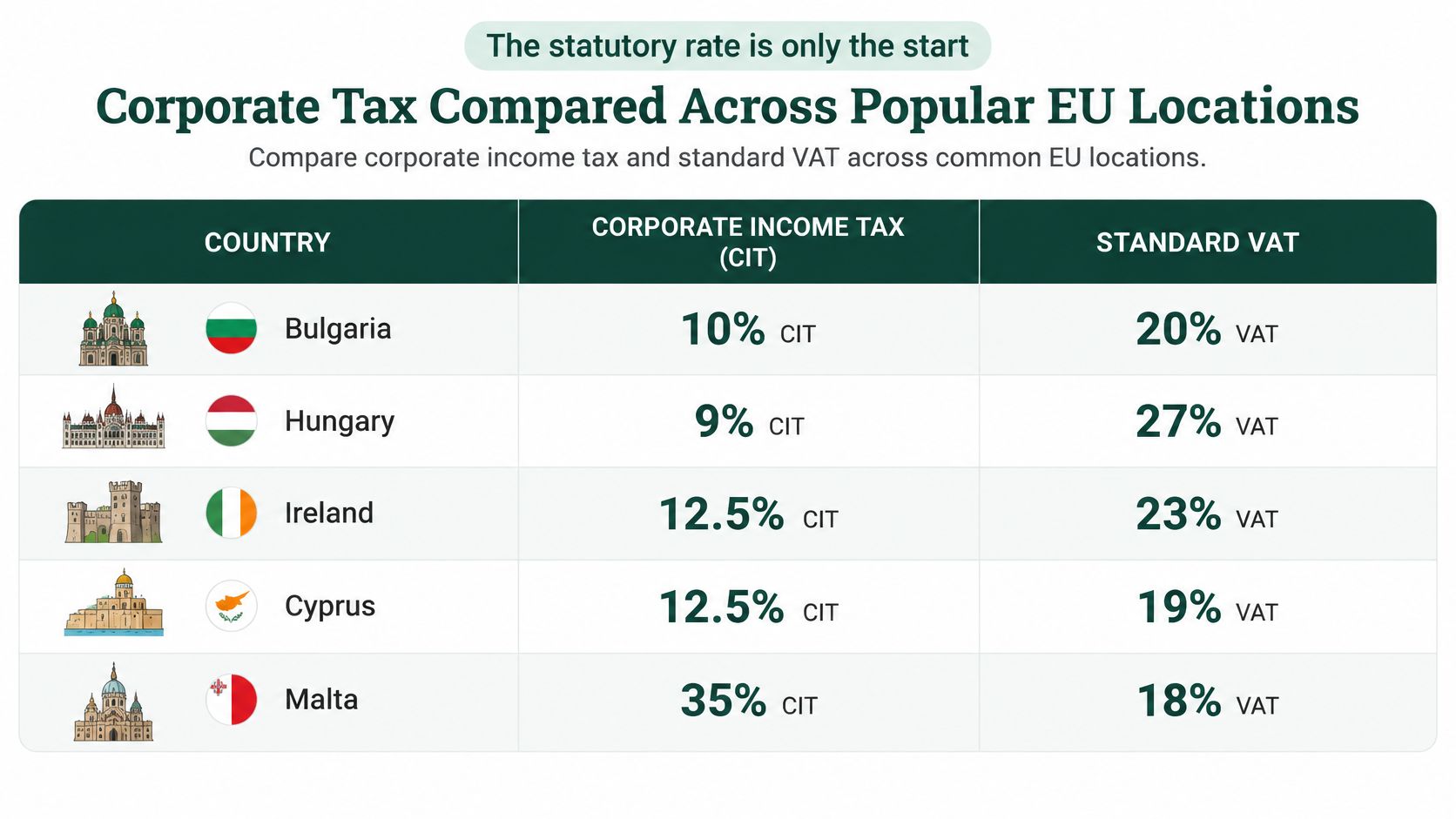
| Bulgaria | 10% | 20% | Payroll, withholding and dividend tax |
| Hungary | 9% | 27% | Local levies and VAT registration |
| Ireland | 12.5% for qualifying trading income | 23% | Trading income versus other income |
| Estonia | 0% on retained profit; 22% on distributed profit | 24% | Tax triggered at distribution |
| Netherlands | 25.8% headline rate | 21% | Substance and withholding rules |
| Germany | About 30% combined with trade tax | 19% | Trade tax and municipal rates |
The OECD's Corporate Tax Statistics 2025 identifies Bulgaria among jurisdictions that reduced their statutory corporate income tax rate by at least 20 percentage points between 2000 and 2025. That history helps explain Bulgaria's appeal, but it doesn't establish your group's effective tax burden.
Compare the operating structure, not just the rate
An incorporation address doesn't relocate the people running your business. Developers, sales staff and managers working elsewhere can create taxable-presence, employment and transfer-pricing questions outside the company's registration country.
Model these costs separately:
- Corporate income tax. Apply the relevant rules to taxable profit, including adjustments and reliefs.
- VAT obligations. Evaluate customer location and sales channels, not just the domestic standard rate.
- Employment costs. Include payroll taxes, social contributions and local administration.
- Payments abroad. Review withholding on relevant cross-border payments and dividend distributions.
- Substance and administration. Budget for genuine operations, accounting, filings and governance.
- Related-party charges. Document management services, development arrangements and intellectual-property payments.
The following visual offers an additional headline comparison. Treat it as an orientation aid and verify current local rules before relying on its figures.
Run the same business through both options
To compare Bulgaria with Ireland, for example, start with the same contracts, staffing plan, operating costs and expected distributions. Map where employees work and where directors make decisions.
Then calculate company-level taxes, employment costs, owner-level distributions and recurring compliance costs separately. Add the cost of maintaining the required substance in each location.
Decision test: If the apparent saving disappears when you include the people and administration needed to operate legally, the headline rate wasn't the right basis for the decision.
Keep the invoice, cash and revenue assumptions identical across both models. Otherwise, you're comparing different businesses rather than different locations.
The Rule of 40 and Retention Metrics Investors Check
Investors want to know whether growth is durable and whether the business can fund it. Your reporting needs to distinguish customer expansion from new sales, and operating performance from cash collection.
Use customer-level records to support that discussion, not a manually adjusted presentation.

Calculate growth and efficiency consistently
The Rule of 40 adds annual revenue growth percentage to EBITDA-margin percentage; a combined result of at least 40% is commonly used as a balance-of-growth-and-efficiency benchmark, as discussed in BCG's Rule of 40 analysis. Using the illustrative calculations, a company growing 55% with a negative 20% EBITDA margin scores 35%, while growth of 30% and a 12% margin produces 42%.
The score isn't a substitute for cash forecasting. Review the growth period, EBITDA definition and expense classification before comparing companies. Capitalization policies and inconsistent adjustments can make superficially similar scores difficult to interpret.
Reconcile retention to customer movements
Gross revenue retention measures recurring revenue retained from an existing customer cohort before expansion. It cannot exceed the starting cohort's revenue. Net revenue retention includes upsells and cross-sells, alongside contraction and churn.
Build a customer movement schedule rather than estimating retention from total revenue. Separate:
- New subscriptions. Revenue from customers outside the opening cohort.
- Expansion. Additional recurring commitments from existing customers.
- Contraction and churn. Reduced commitments and lost subscriptions.
- Acquisition spending. Consistently classified sales and marketing costs supporting CAC analysis.
Use this control:
Opening ARR + new ARR + expansion ARR − contraction ARR − churned ARR = closing ARR.
Tie closing ARR to active subscriptions under a documented definition. Then bridge it to accounting revenue, explaining service timing, usage, non-recurring services and currency treatment rather than forcing equality.
For a visual discussion of the growth-and-profitability framework, use the video below.
Give every metric a named owner and a stable calculation policy. That makes a board question about churn a customer-level investigation, not an argument about which spreadsheet is correct.
Pick an Accounting Setup for Your EU SaaS Company
Choose the operating model around your contracts and reporting needs. An in-house team gives you direct control and faster access to commercial decisions, but requires recruitment, supervision and specialist coverage.
A generic bookkeeper can work for straightforward subscriptions if someone owns revenue schedules and tax decisions. An integrated formation and accounting provider reduces handoffs, but the service scope must explicitly cover the work your SaaS model creates.
Match the service to the workload
| Route | Strongest fit | Main trade-off |
|---|---|---|
| In-house finance | Complex contracts, frequent decisions and internal reporting demands | Higher fixed staffing and management commitment |
| General bookkeeper | Simple billing with clearly documented policies | Specialist revenue and cross-border tax work may sit elsewhere |
| Integrated provider | Non-resident founders coordinating formation and ongoing administration | Scope and data responsibilities need clear agreement |
Assess invoice volume, billing currencies, OSS requirements, payroll and speed to market. Request a sample close pack and confirm who prepares the contract schedule, reviews tax exceptions and authorizes journals.
FastCorp's Online package costs €1,750 and includes EOOD or OOD registration, an EU VAT number, a bank account, virtual office and business address, apostilled company documents, certificate of incorporation, and all legal and government fees. Online setup is completed in 3–5 working days. Banking assistance supports applications with suggested providers such as Revolut, Wise, UniCredit and Paysera, subject to their onboarding requirements.
Keep the workflow online and the responsibilities clear
Company formation, VAT registration, banking assistance and the virtual office can be coordinated through secure online forms and document upload. The process starts with your setup form, followed by checkout and submission of the company details needed for formation.
Bookkeeping, tax and full compliance support are optional after setup. For the ongoing workflow, agree a shared digital ledger and supporting schedules so the monthly close, OSS records and deferred-revenue calculations are accessible without chasing paper.
We're not a law firm or tax authority. You remain legally responsible for the company's activities, tax obligations and reporting accuracy, even when preparation and filing are delegated.
FastCorp offers Bulgarian company formation, VAT registration, banking assistance and optional ongoing bookkeeping and compliance support for SaaS founders. Visit FastCorp, start with the setup form, and bring your monthly-close checklist, OSS requirements and deferred-revenue schedule so we can agree the service scope before your first invoice.