Thin Capitalization Rules Explained for Global Founders
Understand thin capitalization rules, EBITDA limits, and cross-border financing risks for EU and Bulgarian companies. Practical advice

Maya is a Singapore-based SaaS founder who has just incorporated a Bulgarian EOOD and needs cash in the business immediately. She wires a €400,000 shareholder loan to cover payroll, cloud infrastructure, and AWS bills. A few weeks later, her Bulgarian accountant warns her that part of the interest may not be deductible, increasing the company's taxable profit even though the cash has already left the business.
That's the practical trap behind thin capitalization rules. The loan itself isn't automatically the problem. Tax authorities look at the relationship between debt and equity, the company's earnings, the timing of funding, and whether the loan terms resemble an arm's-length commercial arrangement. For a cross-border founder, the financing decision and the tax decision are inseparable. A useful starting point is this guide to cross-border tax planning, but the funding structure needs its own analysis.
Table of Contents
- Why Thin Capitalization Rules Matter to New EU Founders
- What Thin Capitalization Rules Actually Do
- Debt-to-Equity Tests vs EBITDA Earnings-Stripping Limits
- A Worked Example Under Bulgaria's 3 to 1 Thin Cap Rule
- How Bulgaria, Germany, Belgium and the Czech Republic Compare
- Common Compliance Pitfalls and Safe-Harbour Strategies
- How FastCorp Handles Thin-Cap Compliance Fully Online
- Action Plan and Founder FAQ for Thin-Cap Compliance
Why Thin Capitalization Rules Matter to New EU Founders
Maya's structure looks ordinary from a business perspective. A founder lends money to a newly formed company, the company pays its operating costs, and the company records interest expense. The tax authority sees a different question: why was this capital provided as debt rather than equity, and does the Bulgarian company have enough equity to support the related-party borrowing?
That question matters because interest is generally treated more favorably than dividends for corporate tax purposes. A company may deduct qualifying interest, while a dividend is paid from after-tax profit. If a multinational group loads a local subsidiary with excessive related-party debt, it can move profit out of the country through interest payments. The OECD describes this as a debt-versus-equity distortion and links thin-capitalization policy to the risk of profit shifting through excessive intragroup debt in its thin-capitalisation framework.
The risk starts before the first tax return
New companies often have little operating history, limited equity, and significant startup spending. That combination can make shareholder debt look commercially sensible while still creating a tax issue. A long-term, unsecured loan with no realistic repayment timetable and a rate that hasn't been benchmarked can look less like bank financing and more like equity wearing a loan agreement.
Bulgaria uses a hybrid approach. The separate thin-capitalization regime applies when the average debt-to-equity ratio exceeds 3:1, while an additional interest-limitation rule applies when net interest and other borrowing costs exceed BGN 3 million in a calendar year. The additional deduction limit is 30% of tax-adjusted EBITDA, and the separate 3:1 test still applies to all taxpayers, according to this Bulgaria business and tax overview.
Practical rule: Treat every shareholder loan as a tax-sensitive instrument from the day it's negotiated, not from the day the accountant prepares the annual return.
The right response isn't to avoid debt altogether. Debt can preserve ownership, provide working capital, and give a founder flexibility while revenue is still developing. The right response is to decide how much funding should be equity, how much can be debt, what repayment terms are credible, and what evidence will support the arrangement if the Bulgarian tax authority reviews it.
What Thin Capitalization Rules Actually Do
A shareholder loan can create a tax problem even when the documents call it debt. Warning signs include weak security, open-ended repayment, unreliable borrower cash flow, and terms an unrelated lender would reject. The economic substance may look like permanent capital rather than genuine borrowing.
Thin-capitalization rules let tax authorities restrict the financing cost deducted from taxable profit. Depending on the country, the adjustment may be a disallowed interest deduction, a deemed distribution, or another domestic tax consequence. The legal loan usually remains in place. The restriction affects its tax treatment.
Three tests, three different questions
A debt-to-equity test examines the balance sheet and asks whether related-party debt exceeds a permitted multiple of equity. Bulgaria's traditional test uses the 3:1 ratio, calculated by reference to average debt and equity rather than only the year-end position. Bulgaria's rules and exclusions are outlined in this KPMG country profile.
A fixed-ratio interest test compares interest with another tax measure. It can restrict a deduction even when the balance sheet appears adequately capitalized, because the test focuses on the amount of interest claimed.
An EBITDA-based earnings-stripping test limits net interest by reference to tax-adjusted earnings. The European model generally uses a 30% of EBITDA ceiling, with a EUR 3 million threshold under the EU framework, as summarized in this Tax Foundation review of European thin-capitalization rules. OECD BEPS Action 4 helped move international policy toward this earnings-based method.
Article 4 of the EU Anti-Tax Avoidance Directive requires member states to operate an EBITDA-based interest-limitation rule, subject to the directive's design options and safe harbours. A country without an obvious ratio test can still restrict interest through an earnings-stripping provision. Non-resident founders should therefore review both the funding structure and the local implementation before incorporating, including during FastCorp's fully online setup workflow.
Bulgaria requires two monitoring exercises. Test related-party debt under the 3:1 rule, then check whether the BGN 3 million threshold and 30% tax-adjusted EBITDA ceiling apply. One test does not replace the other, so the financing model and supporting records should be prepared before funds move into the company.
Debt-to-Equity Tests vs EBITDA Earnings-Stripping Limits
For a non-resident founder funding a Bulgarian company, the two tests answer different questions. A debt-to-equity test can restrict interest because related-party debt is excessive compared with equity, even if the company has strong earnings. An EBITDA earnings-stripping test can restrict the deduction because net interest is high relative to current earnings, even when the balance sheet appears reasonably funded.
Europe has broadly shifted toward earnings-based limits. The common model caps net interest at 30% of EBITDA, while EU rules generally permit deductions up to 30% of taxable EBITDA or EUR 3 million, whichever is higher. Article 4 of the Anti-Tax Avoidance Directive requires each member state to apply an EBITDA-based interest-limitation rule, subject to permitted design choices and safe harbours. A country can therefore restrict interest without using a traditional ratio.
Germany provides a useful comparator. Its modern regime focuses on earnings stripping rather than a classic balance-sheet test. Net interest deductions are generally capped at 30% of taxable EBITDA, excess interest may be carried forward indefinitely, and a safe harbour applies below €3 million of net interest expense, according to this analysis of Germany's interest barrier.
Belgium applies a similar approach, limiting interest deductions to the higher of €3 million or 30% of EBITDA. The Czech Republic uses the 30% EBITDA standard with a CZK 80 million threshold. These comparisons show why founders should check local implementation rather than rely on the label attached to a country's thin-capitalization rules.
| Feature | Debt-to-Equity Test | EBITDA Earnings-Stripping |
|---|---|---|
| Core question | Is related-party debt excessive compared with equity? | Is net interest excessive compared with earnings? |
| Main measurement | Balance-sheet leverage | Tax-adjusted EBITDA and net borrowing costs |
| Planning advantage | Easy to model before borrowing | Links deductions to earning capacity |
| Compliance burden | Debt tracing, equity calculation, averaging | Earnings adjustments, interest classification, carryforward tracking |
| Main weakness | Can ignore profitability and repayment capacity | Can restrict deductions during low-earnings periods |
| Bulgarian relevance | 3:1 related-party debt-to-equity test | BGN 3 million threshold and 30% tax-adjusted EBITDA ceiling |
The policy direction is clear. An Oxford tax working paper reported that many OECD countries tightened their rules during the period examined, with several moving from safe-harbour methods to earnings-stripping rules. For a Bulgarian setup through FastCorp's fully online 3 to 5 day workflow, model both debt stock and interest flow before funds move. Prepare the shareholder-loan terms, equity records, interest calculations, and carryforward tracking at the same time.
A Worked Example Under Bulgaria's 3 to 1 Thin Cap Rule
A Sofia-based EOOD starts with EUR 200,000 of equity and receives a EUR 1.2 million shareholder loan at 6% annual interest. The debt-to-equity ratio is 6:1, which exceeds Bulgaria's 3:1 related-party threshold. For a founder using FastCorp's fully online setup, this calculation should be completed before the loan is funded, not after the first tax return.
Assume the amounts are converted at 2 BGN for each EUR. The loan is BGN 2.4 million, equity is BGN 400,000, and annual interest is BGN 144,000. At a 3:1 ratio, the debt ceiling based on BGN 400,000 of equity is BGN 1.2 million.
| Input | Amount (BGN) | Calculation Logic | Result |
|---|---|---|---|
| Shareholder loan | 2,400,000 | EUR 1.2 million × 2 | Related-party debt |
| Equity | 400,000 | EUR 200,000 × 2 | Capital base |
| Permitted debt at 3:1 | 1,200,000 | BGN 400,000 × 3 | Ratio ceiling |
| Excess debt | 1,200,000 | BGN 2.4 million minus BGN 1.2 million | Above the ratio |
| Annual interest | 144,000 | BGN 2.4 million × 6% | Recorded interest |
| Simplified deductible share | 72,000 | 50% permitted debt share of total debt | Illustration only |
| Simplified restricted share | 72,000 | Total interest minus deductible share | Non-deductible portion |
On this simplified basis, half of the related-party debt exceeds the 3:1 ceiling, so half of the interest is treated as non-deductible for the illustration. The actual computation must apply Bulgaria's required averaging and tax adjustments rather than relying only on the year-end balance. Certain bank-loan and finance-lease interest may be excluded, although related-party backing can change the result, as noted earlier.
The BGN 3 million rule is a separate gate
The assumed annual interest of BGN 144,000 is below the BGN 3 million net-interest threshold. The additional 30% tax-adjusted EBITDA restriction therefore does not apply to these figures. If net interest and other borrowing costs later exceed BGN 3 million, the company must calculate the EBITDA-based limit as well and apply the relevant Bulgarian rules.
Disallowed interest is a corporate tax restriction, not automatically a dividend. The company must still keep the loan in its records, accrue accounting interest correctly, and check whether Bulgarian carryforward rules allow later use of the restricted amount.
Build the file before the money moves
Prepare the following records before funding:
- Loan agreement: State the principal, maturity, repayment schedule, security, covenants, default terms, and payment dates.
- Transfer-pricing support: Benchmark the interest rate against comparable arm's-length financing and explain why the company can support the debt.
- Thin-cap schedule: Reconcile average debt, equity, related-party balances, interest, exclusions, and the annual tax-return disclosure.
- Cash evidence: Retain bank transfers, interest payments, board approvals, and correspondence showing the commercial purpose.
A correct ratio calculation cannot fix implausible financing terms. Set the capitalization, loan documents, interest rate, and tax schedule together before the funds move.
How Bulgaria, Germany, Belgium and the Czech Republic Compare
The same EUR 1.2 million related-party loan can produce different tax results across the EU. Each jurisdiction tests financing differently and offers different relief. Bulgaria starts with its 3:1 related-party debt-to-equity rule, then adds an earnings-based restriction when the BGN 3 million threshold is crossed.
Germany uses an earnings-stripping regime. Net interest is generally measured against 30% of taxable EBITDA, with excess interest carried forward indefinitely. The German reform replaced a more traditional thin-capitalization approach with an earnings-based rule, making Germany a clear example of this wider shift, as explained in this comparative analysis of the German reform.
Belgium applies the higher of €3 million or 30% of EBITDA for its interest limitation. The Czech Republic applies a 30% EBITDA standard with a CZK 80 million threshold, according to the European country comparison. These thresholds become more significant as borrowing costs grow. A startup below a threshold still needs a sound financing structure, because threshold relief does not remove every related-party or transfer-pricing issue.
| Jurisdiction | Primary Test | Threshold | De Minimis | Disallowed Interest Treatment |
|---|---|---|---|---|
| Bulgaria | 3:1 debt-to-equity plus additional earnings-based limitation | BGN 3 million for the additional interest rule | Certain financing exclusions may apply | Corporate-level non-deductibility, with carryforward treatment subject to Bulgarian rules |
| Germany | 30% of taxable EBITDA | EUR 3 million net interest safe harbour | Net interest below EUR 3 million | Excess interest can be carried forward indefinitely |
| Belgium | 30% of EBITDA, with the higher threshold framework | EUR 3 million or 30% of EBITDA | Higher of the stated amounts | Deduction restricted under the earnings-stripping rule |
| Czech Republic | 30% EBITDA standard | CZK 80 million threshold | Threshold-based relief | Deduction restricted under the local interest-limitation framework |
Do not choose a jurisdiction by headline corporate tax rate alone. Compare the rate with funding rules, banking requirements, VAT administration, transfer-pricing work, and the treatment of future losses. A comparison of the lowest corporate tax rates in Europe helps with the first filter, but it cannot replace a capital-structure review.
For a non-resident founder setting up a Bulgarian EOOD through FastCorp's online 3–5 day workflow, the practical choice is clear. Start with the intended funding mix, test the Bulgarian rules, and document the commercial purpose before transferring funds. The advantage of Bulgaria's 10% corporate tax setup is useful only when the debt and equity structure supports the deduction.
Country selection and financing selection are one decision. A Bulgarian EOOD funded with sensible equity and documented debt may be easier to operate than a nominally attractive structure that creates recurring interest denials elsewhere.
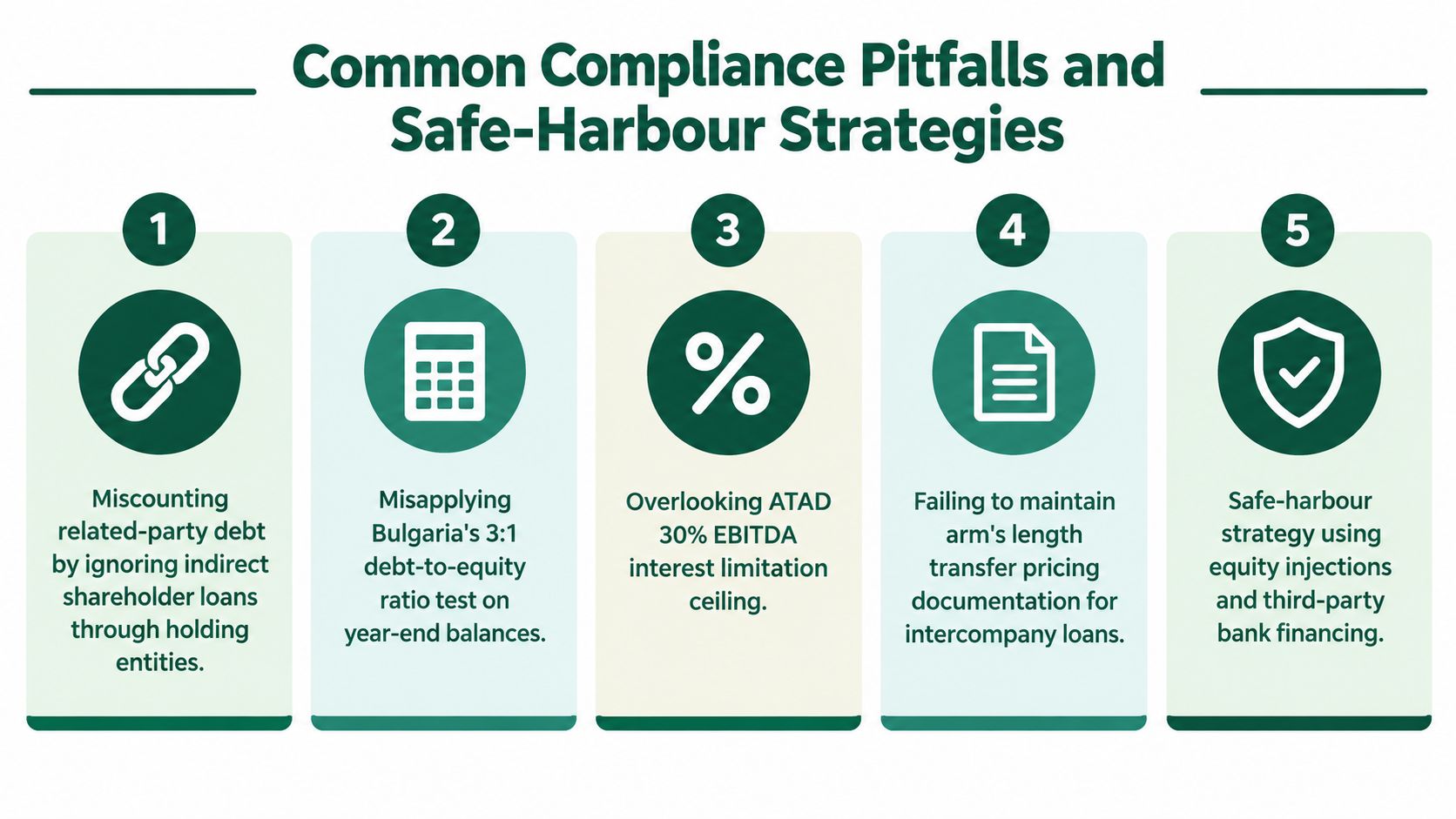
Common Compliance Pitfalls and Safe-Harbour Strategies
Founders usually don't lose interest deductions because they intended to avoid tax. They lose them because the financing file was assembled as a corporate formality rather than as evidence of a real commercial transaction.
Trace the entire financing chain
A related party may sit several steps above the Bulgarian company. The lender could be an individual shareholder, a holding company, a trust-linked entity, or another group company funded by the shareholder. Ignoring the indirect chain can produce an incomplete debt calculation and an inaccurate disclosure.
Don't rely on the balance shown by the Bulgarian operating company alone. Map the lender, beneficial owner, guarantor, source of funds, and any back-to-back arrangement.
Treaty relief requires separate attention. A treaty rate for interest withholding tax doesn't automatically restore an interest deduction denied under domestic thin-capitalization rules. The updated OECD commentary reinforces that a thin-capitalization disallowance doesn't automatically create a corresponding adjustment under treaty transfer-pricing logic, as discussed in this commentary on the OECD model updates.
Use safeguards that match the business
- Fund early uncertainty with equity: Equity is less flexible than debt, but it doesn't create the same recurring interest-deduction pressure while the company is loss-making or lightly profitable.
- Benchmark every related-party rate: A signed loan agreement isn't a transfer-pricing analysis. Document credit risk, maturity, security, currency, repayment capacity, and comparable market terms.
- Monitor monthly, not annually: A year-end ratio can hide earlier borrowing, cash sweeps, refinancing, or periods when the company had insufficient equity.
- Use third-party borrowing where commercially available: Bank financing can improve the credibility of the capital structure, but guarantees and related-party support still need review.
- Model EBITDA before borrowing: Earnings-based limits can bind when revenue is delayed, margins fall, or a business invests heavily before monetization.
Founder-level decision: Keep enough equity to absorb a weak trading period, then use debt for a defined commercial purpose with a repayment plan you could defend to an unrelated lender.
The most reliable safe harbour isn't a clever ratio. It's a financing file that links the amount borrowed to a business need, demonstrates repayment capacity, and reconciles every related-party balance to the tax return.
How FastCorp Handles Thin-Cap Compliance Fully Online
A fully online setup works only when incorporation and tax operations share the same information. The founder shouldn't have to repeat beneficial-owner details to a formation provider, a bank, an accountant, and a transfer-pricing adviser while each keeps a separate version of the capital structure.
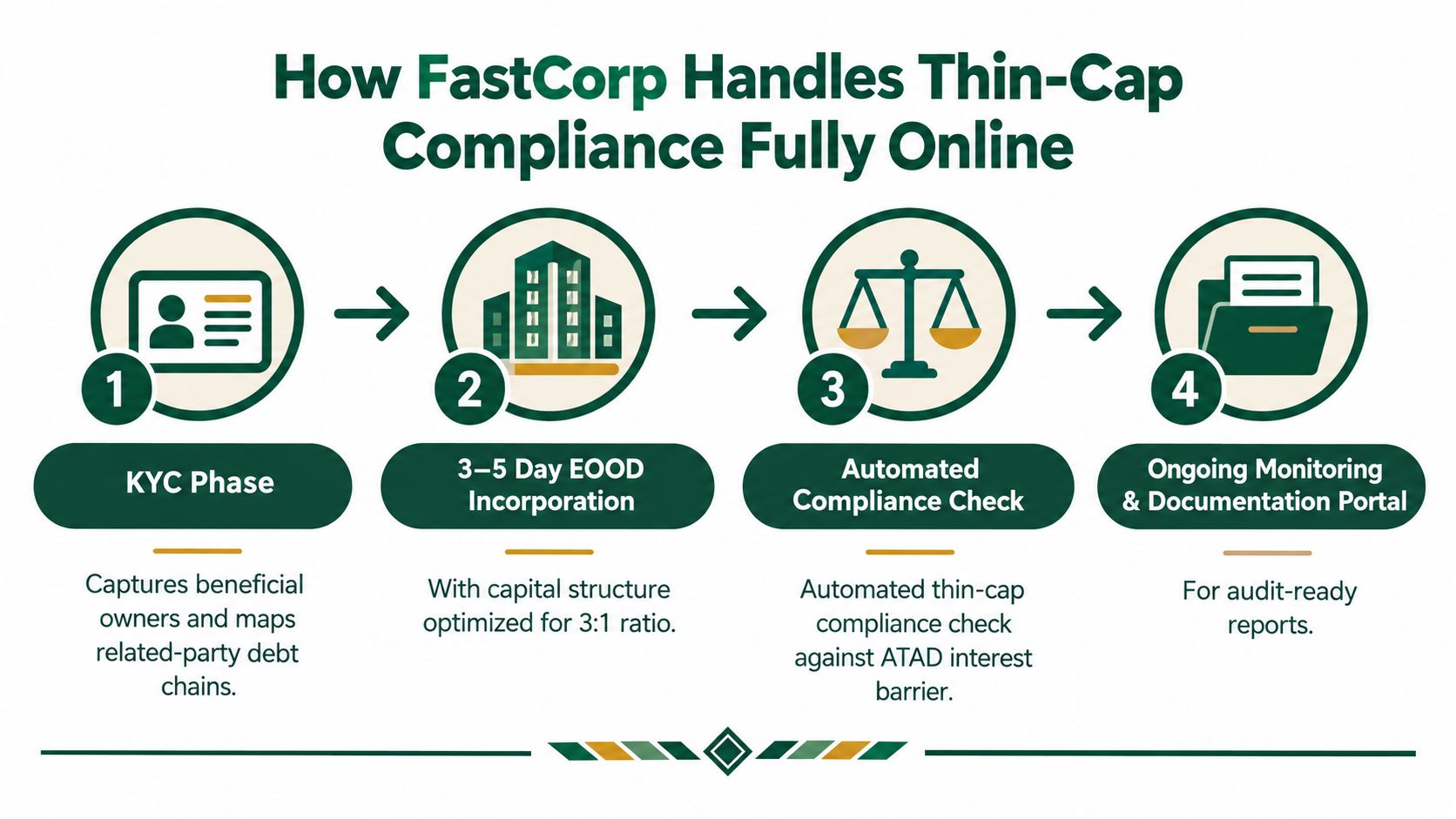
FastCorp's online process is built around a 3–5 working day Bulgarian EOOD formation workflow, with identity verification and document signing handled remotely. The thin-cap benefit comes from capturing funding information at onboarding instead of waiting until the first annual filing.
What the workflow should capture
The KYC process records beneficial owners and related parties, including lenders connected through holding structures. That information supports the related-party analysis and helps the accounting team identify which balances belong in the thin-cap calculation.
The corporate-documentation pack should distinguish equity from debt clearly. A shareholder-loan template needs principal, interest, maturity, repayment mechanics, covenants, and arm's-length terms. The company shouldn't receive a generic loan document that leaves the most important tax facts undocumented.
The accounting layer then monitors debt and interest before the corporate-tax filing. For a Bulgarian company, that means tracking the 3:1 test, identifying relevant exclusions, and preparing the BGN-denominated analysis for the additional interest-limitation rule when the threshold becomes relevant.
Online doesn't mean light-touch
A useful compliance dashboard should let a founder see:
- Related-party debt mapping: Which entities or individuals have lent money and how they connect to the owner.
- Capitalization status: Whether average debt and equity remain within the intended structure.
- Interest-cap monitoring: Whether net interest and borrowing costs are approaching the Bulgarian threshold.
- Document storage: Loan agreements, transfer-pricing studies, approvals, payment evidence, and filing schedules.
- Escalation triggers: A new lender, refinancing, guarantee, equity reduction, or major change in projected earnings.
That integrated record is the practical advantage of online administration. Founders get a single audit trail rather than disconnected PDFs and spreadsheets. For ongoing bookkeeping, VAT returns, payroll, and corporate filings, a coordinated accounting service also gives the adviser a chance to identify financing changes before they become filing errors.
The objective isn't to automate judgment away. It's to make the relevant facts visible early enough for a tax adviser to act.
Action Plan and Founder FAQ for Thin-Cap Compliance
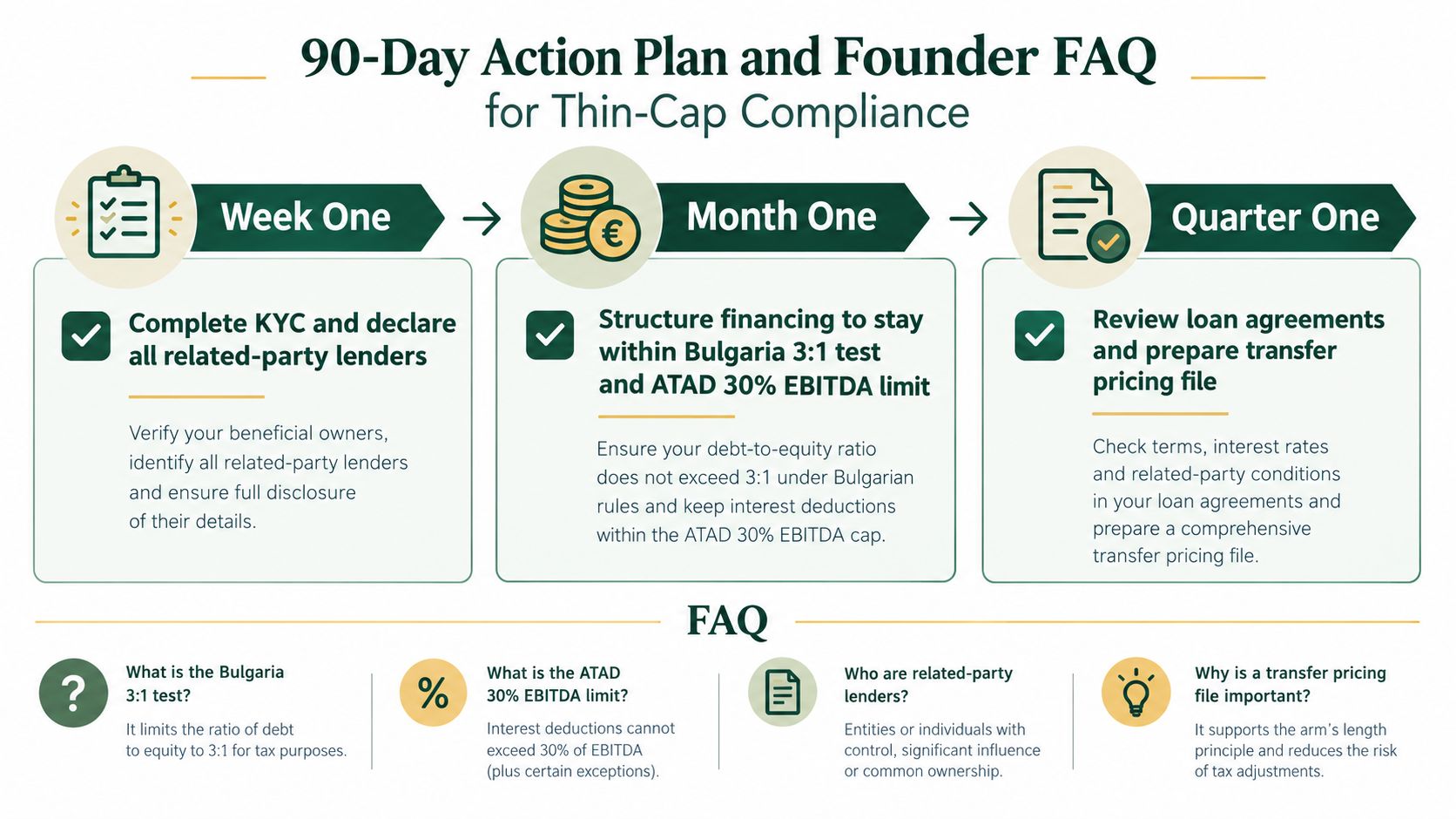
Use the first 90 days to establish the financing record, not just the company registration.
Week one
- Declare the funding chain: Identify every shareholder, beneficial owner, group lender, guarantor, and intermediary.
- Separate equity and debt: Record which amounts are paid-in capital, shareholder loans, accrued interest, or reimbursable expenses.
- Approve the commercial purpose: Keep a board or shareholder resolution explaining what the borrowing will finance.
Month one
- Review the 3:1 position: Calculate the Bulgarian debt-to-equity relationship using the required methodology, not only the closing balance.
- Benchmark the interest: Prepare transfer-pricing support before the first interest accrual.
- Forecast earnings: Model how the interest deduction interacts with tax-adjusted EBITDA if borrowing costs grow.
Quarter one
- Reconcile the ledger: Match loan balances, interest accruals, repayments, and bank evidence.
- Prepare the filing schedule: Keep the thin-cap calculation ready for the corporate-tax return and its supporting records.
- Escalate structural changes: Obtain advice before refinancing, adding a holding-company lender, issuing guarantees, or reducing equity.
The FAQ is where founders often make expensive assumptions.
Does an individual shareholder's loan trigger thin-cap rules?
It can. The relevant question is whether the lender is a related party under Bulgarian rules and how the debt is treated, not whether the lender is a person or a company.
Can a treaty rate make denied interest deductible?
No automatic relief follows. Treaty withholding relief and domestic interest deductibility are separate questions. A treaty may affect withholding, while the Bulgarian thin-cap rules may still restrict the corporate deduction.
Can disallowed interest be carried forward for five years?
Bulgarian treatment has historically treated disallowed interest as a temporary difference that can be carried forward, but the exact availability and use of carryforwards must be checked against the law and the filing position for the relevant year. Don't book a future deduction without confirming the current mechanics.
What changes once revenues exceed BGN 3 million?
Revenue alone isn't the stated trigger for Bulgaria's additional rule. The relevant threshold concerns net interest and other borrowing costs exceeding BGN 3 million in a calendar year, followed by the 30% tax-adjusted EBITDA calculation.
Every financing choice in the first quarter shapes the next five years of deductions, documentation, and tax risk. Make the capital structure defendable before the cash starts moving.
FastCorp helps global founders form Bulgarian EOOD companies fully online in 3–5 working days, then coordinate accounting, VAT compliance, banking assistance, and financing documentation around the company's real operating needs. Visit FastCorp to set up the company and build a thin-capitalization compliance process from day one.